## Code Snippet: String Concatenation Functions
### Overview
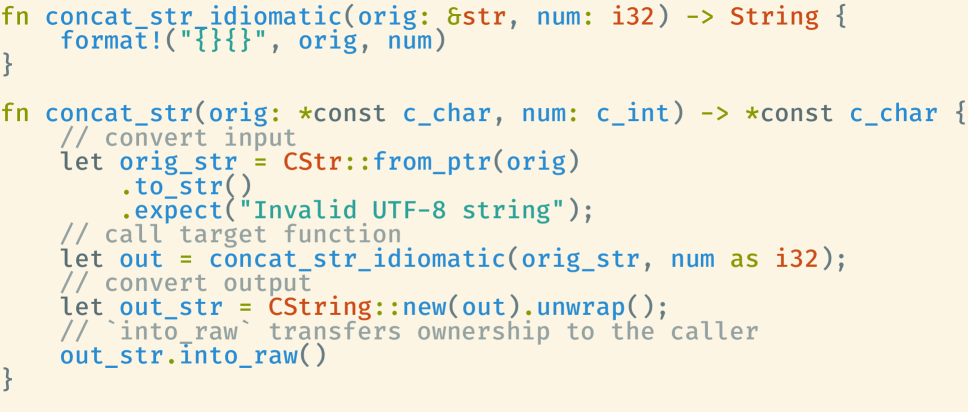
The image presents two Rust functions designed to concatenate a string with an integer. The first function, `concat_str_idiomatic`, takes a Rust string slice (`&str`) and an i32 integer as input and returns a new String. The second function, `concat_str`, takes a C-style string pointer (`*const c_char`) and a C integer (`c_int`) as input, converts the C-style string to a Rust string, calls the first function, and then converts the result back to a C-style string pointer.
### Components/Axes
* **Function Definitions:** Two function definitions are present: `concat_str_idiomatic` and `concat_str`.
* **Data Types:** The code uses Rust's `String`, `&str`, `i32`, and C's `*const c_char`, `c_int`.
* **Error Handling:** The `concat_str` function includes error handling using `.expect("Invalid UTF-8 string")`.
* **Memory Management:** The `concat_str` function uses `into_raw` to transfer ownership of the allocated memory to the caller.
### Detailed Analysis or Content Details
**Function 1: `concat_str_idiomatic`**
```rust
fn concat_str_idiomatic(orig: &str, num: i32) -> String {
format!("{}{}", orig, num)
}
```
* **Name:** `concat_str_idiomatic`
* **Input Parameters:**
* `orig`: A string slice (`&str`).
* `num`: A 32-bit integer (`i32`).
* **Return Type:** A `String`.
* **Functionality:** Uses the `format!` macro to concatenate the input string `orig` and the integer `num` into a new `String`.
**Function 2: `concat_str`**
```rust
fn concat_str(orig: *const c_char, num: c_int) -> *const c_char {
// convert input
let orig_str = CStr::from_ptr(orig)
.to_str()
.expect("Invalid UTF-8 string");
// call target function
let out = concat_str_idiomatic(orig_str, num as i32);
// convert output
let out_str = CString::new(out).unwrap();
// `into_raw` transfers ownership to the caller
out_str.into_raw()
}
```
* **Name:** `concat_str`
* **Input Parameters:**
* `orig`: A pointer to a constant C-style character array (`*const c_char`).
* `num`: A C integer (`c_int`).
* **Return Type:** A pointer to a constant C-style character array (`*const c_char`).
* **Functionality:**
1. **Convert Input:** Converts the C-style string `orig` to a Rust string slice `orig_str` using `CStr::from_ptr` and `to_str`. It uses `.expect` to handle potential UTF-8 encoding errors.
2. **Call Target Function:** Calls `concat_str_idiomatic` with the Rust string `orig_str` and the C integer `num` (cast to `i32`).
3. **Convert Output:** Converts the resulting Rust `String` to a C-style string `out_str` using `CString::new`.
4. **Memory Management:** Calls `out_str.into_raw()` to transfer ownership of the allocated memory for the C-style string to the caller. This is crucial to avoid memory leaks.
### Key Observations
* The `concat_str_idiomatic` function provides a simple and idiomatic way to concatenate a string and an integer in Rust.
* The `concat_str` function bridges the gap between C-style strings and Rust strings, allowing the `concat_str_idiomatic` function to be used with C code.
* The `concat_str` function includes error handling for invalid UTF-8 strings.
* The `concat_str` function carefully manages memory by transferring ownership of the allocated memory to the caller.
### Interpretation
The code demonstrates two approaches to string concatenation in Rust. The `concat_str_idiomatic` function showcases the idiomatic Rust way, leveraging the `format!` macro for concise string formatting. The `concat_str` function highlights interoperability with C code, handling the conversion between C-style strings and Rust strings, as well as managing memory ownership across the language boundary. The use of `into_raw` is critical for ensuring that memory allocated within Rust is properly managed when the resulting string is passed back to C code. The error handling in `concat_str` is also important for robustness, as it prevents the program from crashing if the C-style string contains invalid UTF-8 characters.