\n
## Code Snippet: Rust Function Definitions
### Overview
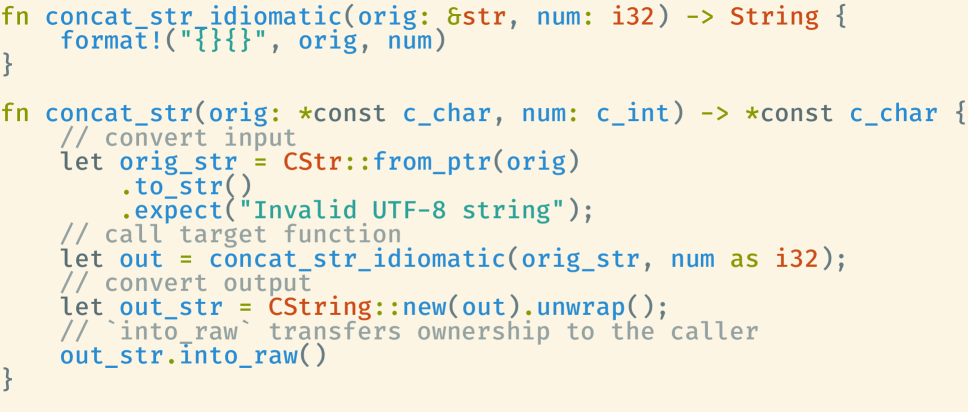
The image presents a code snippet written in the Rust programming language. It defines two functions: `concat_str_idiomatic` and `concat_str`. The code demonstrates string concatenation and handling of C-style strings.
### Components/Axes
There are no axes or traditional chart components. The content is purely textual code. The code is formatted with indentation to indicate block structure. Comments are included to explain the purpose of certain code sections.
### Detailed Analysis or Content Details
**Function 1: `concat_str_idiomatic`**
```rust
fn concat_str_idiomatic(orig: &str, num: i32) -> String {
format!("{}{}", orig, num)
}
```
* **Function Signature:** `fn concat_str_idiomatic(orig: &str, num: i32) -> String`
* `fn`: Keyword indicating a function definition.
* `concat_str_idiomatic`: Function name.
* `orig: &str`: Input parameter named `orig` of type `&str` (string slice).
* `num: i32`: Input parameter named `num` of type `i32` (32-bit integer).
* `-> String`: Return type is `String` (owned string).
* **Function Body:** `format!("{}{}", orig, num)`
* `format!()`: Macro for string formatting.
* `"{}{}"`: Format string with two placeholders.
* `orig`: First argument to be inserted into the format string.
* `num`: Second argument to be inserted into the format string.
**Function 2: `concat_str`**
```rust
fn concat_str(orig: *const c_char, num: c_int) -> *const c_char {
// convert input
let orig_str = CStr::from_ptr(orig)
.to_str()
.expect("Invalid UTF-8 string");
// call target function
let out = concat_str_idiomatic(orig_str, num as i32);
// convert output
let out_str = CString::new(out).unwrap();
// `into_raw` transfers ownership to the caller
out_str.into_raw()
}
```
* **Function Signature:** `fn concat_str(orig: *const c_char, num: c_int) -> *const c_char`
* `orig: *const c_char`: Input parameter named `orig` of type `*const c_char` (raw pointer to a C-style string).
* `num: c_int`: Input parameter named `num` of type `c_int` (C integer).
* `-> *const c_char`: Return type is `*const c_char` (raw pointer to a C-style string).
* **Function Body:**
* `let orig_str = CStr::from_ptr(orig).to_str().expect("Invalid UTF-8 string");`: Converts the C-style string pointer `orig` to a Rust string slice `orig_str`. It uses `CStr::from_ptr` to create a `CStr` from the raw pointer, then `to_str()` to convert it to a `&str`. The `expect` method handles potential errors if the C-style string is not valid UTF-8.
* `let out = concat_str_idiomatic(orig_str, num as i32);`: Calls the `concat_str_idiomatic` function with the Rust string slice `orig_str` and the integer `num` (cast to `i32`). The result is stored in the `out` variable.
* `let out_str = CString::new(out).unwrap();`: Creates a `CString` from the Rust `String` `out`. The `unwrap` method handles potential errors if the string cannot be converted to a C-style string.
* `out_str.into_raw()`: Consumes the `CString` and returns a raw pointer to its underlying data. This transfers ownership of the memory to the caller.
### Key Observations
* The `concat_str` function acts as a bridge between C-style strings and Rust strings.
* Error handling is present in the `concat_str` function to ensure the input C-style string is valid UTF-8.
* The `into_raw()` method is used to transfer ownership of the allocated memory to the caller, which is a common pattern when interacting with C code.
* The `concat_str_idiomatic` function provides a simple string concatenation using the `format!` macro.
### Interpretation
The code snippet demonstrates how to concatenate strings in Rust, specifically handling the conversion between Rust strings and C-style strings. This is often necessary when interfacing with C libraries or APIs. The `concat_str` function provides a safe and convenient way to perform this conversion, including error handling for invalid UTF-8 strings. The use of `into_raw()` is crucial for managing memory ownership correctly when passing the resulting C-style string back to the caller. The code highlights Rust's emphasis on memory safety and error handling, even when dealing with potentially unsafe operations like raw pointers. The two functions provide a clear separation of concerns: `concat_str_idiomatic` handles the core string concatenation logic, while `concat_str` handles the conversion between different string representations.