\n
## Code Snippet: Rust String Concatenation Functions
### Overview
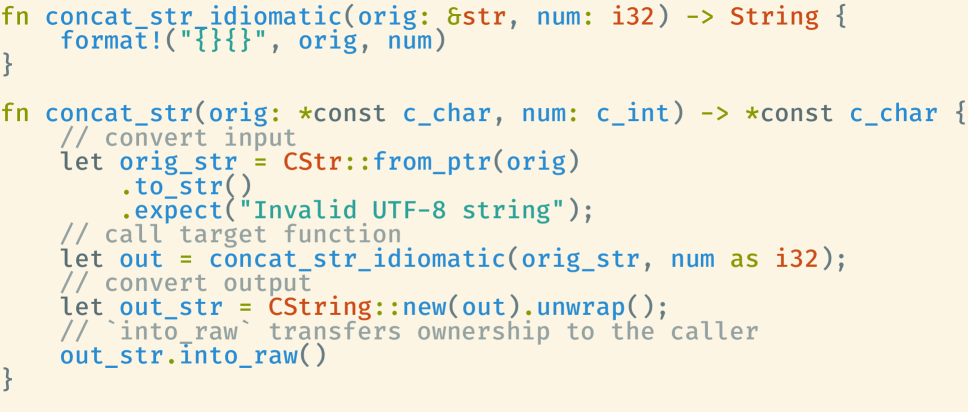
The image displays two Rust functions for string concatenation. The first is an idiomatic Rust implementation, while the second is a C-compatible wrapper function designed to work with C-style strings and raw pointers. The code is presented with syntax highlighting on a light background.
### Components/Axes
The image contains two distinct function definitions with associated comments and syntax elements.
**Function 1: `concat_str_idiomatic`**
* **Signature:** `fn concat_str_idiomatic(orig: &str, num: i32) -> String`
* **Parameters:**
* `orig`: A string slice (`&str`).
* `num`: A 32-bit signed integer (`i32`).
* **Return Type:** An owned `String`.
* **Body:** A single line using the `format!` macro: `format!("{}{}", orig, num)`.
**Function 2: `concat_str`**
* **Signature:** `fn concat_str(orig: *const c_char, num: c_int) -> *const c_char`
* **Parameters:**
* `orig`: A raw pointer to a C-style string (`*const c_char`).
* `num`: A C-style integer (`c_int`).
* **Return Type:** A raw pointer to a C-style string (`*const c_char`).
* **Body:** Contains several steps with explanatory comments:
1. **Comment:** `// convert input`
2. **Code:** `let orig_str = CStr::from_ptr(orig).to_str().expect("Invalid UTF-8 string");`
3. **Comment:** `// call target function`
4. **Code:** `let out = concat_str_idiomatic(orig_str, num as i32);`
5. **Comment:** `// convert output`
6. **Code:** `let out_str = CString::new(out).unwrap();`
7. **Comment:** `// \`into_raw\` transfers ownership to the caller`
8. **Code:** `out_str.into_raw()`
### Detailed Analysis
The code demonstrates a common pattern for creating a Rust-friendly API that interfaces with C.
1. **Idiomatic Core (`concat_str_idiomatic`):** This function contains the core logic using safe, idiomatic Rust types (`&str`, `i32`, `String`). It performs the concatenation simply via string formatting.
2. **C-Compatible Wrapper (`concat_str`):** This function acts as a bridge.
* **Input Conversion:** It takes a raw C string pointer (`*const c_char`). It uses `CStr::from_ptr` to create a borrowed C string wrapper, then `.to_str()` to convert it to a Rust `&str`, with `.expect()` handling potential UTF-8 conversion errors.
* **Delegation:** It casts the `c_int` to an `i32` and calls the idiomatic `concat_str_idiomatic` function.
* **Output Conversion:** The resulting Rust `String` (`out`) is converted into a C-compatible, null-terminated `CString` using `CString::new()`. The `.unwrap()` here would panic if the string contained an interior null byte.
* **Ownership Transfer:** The critical step is `out_str.into_raw()`. This consumes the `CString`, deallocates its Rust-managed memory, and returns a raw pointer (`*const c_char`) to the caller. The comment explicitly notes this transfers ownership, meaning the caller (presumably C code) becomes responsible for freeing this memory later using the appropriate C function (e.g., `free`).
### Key Observations
* **Safety Boundary:** The wrapper function (`concat_str`) is the point where safe Rust code interacts with the unsafe, raw world of C pointers. The `unsafe` block is not explicitly shown but is implied by the use of `CStr::from_ptr` and `into_raw`, which are `unsafe` operations.
* **Error Handling:** The input conversion uses `.expect()`, which will panic on invalid UTF-8. The output conversion uses `.unwrap()`, which will panic on interior nulls. This is a simple error strategy; a production API might return a result code or use out-parameters for errors.
* **Memory Management:** The pattern of `into_raw()` is standard for returning owned data to C. It is the counterpart to `from_raw()` which would be used to take ownership back from C.
### Interpretation
This code snippet is a technical illustration of **Foreign Function Interface (FFI) bridging** in Rust. It shows the necessary "glue code" required to expose a safe, high-level Rust function to a C codebase.
The primary relationship is one of **delegation and translation**. The `concat_str` function does not contain business logic; its sole purpose is to translate types across the language boundary (`c_char*` to `&str`, `c_int` to `i32`, `String` to `c_char*`) and manage the associated memory ownership semantics.
The notable pattern is the **ownership hand-off**. The Rust function creates a `String`, converts it to a `CString`, and then deliberately leaks the Rust-owned memory by turning it into a raw pointer. This is not a bug but a deliberate protocol, placing the burden of deallocation on the C caller. This pattern is fundamental to creating interoperable libraries but requires careful documentation to prevent memory leaks on the C side. The code serves as a concise template for this common systems programming task.