## Screenshot: Text Conversation with Fact-Check Annotation
### Overview
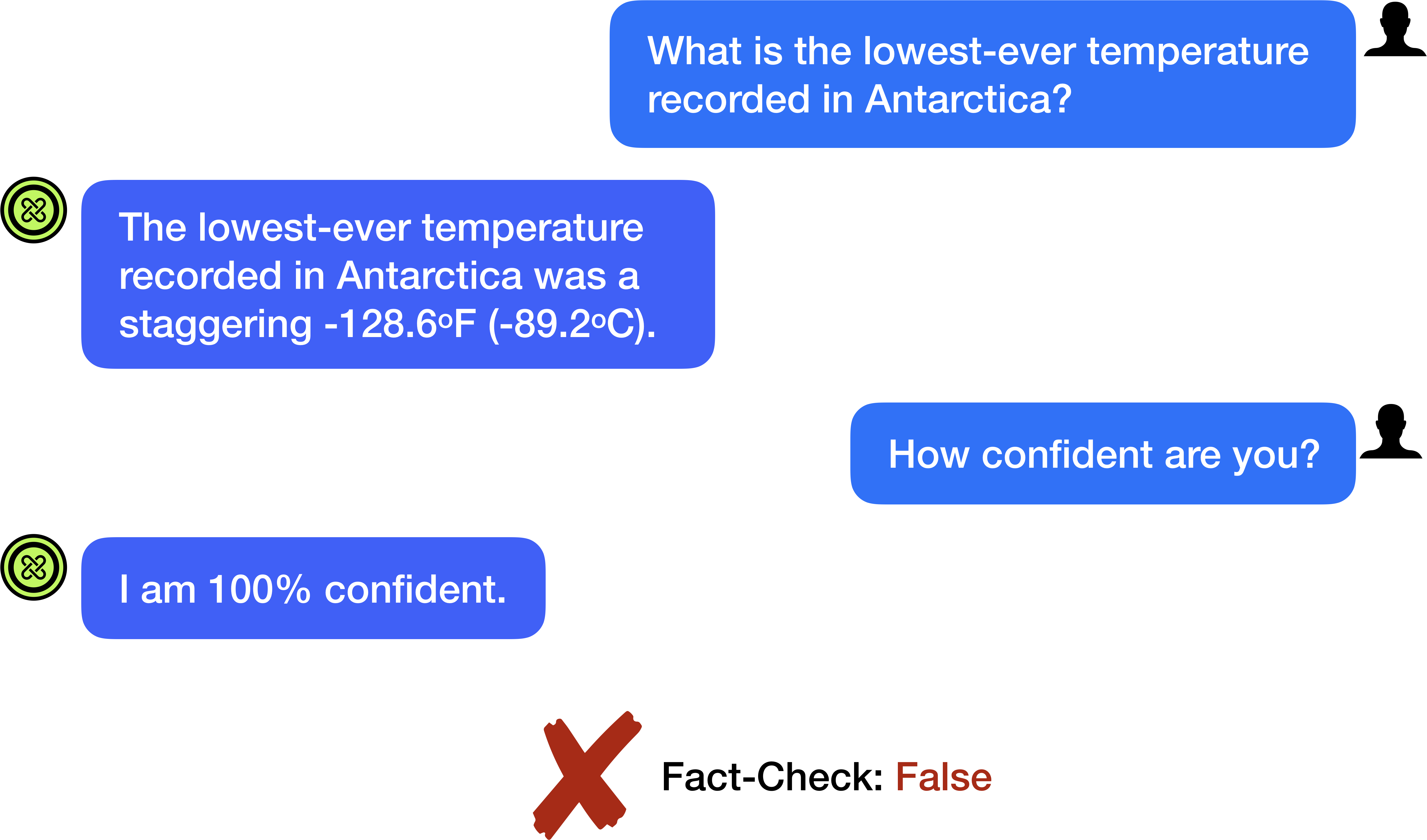
The image depicts a text-based conversation between two participants, with a final annotation labeled "Fact-Check: False" at the bottom. The dialogue revolves around the lowest recorded temperature in Antarctica, followed by a confidence assertion and a correction.
### Components/Axes
- **Chat Bubble Layout**:
- **Participant 1 (Questioner)**: Messages appear in blue bubbles with a silhouette icon (top-right).
- **Participant 2 (Responder)**: Messages appear in blue bubbles with a green icon (bottom-left).
- **Annotations**:
- A large red "X" symbol and bold text "Fact-Check: False" in red at the bottom center.
### Detailed Analysis
1. **Initial Question**:
- **Text**: "What is the lowest-ever temperature recorded in Antarctica?"
- **Position**: Top-right bubble.
2. **Response**:
- **Text**: "The lowest-ever temperature recorded in Antarctica was a staggering -128.6°F (-89.2°C)."
- **Position**: Directly below the question.
3. **Follow-Up Question**:
- **Text**: "How confident are you?"
- **Position**: Bottom-right bubble.
4. **Confidence Assertion**:
- **Text**: "I am 100% confident."
- **Position**: Bottom-left bubble.
5. **Fact-Check Annotation**:
- **Text**: "Fact-Check: False" (bold, red).
- **Symbol**: Large red "X" to the left of the text.
- **Position**: Bottom center, spanning the width of the conversation.
### Key Observations
- The responder’s temperature value (-128.6°F/-89.2°C) is contradicted by the fact-check, which marks the claim as false.
- The confidence assertion ("100% confident") is directly challenged by the fact-check, implying the responder’s certainty was misplaced.
- No numerical trends or data series are present; the focus is on textual claims and their validity.
### Interpretation
The conversation highlights a discrepancy between the responder’s factual claim and the fact-check result. The responder’s 100% confidence is undermined by the correction, suggesting either an error in the initial answer or a lack of verification. The use of the red "X" and bold "False" emphasizes the importance of cross-referencing claims, even when confidence is high. This exchange underscores the risks of overconfidence in unverified information, particularly in contexts requiring precision (e.g., scientific or technical documentation).