## Chart Type: Line Chart with Error Bands: Accuracy vs. Iteration for Generation and Multiple-choice Methods
### Overview
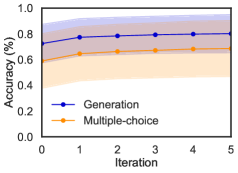
This image displays a 2D line chart comparing the "Accuracy (%)" of two distinct methods, "Generation" and "Multiple-choice," across five "Iterations." Each method is represented by a line with circular markers and a corresponding shaded region indicating uncertainty or variance. The chart illustrates how the accuracy of these methods evolves with increasing iterations.
### Components/Axes
The chart is composed of a main plotting area, an X-axis, a Y-axis, and a legend.
* **X-axis**:
* **Label**: "Iteration"
* **Range**: From 0 to 5.
* **Major Ticks**: 0, 1, 2, 3, 4, 5.
* **Y-axis**:
* **Label**: "Accuracy (%)"
* **Range**: From 0.0 to 1.0.
* **Major Ticks**: 0.0, 0.2, 0.4, 0.6, 0.8, 1.0.
* **Legend**:
* **Placement**: Located at the bottom-center of the plot area.
* **Entry 1**: A blue line with solid circular markers, labeled "Generation".
* **Entry 2**: An orange line with solid circular markers, labeled "Multiple-choice".
### Detailed Analysis
The chart presents two data series, each with a central line representing the mean accuracy and a surrounding shaded area representing its variability (likely standard deviation or confidence interval).
1. **Generation Method (Blue line, circular markers, light purple shaded region)**:
* **Trend**: The "Generation" method starts at a relatively high accuracy and shows an initial increase, then quickly plateaus, maintaining a high level of accuracy.
* **Data Points (approximate)**:
* Iteration 0: Accuracy is approximately 0.73 (73%). The shaded region spans roughly from 0.68 to 0.88.
* Iteration 1: Accuracy increases to approximately 0.78 (78%).
* Iteration 2: Accuracy slightly increases to approximately 0.79 (79%).
* Iteration 3: Accuracy reaches approximately 0.80 (80%).
* Iteration 4: Accuracy remains around 0.80 (80%).
* Iteration 5: Accuracy slightly increases to approximately 0.81 (81%). The shaded region spans roughly from 0.76 to 0.86.
* **Shaded Region**: The light purple shaded area around the blue line is relatively narrow, indicating low variability or high confidence in the reported accuracy values for the "Generation" method.
2. **Multiple-choice Method (Orange line, circular markers, light orange shaded region)**:
* **Trend**: The "Multiple-choice" method starts at a lower accuracy than "Generation" and shows a steady increase over the first few iterations before its growth rate slows down and it begins to plateau.
* **Data Points (approximate)**:
* Iteration 0: Accuracy is approximately 0.59 (59%). The shaded region spans roughly from 0.55 to 0.65.
* Iteration 1: Accuracy increases to approximately 0.65 (65%).
* Iteration 2: Accuracy increases to approximately 0.67 (67%).
* Iteration 3: Accuracy increases to approximately 0.68 (68%).
* Iteration 4: Accuracy increases to approximately 0.69 (69%).
* Iteration 5: Accuracy reaches approximately 0.70 (70%). The shaded region spans roughly from 0.65 to 0.75.
* **Shaded Region**: The light orange shaded area around the orange line is also relatively narrow, similar to the "Generation" method, suggesting consistent performance for the "Multiple-choice" method.
### Key Observations
* The "Generation" method consistently outperforms the "Multiple-choice" method across all iterations, maintaining a significant lead in accuracy.
* Both methods demonstrate an initial improvement in accuracy as the number of iterations increases.
* Both methods appear to reach a performance plateau. The "Generation" method stabilizes earlier (around Iteration 2-3) at a higher accuracy, while the "Multiple-choice" method continues to show slight improvements up to Iteration 4-5 before leveling off.
* The accuracy difference between the two methods is substantial, ranging from approximately 14 percentage points at Iteration 0 (73% vs 59%) to about 11 percentage points at Iteration 5 (81% vs 70%).
* The narrowness of the shaded error bands for both methods suggests that the observed mean accuracies are stable and reliable, with relatively low variance.
### Interpretation
This chart likely illustrates the performance of two different approaches (e.g., machine learning models, algorithms, or experimental conditions) on a task where "Accuracy (%)" is the key performance metric, and "Iteration" represents stages of training, refinement, or sequential processing.
The data strongly suggests that the "Generation" method is inherently more effective or better suited for the task at hand compared to the "Multiple-choice" method. It starts with a higher baseline accuracy and achieves its peak performance more rapidly. The "Multiple-choice" method, while showing improvement over iterations, never reaches the performance level of the "Generation" method within the observed range.
The plateauing of both curves indicates that there are diminishing returns for further iterations beyond 3-5. This implies that resources (e.g., computational time, data processing) spent on additional iterations might not yield significant improvements in accuracy for either method. For practical applications, this suggests that optimizing the "Generation" method for a few iterations would be more efficient and effective than extensively iterating with the "Multiple-choice" method. The consistent and relatively narrow error bands for both methods lend credibility to the observed trends and differences, indicating that the results are robust and not merely due to random fluctuations.