## Line Chart: Performance Comparison of Different Stencil Sizes
### Overview
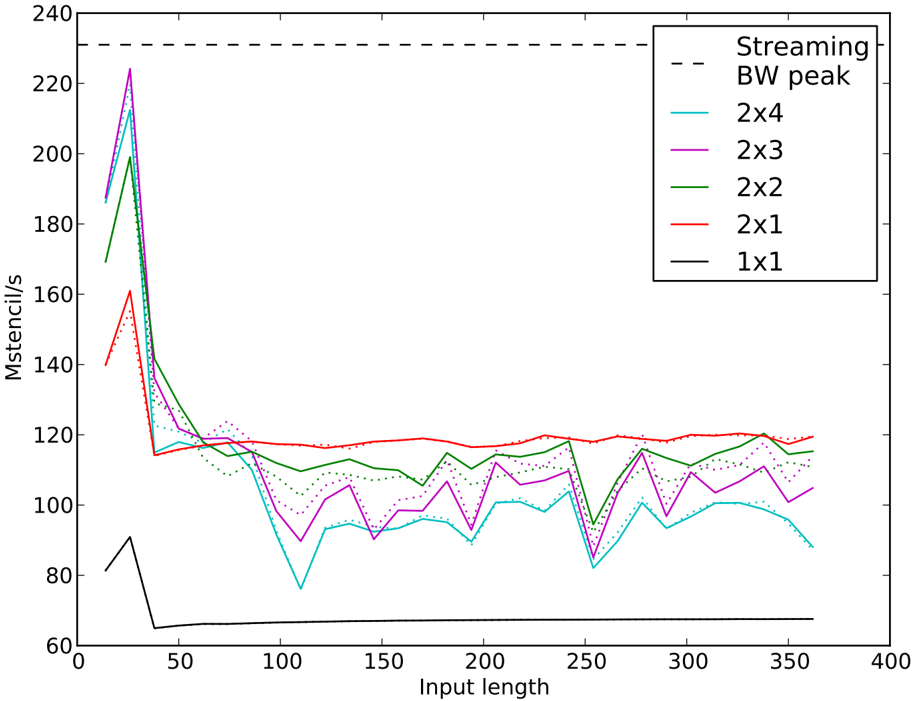
This image presents a line chart comparing the performance (measured in Mstencils/s) of different stencil sizes (1x1, 2x1, 2x2, 2x3, 2x4) against input length. A dashed line represents the performance of "Streaming BW peak". The chart aims to illustrate how the performance of stencil operations varies with input length and stencil size.
### Components/Axes
* **X-axis:** "Input length" ranging from 0 to 400 (units not specified, but likely characters or data points). Marked with increments of 50.
* **Y-axis:** "Mstencils/s" ranging from 60 to 240. Marked with increments of 20.
* **Legend:** Located in the top-right corner. Contains the following labels and corresponding line colors:
* "Streaming BW peak" (dashed black line)
* "2x4" (cyan line)
* "2x3" (magenta line)
* "2x2" (green line)
* "2x1" (red line)
* "1x1" (black line)
### Detailed Analysis
The chart displays six lines representing the performance of each stencil size and the streaming bandwidth peak.
* **Streaming BW peak (dashed black):** This line is approximately horizontal, maintaining a value around 225 Mstencils/s across the entire input length range. There is a slight dip around input length 300, but it quickly recovers.
* **2x4 (cyan):** This line exhibits a significant initial peak at an input length of approximately 25, reaching around 220 Mstencils/s. It then rapidly declines to around 80 Mstencils/s by an input length of 50. After that, it fluctuates between 80 and 110 Mstencils/s with some oscillations, ending around 100 Mstencils/s at input length 400.
* **2x3 (magenta):** This line starts at approximately 160 Mstencils/s at input length 0, drops to around 90 Mstencils/s by input length 50, and then fluctuates between 90 and 120 Mstencils/s with some oscillations. It ends around 110 Mstencils/s at input length 400.
* **2x2 (green):** This line begins at approximately 140 Mstencils/s, decreases to around 85 Mstencils/s by input length 50, and then fluctuates between 90 and 115 Mstencils/s. It ends around 105 Mstencils/s at input length 400.
* **2x1 (red):** This line starts at approximately 170 Mstencils/s, drops to around 110 Mstencils/s by input length 50, and then remains relatively stable between 110 and 125 Mstencils/s. It ends around 120 Mstencils/s at input length 400.
* **1x1 (black):** This line shows a sharp initial drop from approximately 150 Mstencils/s to around 70 Mstencils/s by input length 50. It then stabilizes around 110-120 Mstencils/s, with some minor fluctuations, and ends around 115 Mstencils/s at input length 400.
### Key Observations
* The "Streaming BW peak" provides a performance ceiling for all stencil sizes.
* Larger stencil sizes (2x4, 2x3, 2x2) exhibit a more pronounced initial performance drop compared to smaller stencil sizes (2x1, 1x1).
* All stencil sizes converge to a similar performance level (around 110-125 Mstencils/s) as the input length increases.
* The 1x1 stencil size shows the most stable performance after the initial drop.
### Interpretation
The data suggests that the performance of stencil operations is heavily influenced by the input length, particularly at lower lengths. Larger stencil sizes initially offer higher performance but suffer a more significant performance degradation as the input length increases. This could be due to increased memory access costs or cache misses associated with larger stencils. As the input length grows, the performance of all stencil sizes converges, indicating that the overhead associated with the stencil size becomes less significant compared to other factors, such as memory bandwidth or computational complexity. The "Streaming BW peak" represents the theoretical maximum performance achievable, and the stencil operations are all operating below this limit. The initial peak for the 2x4 stencil might indicate a benefit from increased parallelism at very small input sizes, but this benefit is quickly outweighed by the associated overhead as the input length increases. The stability of the 1x1 stencil suggests that it might be a more efficient choice for larger input lengths where performance consistency is prioritized over initial peak performance.