## Screenshot: Interactive Dress Guessing Quiz
### Overview
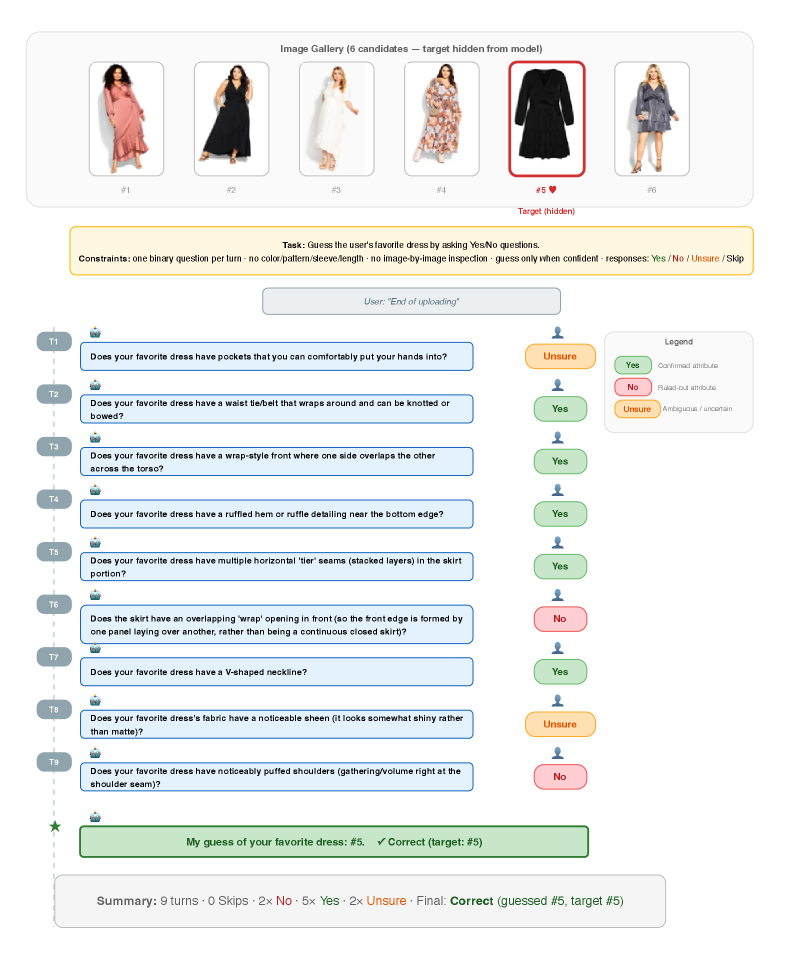
The image depicts an interactive quiz interface where a user attempts to guess another person's favorite dress from six candidates by asking binary (Yes/No/Unsure) questions about dress attributes. The quiz includes a visual gallery of dresses, a question-answer flow, and a summary of results.
### Components/Axes
1. **Image Gallery** (Top Section):
- Six dresses labeled #1 to #6.
- Dress #5 is highlighted with a red border and labeled "Target (hidden)".
- Dresses vary in color (pink, black, white, floral, black, gray) and style (long/short, sleeveless/long sleeves).
2. **Question-Asking Flow** (Central Section):
- Nine questions (T1-T9) about dress attributes (e.g., pockets, waist ties, ruffles, fabric texture).
- Responses are color-coded:
- **Green**: Yes (confirmed attribute).
- **Red**: No (ruled-out attribute).
- **Orange**: Unsure (ambiguous/uncertain).
- Example questions:
- T1: "Does your favorite dress have pockets...?" → **Unsure** (orange).
- T2: "Does your favorite dress have a waist tie...?" → **Yes** (green).
3. **Legend** (Right Panel):
- Explains response colors:
- Green: Yes (confirmed attribute).
- Red: No (ruled-out attribute).
- Orange: Unsure (ambiguous/uncertain).
4. **Summary** (Bottom Section):
- Final guess: "My guess of your favorite dress: #5. ✅ Correct (target: #5)".
- Statistics: 9 turns, 0 skips, 2 No, 5 Yes, 2 Unsure.
### Detailed Analysis
- **Question Flow**:
- Questions focus on specific attributes (e.g., pockets, ruffles, neckline shape).
- Responses guide elimination: "No" answers rule out dresses lacking the attribute, while "Yes" confirms it.
- Example: T6 ("Does the skirt have an overlapping 'wrap' opening...?") → **No** (red), eliminating dresses with this feature.
- **Final Outcome**:
- The user correctly identified dress #5 after 9 questions.
- The target dress (#5) is a black long-sleeve dress with a V-neckline and noticeable sheen (T8: **Unsure**, T9: **No** for puffed shoulders).
### Key Observations
1. **Attribute-Based Elimination**: The quiz systematically narrows options by focusing on distinct dress features (e.g., pockets, ruffles, fabric texture).
2. **Confidence in Attributes**: Most responses are "Yes" (5/9), indicating strong confidence in the target dress's attributes.
3. **Uncertainty in Key Features**: Two "Unsure" responses (T1, T8) suggest ambiguity about pockets and fabric sheen, yet the final guess remained accurate.
4. **Efficiency**: The user achieved the correct guess in 9 turns without skips, demonstrating effective questioning.
### Interpretation
The quiz illustrates a structured approach to narrowing down choices through binary questioning. By focusing on unique attributes (e.g., ruffles, V-necklines), the user efficiently eliminated less likely options. The high frequency of "Yes" responses (5/9) highlights the importance of confirming key attributes, while "Unsure" answers (2/9) reflect the need for flexibility when details are ambiguous. The correct identification of dress #5 underscores the effectiveness of this method, even with partial uncertainty. This process mirrors decision-making frameworks in machine learning (e.g., decision trees) and human cognition, where attributes are prioritized to reach a conclusion.