## Diagram: Generative Model and Image Classifier
### Overview
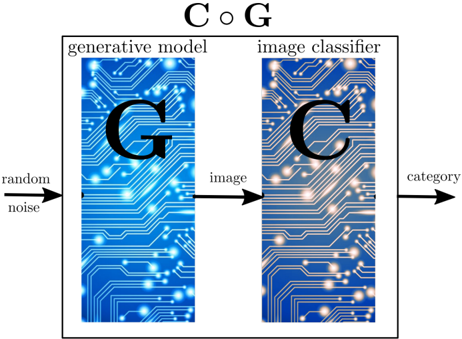
The image is a diagram illustrating the interaction between a generative model (G) and an image classifier (C). Random noise is input into the generative model, which produces an image. This image is then fed into the image classifier, which outputs a category. The diagram is enclosed in a rectangular box.
### Components/Axes
* **Title:** C ∘ G
* **Left Box:**
* Label: "generative model"
* Symbol: "G" (large, black)
* Input: "random noise" (arrow pointing into the left side of the box)
* Background: Blue circuit board pattern
* **Right Box:**
* Label: "image classifier"
* Symbol: "C" (large, black)
* Input: "image" (arrow pointing into the left side of the box)
* Output: "category" (arrow pointing out of the right side of the box)
* Background: Blue circuit board pattern
### Detailed Analysis
The diagram shows a sequential process. Random noise is the initial input. The generative model (G) transforms this noise into an image. This image then becomes the input for the image classifier (C), which categorizes the image. The circuit board pattern in both boxes suggests a connection to computer science or artificial intelligence.
### Key Observations
* The diagram is a high-level representation of a system.
* The "C ∘ G" notation suggests a composition of functions, where G is applied first, followed by C.
* The use of "random noise" as input to the generative model indicates a stochastic process.
### Interpretation
The diagram illustrates a common setup in machine learning, particularly in the context of generative adversarial networks (GANs) or similar systems. The generative model (G) learns to create realistic images from random noise, while the image classifier (C) learns to categorize these images. The composition "C ∘ G" represents the entire pipeline, from noise to category. This setup can be used for various applications, such as image generation, image classification, and anomaly detection. The diagram highlights the flow of information and the roles of the two main components.