\n
## Diagram: Generative Adversarial Network (GAN) Architecture
### Overview
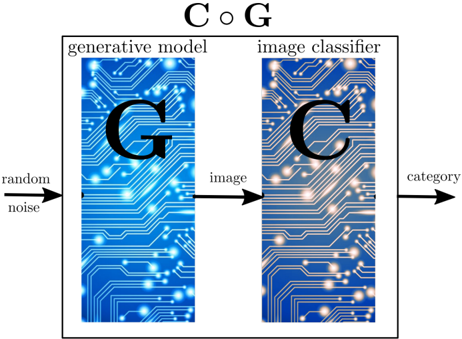
The image depicts a simplified diagram of a Generative Adversarial Network (GAN) architecture. It illustrates the interaction between a generative model (G) and an image classifier (C). The diagram shows the flow of information from random noise through the generative model to produce an image, and then through the image classifier to assign a category.
### Components/Axes
The diagram consists of two main rectangular blocks representing the generative model (G) and the image classifier (C), separated by an arrow indicating the flow of an "image". Arrows indicate inputs and outputs: "random noise" enters the generative model, and "category" is the output of the image classifier. The title "C ◦ G" is positioned above the two blocks. Labels are present above each block: "generative model" above the left block and "image classifier" above the right block. Large letters "G" and "C" are superimposed on each block, respectively. Each block contains a background pattern resembling a circuit board.
### Detailed Analysis or Content Details
The diagram shows a sequential process:
1. **Input:** "random noise" is fed into the "generative model" (G).
2. **Transformation:** The generative model transforms the random noise into an "image".
3. **Classification:** The generated "image" is then fed into the "image classifier" (C).
4. **Output:** The image classifier outputs a "category".
The generative model (G) block is filled with a blue and white circuit board pattern. The letter "G" is black and bold.
The image classifier (C) block is filled with a reddish-brown and white circuit board pattern. The letter "C" is black and bold.
The arrows are simple lines indicating direction.
### Key Observations
The diagram is a high-level representation of a GAN. It doesn't provide specific details about the internal workings of the generative model or the image classifier. It focuses on the overall flow of information and the interaction between the two components. The circuit board patterns within the blocks likely symbolize the complex computational processes occurring within each model.
### Interpretation
This diagram illustrates the core concept of a GAN: a system where two neural networks, a generator and a discriminator (in this case, the image classifier), compete against each other. The generator attempts to create realistic images from random noise, while the discriminator tries to distinguish between generated images and real images. This adversarial process drives both networks to improve, ultimately leading to the generation of high-quality images. The "C ◦ G" notation suggests a composition of functions, where the classifier (C) acts on the output of the generator (G). The diagram is a conceptual illustration rather than a detailed technical specification. It serves to convey the fundamental architecture and information flow within a GAN.