\n
## Diagram: Cooperative Process Flow
### Overview
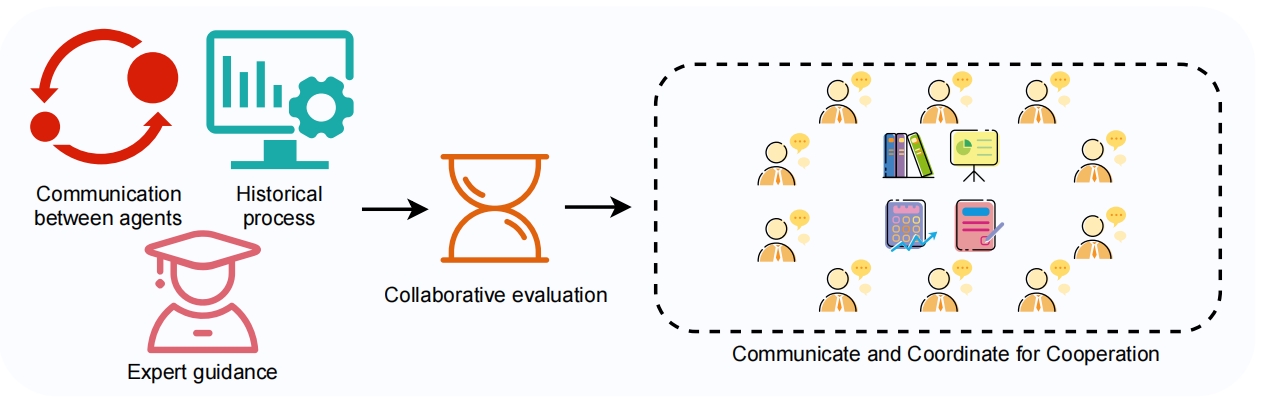
The image depicts a diagram illustrating a process flow for cooperative work, starting with initial inputs of communication, historical data, and expert guidance, progressing through collaborative evaluation, and culminating in communication and coordination for cooperation. The diagram uses icons and text labels to represent each stage.
### Components/Axes
The diagram is structured linearly from left to right, with three main sections: Input, Process, and Output.
* **Input Section:** Contains three elements:
* "Communication between agents" - Represented by a circular arrow icon with two speech bubbles.
* "Historical process" - Represented by a computer screen with a bar chart and a gear icon.
* "Expert guidance" - Represented by a graduation cap icon.
* **Process Section:** Contains one element:
* "Collaborative evaluation" - Represented by an hourglass icon.
* **Output Section:** Contains one element:
* "Communicate and Coordinate for Cooperation" - Represented by a dashed-border rectangle containing multiple human figure icons, each holding or interacting with different objects.
### Detailed Analysis or Content Details
The diagram shows a flow from the Input section to the Process section via an arrow, and then from the Process section to the Output section via another arrow.
The Output section contains a group of six human figures arranged in three rows of two. Each figure is depicted with a different object:
* **Row 1:** One figure holds a stack of books and a green file folder. The other figure holds a blue book.
* **Row 2:** One figure holds a calculator and a smartphone. The other figure holds a tablet.
* **Row 3:** One figure holds a pen and a notepad. The other figure is empty-handed.
### Key Observations
The diagram emphasizes the importance of combining different types of input (communication, historical data, expertise) to facilitate collaborative evaluation, which ultimately leads to effective communication and coordination for cooperation. The variety of objects held by the figures in the output section suggests diverse roles and contributions within the cooperative process.
### Interpretation
This diagram illustrates a model for successful teamwork or collaborative problem-solving. The initial inputs represent the foundational elements needed for effective cooperation. Communication ensures information exchange, historical data provides context and learning opportunities, and expert guidance offers specialized knowledge. The collaborative evaluation stage acts as a filter or refinement process, ensuring that the inputs are properly assessed and integrated. The final output highlights the importance of clear communication and coordinated action to achieve a common goal. The objects held by the figures suggest that different team members may contribute different skills and resources to the cooperative effort. The diagram is conceptual and does not contain specific numerical data or measurable values. It is a visual representation of a process rather than a quantitative analysis.