\n
## Diagram: Logical Fallacy Illustration
### Overview
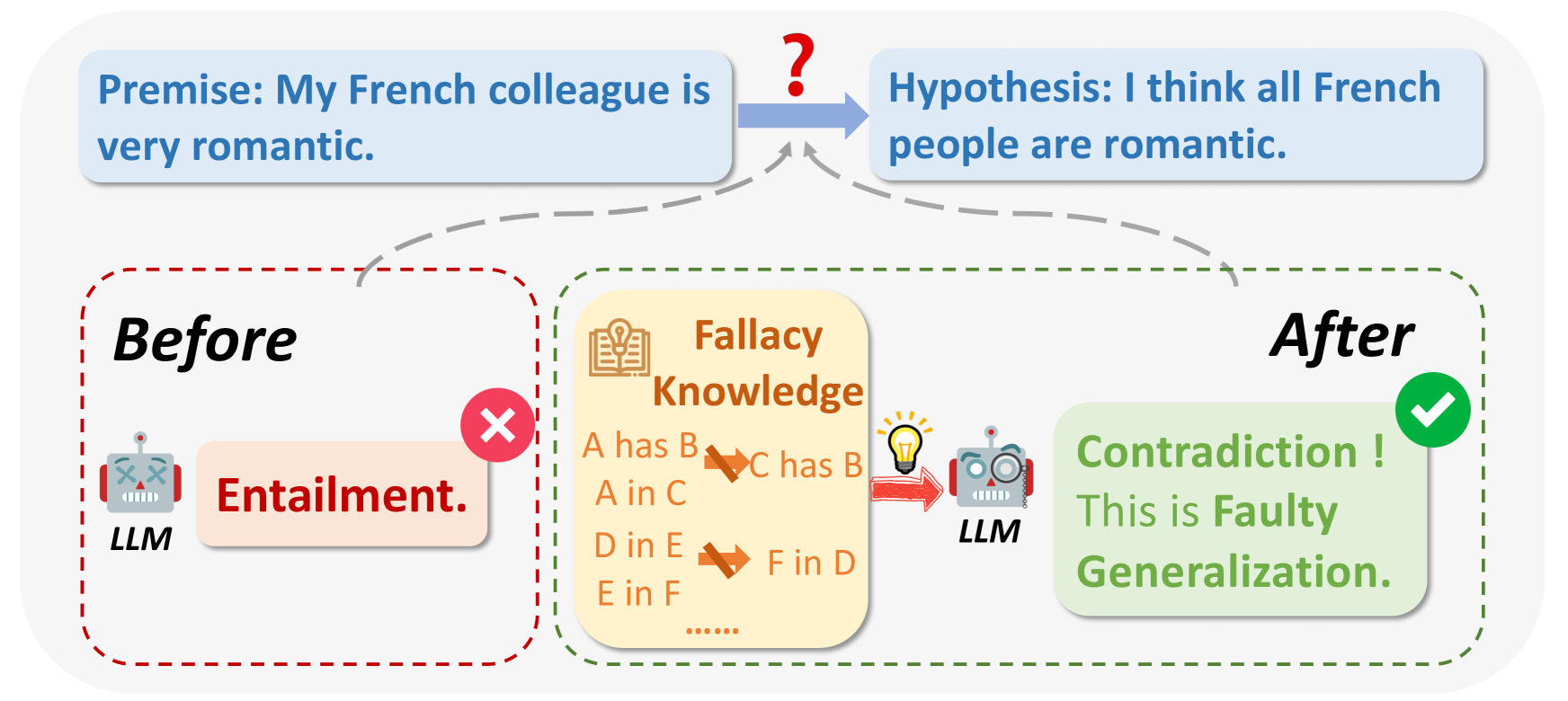
This diagram illustrates a logical fallacy, specifically a faulty generalization, stemming from an initial premise and hypothesis. It visually contrasts a state "Before" understanding the fallacy with a state "After" recognizing it. The diagram uses a question mark and arrows to show the progression of thought and the identification of the fallacy.
### Components/Axes
The diagram is divided into three main sections:
1. **Premise & Hypothesis:** Located at the top, presenting the initial statement and resulting hypothesis.
2. **Before:** A dashed-border section on the left, representing the initial flawed reasoning.
3. **After:** A dashed-border section on the right, representing the corrected understanding.
Within the "Before" section, there's a box labeled "Fallacy Knowledge" containing a series of statements:
* A has B
* A in C
* D in E
* E in F
* F in D
* ...... (ellipsis indicating continuation)
The diagram also includes:
* A question mark icon positioned between the premise and hypothesis.
* Arrows indicating the flow of thought.
* A red "X" symbol over the "Entailment" label in the "Before" section.
* A green checkmark symbol next to "Contradiction!" in the "After" section.
* Icons representing a "LLM" (Large Language Model) in both the "Before" and "After" sections.
### Detailed Analysis or Content Details
The diagram presents a logical progression:
1. **Premise:** "My French colleague is very romantic."
2. **Hypothesis:** "I think all French people are romantic."
3. **Before (Flawed Reasoning):** The initial state incorrectly assumes entailment. The "Fallacy Knowledge" box contains a series of seemingly unrelated statements (A has B, A in C, etc.) which likely represent the flawed reasoning process. The "Entailment" label is marked with a red "X", indicating it is incorrect.
4. **After (Corrected Reasoning):** The corrected state identifies the flaw as a "Contradiction!" and labels it as a "Faulty Generalization." A green checkmark signifies the correct identification of the fallacy.
The arrows show the flow of thought from the premise to the hypothesis, and then to the identification of the fallacy. The LLM icons suggest that this diagram is relevant to the understanding of logical fallacies within the context of Large Language Models.
### Key Observations
* The diagram highlights the danger of making generalizations based on limited observations.
* The "Fallacy Knowledge" section is intentionally abstract and serves to represent the flawed reasoning process rather than providing concrete data.
* The use of visual cues (red "X", green checkmark, arrows) effectively communicates the correction of the logical error.
* The inclusion of LLM icons suggests the diagram is intended for an audience interested in the logical capabilities and potential pitfalls of AI models.
### Interpretation
The diagram demonstrates how a seemingly innocuous premise can lead to a flawed generalization. The initial hypothesis, based on a single observation (a romantic French colleague), incorrectly assumes that all French people share that characteristic. The diagram effectively illustrates the importance of critical thinking and avoiding hasty generalizations. The "Fallacy Knowledge" section, while abstract, represents the internal, often unexamined, reasoning that leads to the error. The correction, identifying the fallacy as a "Faulty Generalization," highlights the need to base conclusions on sufficient evidence rather than anecdotal experiences. The presence of the LLM icons suggests that this type of logical reasoning is crucial for developing and evaluating AI systems, as LLMs are prone to making similar generalizations based on the data they are trained on. The diagram serves as a cautionary tale about the potential for bias and flawed reasoning in both human and artificial intelligence.