## Heatmap: Coverage Similarity Matrix for Gemini-2.0 Generation & Refinement Strategies
### Overview
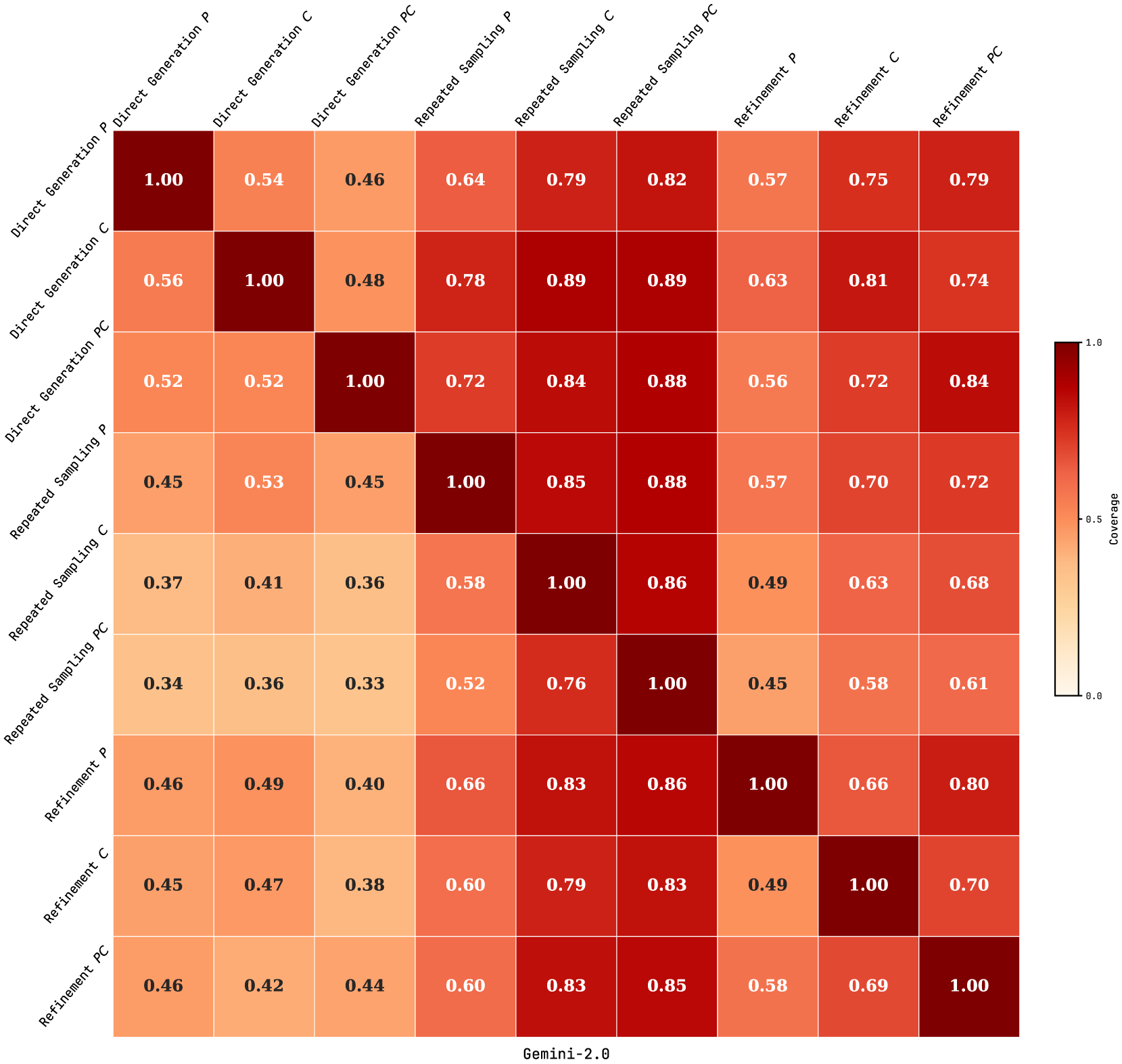
The image is a 9x9 heatmap titled "Gemini-2.0" at the bottom center. It visualizes a symmetric matrix of "Coverage" values between nine different strategies or methods. The color scale, located on the right, ranges from 0.0 (light orange) to 1.0 (dark red), indicating the degree of coverage similarity or overlap. Each cell contains a precise numerical value.
### Components/Axes
* **Chart Type:** Heatmap (symmetric matrix).
* **Title:** "Gemini-2.0" (bottom center).
* **Color Scale/Legend:** A vertical bar on the right side labeled "Coverage". It shows a gradient from light orange (0.0) to dark red (1.0), with tick marks at 0.0, 0.5, and 1.0.
* **X-Axis Labels (Top, rotated ~45 degrees):**
1. Direct Generation P
2. Direct Generation C
3. Direct Generation PC
4. Repeated Sampling P
5. Repeated Sampling C
6. Repeated Sampling PC
7. Refinement P
8. Refinement C
9. Refinement PC
* **Y-Axis Labels (Left, rotated ~45 degrees):** Identical to the X-axis labels, in the same order from top to bottom.
* **Data Cells:** A 9x9 grid of colored squares. Each square contains a two-decimal numerical value representing the coverage metric between the row and column strategy. The diagonal cells (where row and column are identical) are all 1.00 and are the darkest red.
### Detailed Analysis
The matrix is symmetric (A vs. B equals B vs. A). Below is the full data extraction, presented as a table for clarity. The row and column headers correspond to the axis labels.
| | Dir. Gen. P | Dir. Gen. C | Dir. Gen. PC | Rep. Samp. P | Rep. Samp. C | Rep. Samp. PC | Refinement P | Refinement C | Refinement PC |
| :--- | :---: | :---: | :---: | :---: | :---: | :---: | :---: | :---: | :---: |
| **Dir. Gen. P** | **1.00** | 0.54 | 0.46 | 0.64 | 0.79 | 0.82 | 0.57 | 0.75 | 0.79 |
| **Dir. Gen. C** | 0.56 | **1.00** | 0.48 | 0.78 | 0.89 | 0.89 | 0.63 | 0.81 | 0.74 |
| **Dir. Gen. PC** | 0.52 | 0.52 | **1.00** | 0.72 | 0.84 | 0.88 | 0.56 | 0.72 | 0.84 |
| **Rep. Samp. P** | 0.45 | 0.53 | 0.45 | **1.00** | 0.85 | 0.88 | 0.57 | 0.70 | 0.72 |
| **Rep. Samp. C** | 0.37 | 0.41 | 0.36 | 0.58 | **1.00** | 0.86 | 0.49 | 0.63 | 0.68 |
| **Rep. Samp. PC** | 0.34 | 0.36 | 0.33 | 0.52 | 0.76 | **1.00** | 0.45 | 0.58 | 0.61 |
| **Refinement P** | 0.46 | 0.49 | 0.40 | 0.66 | 0.83 | 0.86 | **1.00** | 0.66 | 0.80 |
| **Refinement C** | 0.45 | 0.47 | 0.38 | 0.60 | 0.79 | 0.83 | 0.49 | **1.00** | 0.70 |
| **Refinement PC** | 0.46 | 0.42 | 0.44 | 0.60 | 0.83 | 0.85 | 0.58 | 0.69 | **1.00** |
**Trend Verification by Row:**
* **Direct Generation P:** Shows moderate to high similarity with Repeated Sampling and Refinement methods (0.64-0.82), but lower similarity with other Direct Generation methods (0.46-0.54).
* **Direct Generation C:** Exhibits very high similarity with Repeated Sampling C & PC (0.89) and Refinement C (0.81).
* **Repeated Sampling PC:** Has the lowest overall similarity scores with other methods, particularly with Direct Generation strategies (0.33-0.36).
* **Within-Group Similarity:** Methods within the same family (e.g., Repeated Sampling C vs. Repeated Sampling PC) generally show high similarity (0.76-0.89).
### Key Observations
1. **Highest Values (Dark Red):** The highest off-diagonal values are 0.89 (Direct Generation C vs. Repeated Sampling C and PC) and 0.88 (Direct Generation PC vs. Repeated Sampling PC, and Repeated Sampling P vs. PC).
2. **Lowest Values (Light Orange):** The lowest values are concentrated in the "Repeated Sampling PC" row/column when compared to "Direct Generation" methods, with a minimum of 0.33 (Repeated Sampling PC vs. Direct Generation PC).
3. **Asymmetry:** While the matrix is conceptually symmetric, minor numerical asymmetries exist (e.g., Dir. Gen. P vs. C is 0.54, but C vs. P is 0.56). This may be due to rounding or a non-commutative underlying metric.
4. **Pattern by Strategy Type:** "Repeated Sampling" and "Refinement" strategies tend to have higher similarity with each other than they do with "Direct Generation" strategies. "Direct Generation" methods show more internal variation.
### Interpretation
This heatmap quantifies the similarity in "Coverage" between different AI generation and refinement strategies for the Gemini-2.0 model. "Coverage" likely refers to the diversity, breadth, or representativeness of the outputs or solutions produced by each method.
* **What the data suggests:** The strategies are not independent. There is significant overlap in the coverage provided by methods within the same family (Repeated Sampling, Refinement). The high similarity between "Direct Generation C" and the "Repeated Sampling" methods suggests that the "C" variant (possibly "Critique" or "Conditional") produces outputs whose coverage is readily replicated or encompassed by repeated sampling approaches.
* **Relationships:** The "PC" variants (possibly "Plan-and-Critique" or "Parallel Conditioning") often act as bridges. For example, "Repeated Sampling PC" has high similarity with its family members but low similarity with "Direct Generation," indicating it explores a distinct region of the solution space that is nonetheless related to other sampling methods.
* **Notable Anomaly:** The consistently low similarity scores involving "Repeated Sampling PC" when paired with "Direct Generation" methods (0.33-0.36) is striking. This implies that the coverage achieved by repeatedly sampling with the PC strategy is fundamentally different from that achieved by a single direct generation with the same PC strategy. This could indicate that repeated sampling unlocks a qualitatively different mode of exploration for the PC method.
* **Practical Implication:** For a user of Gemini-2.0, this matrix is a guide for strategy selection. If high coverage diversity is the goal, combining a "Direct Generation" method with a "Repeated Sampling" method (especially of a different variant, e.g., Dir. Gen. P with Rep. Samp. C) would yield more complementary results than using two methods from the same family. The matrix helps avoid redundancy when chaining or ensembling these techniques.