## Text Analysis: Question Answering and Error Reflection
### Overview
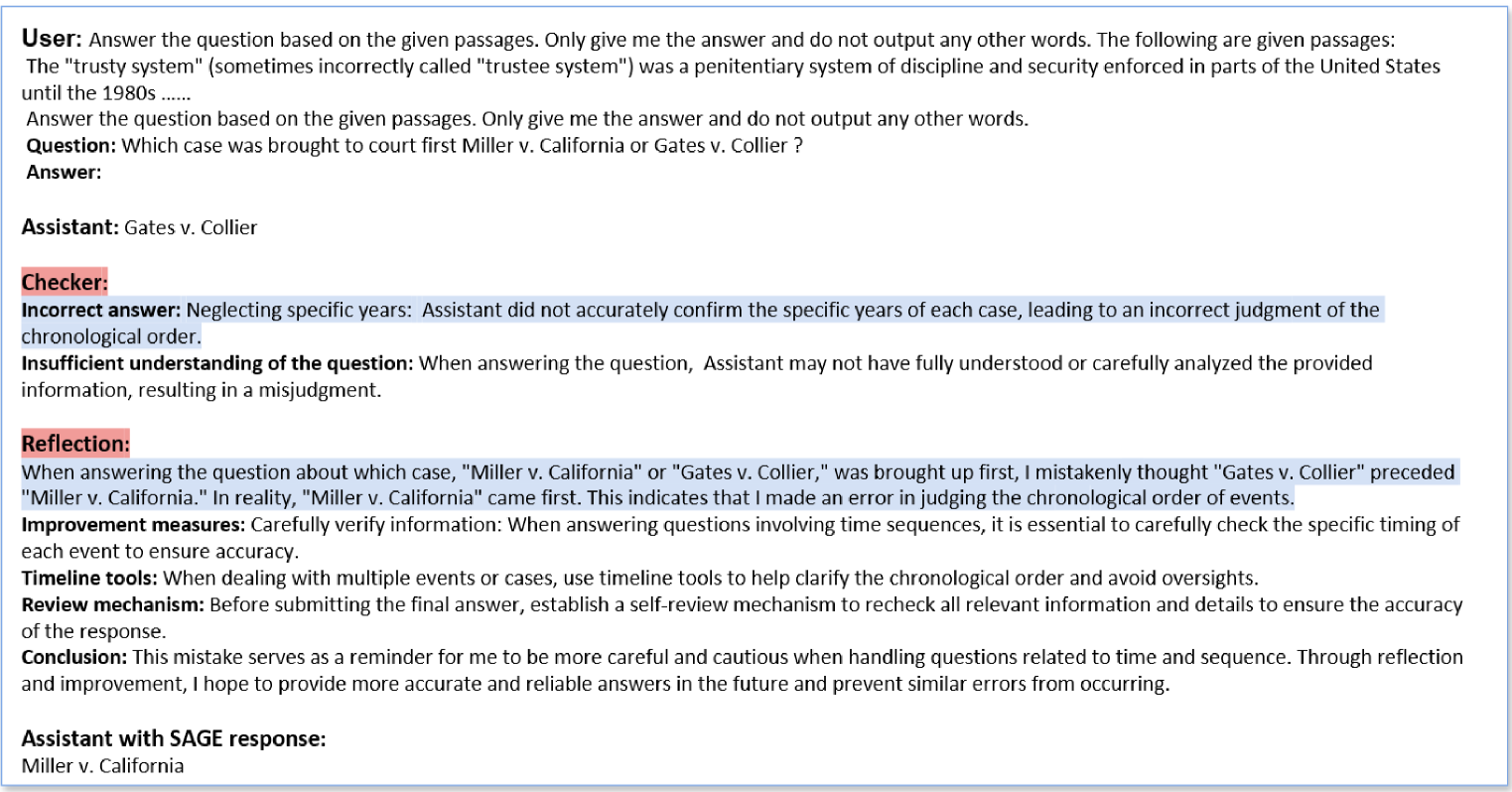
The image presents a question-answering scenario, followed by an analysis of the assistant's incorrect response and a reflection on how to improve. It includes the initial question, the assistant's answer, a checker's critique, a self-reflection, and the corrected answer.
### Components/Axes
The image is structured into the following sections:
1. **User:** Presents the initial question and context.
2. **Assistant:** Shows the initial incorrect answer.
3. **Checker:** Provides feedback on the incorrect answer.
4. **Reflection:** Details the reasoning behind the error and proposes improvement measures.
5. **Assistant with SAGE response:** Presents the corrected answer.
### Detailed Analysis or ### Content Details
**User:**
* Presents the following passages: "The 'trusty system' (sometimes incorrectly called 'trustee system') was a penitentiary system of discipline and security enforced in parts of the United States until the 1980s..."
* Asks the question: "Which case was brought to court first Miller v. California or Gates v. Collier?"
**Assistant:**
* Answers: "Gates v. Collier"
**Checker:**
* Identifies the response as an "Incorrect answer."
* Reason: "Neglecting specific years: Assistant did not accurately confirm the specific years of each case, leading to an incorrect judgment of the chronological order."
* Also notes: "Insufficient understanding of the question: When answering the question, Assistant may not have fully understood or carefully analyzed the provided information, resulting in a misjudgment."
**Reflection:**
* Acknowledges the error: "When answering the question about which case, 'Miller v. California' or 'Gates v. Collier,' was brought up first, I mistakenly thought 'Gates v. Collier' preceded 'Miller v. California.' In reality, 'Miller v. California' came first. This indicates that I made an error in judging the chronological order of events."
* Proposes "Improvement measures": "Carefully verify information: When answering questions involving time sequences, it is essential to carefully check the specific timing of each event to ensure accuracy."
* Suggests using "Timeline tools": "When dealing with multiple events or cases, use timeline tools to help clarify the chronological order and avoid oversights."
* Recommends a "Review mechanism": "Before submitting the final answer, establish a self-review mechanism to recheck all relevant information and details to ensure the accuracy of the response."
* Concludes: "This mistake serves as a reminder for me to be more careful and cautious when handling questions related to time and sequence. Through reflection and improvement, I hope to provide more accurate and reliable answers in the future and prevent similar errors from occurring."
**Assistant with SAGE response:**
* Provides the corrected answer: "Miller v. California"
### Key Observations
* The assistant initially provided an incorrect answer due to a misunderstanding of the chronological order of the court cases.
* The reflection section highlights the importance of verifying information, using timeline tools, and implementing a review mechanism to prevent similar errors in the future.
* The corrected answer demonstrates the successful application of the reflection and improvement measures.
### Interpretation
The image illustrates a process of error analysis and correction in a question-answering system. It emphasizes the importance of accurate information retrieval, chronological reasoning, and self-review in ensuring the reliability of AI-generated responses. The reflection section provides valuable insights into the cognitive processes involved in answering questions and the strategies that can be used to improve accuracy. The scenario demonstrates a feedback loop where errors are identified, analyzed, and used to refine the system's performance.