\n
## Sudoku Puzzle Grid: Completed Puzzle with Highlighted Cells
### Overview
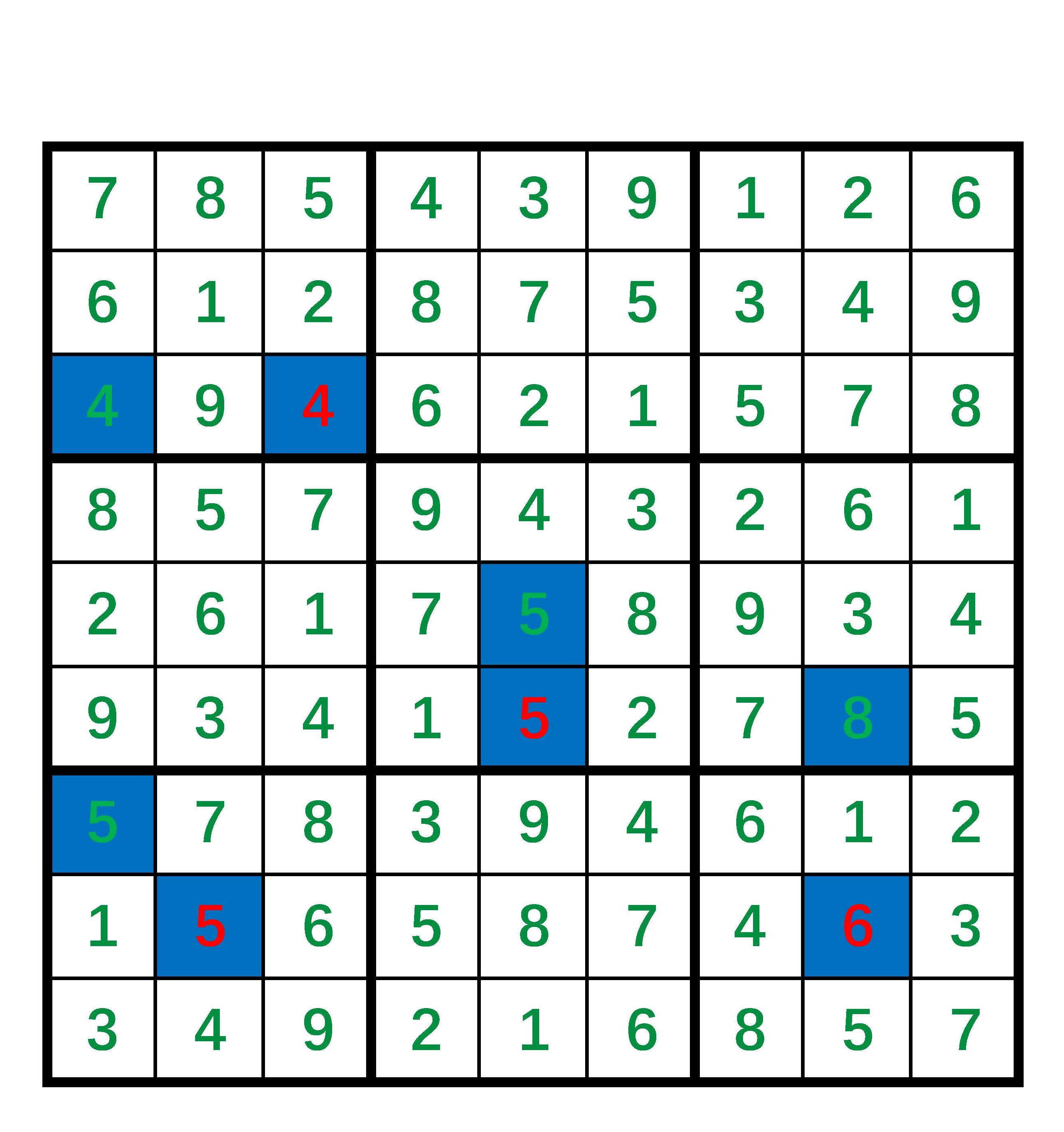
The image displays a completed 9x9 Sudoku puzzle grid. The grid is divided into nine 3x3 subgrids (boxes) by thicker black lines. All 81 cells are filled with numbers from 1 to 9. Several cells are highlighted with a blue background, and within some of these blue cells, the number is colored red instead of the standard green. The puzzle appears to be solved, but the color coding suggests a focus on specific cells, potentially indicating errors or points of interest.
### Components/Axes
* **Grid Structure:** A standard 9x9 Sudoku grid.
* **Cell Content:** Each cell contains a single digit (1-9).
* **Color Coding:**
* **Default:** Green numbers on a white background.
* **Highlighted Cells:** Blue background.
* **Special Numbers:** Red numbers (always within a blue-highlighted cell).
* **Subgrid Divisions:** Thick black lines separate the nine 3x3 boxes.
### Detailed Analysis
The grid is fully populated. Below is a row-by-row transcription of all numbers, noting their color and background. Row and column positions are given as (Row, Column), with Row 1 at the top and Column 1 at the left.
**Row 1:** 7 (green/white), 8 (green/white), 5 (green/white), 4 (green/white), 3 (green/white), 9 (green/white), 1 (green/white), 2 (green/white), 6 (green/white)
**Row 2:** 6 (green/white), 1 (green/white), 2 (green/white), 8 (green/white), 7 (green/white), 5 (green/white), 3 (green/white), 4 (green/white), 9 (green/white)
**Row 3:** **4 (green/blue)**, 9 (green/white), **4 (red/blue)**, 6 (green/white), 2 (green/white), 1 (green/white), 5 (green/white), 7 (green/white), 8 (green/white)
**Row 4:** 8 (green/white), 5 (green/white), 7 (green/white), 9 (green/white), 4 (green/white), 3 (green/white), 2 (green/white), 6 (green/white), 1 (green/white)
**Row 5:** 2 (green/white), 6 (green/white), 1 (green/white), 7 (green/white), **5 (green/blue)**, 8 (green/white), 9 (green/white), 3 (green/white), 4 (green/white)
**Row 6:** 9 (green/white), 3 (green/white), 4 (green/white), 1 (green/white), **5 (red/blue)**, 2 (green/white), 7 (green/white), **8 (green/blue)**, 5 (green/white)
**Row 7:** **5 (green/blue)**, 7 (green/white), 8 (green/white), 3 (green/white), 9 (green/white), 4 (green/white), 6 (green/white), 1 (green/white), 2 (green/white)
**Row 8:** 1 (green/white), **5 (red/blue)**, 6 (green/white), 5 (green/white), 8 (green/white), 7 (green/white), 4 (green/white), **6 (red/blue)**, 3 (green/white)
**Row 9:** 3 (green/white), 4 (green/white), 9 (green/white), 2 (green/white), 1 (green/white), 6 (green/white), 8 (green/white), 5 (green/white), 7 (green/white)
**List of Blue-Highlighted Cells:**
1. (3,1): Number 4 (Green)
2. (3,3): Number 4 (Red)
3. (5,5): Number 5 (Green)
4. (6,5): Number 5 (Red)
5. (6,8): Number 8 (Green)
6. (7,1): Number 5 (Green)
7. (8,2): Number 5 (Red)
8. (8,8): Number 6 (Red)
### Key Observations
1. **Duplicate Numbers in Rows:** The color coding highlights apparent violations of Sudoku rules:
* **Row 3:** Contains two 4s (at columns 1 and 3). The second 4 (3,3) is colored red.
* **Row 8:** Contains two 5s (at columns 2 and 4). The first 5 (8,2) is colored red.
2. **Duplicate Numbers in Columns:**
* **Column 5:** Contains two 5s (at rows 5 and 6). The 5 at (6,5) is colored red.
* **Column 8:** Contains two 6s (at rows 8 and 9? Wait, Row 9, Col 8 is 5). Re-checking: Column 8 has values: 2,4,7,6,3,8,1,6,5. There are two 6s at (4,8) and (8,8). The 6 at (8,8) is colored red.
3. **Pattern in Highlights:** All blue cells contain numbers that are either part of a duplicate pair (the red ones) or the first instance of a duplicated number in that row/column (the green ones). This suggests the highlights are flagging errors in the puzzle's solution.
4. **Overall Grid Validity:** Despite the highlighted duplicates, a quick check suggests the grid may still satisfy the core Sudoku constraint for most rows, columns, and boxes. The errors are localized to the specific highlighted cells.
### Interpretation
This image is not a puzzle to be solved, but rather a **diagnostic or analytical view of a completed Sudoku grid**. The color-coding system serves as an error-checking mechanism.
* **Purpose:** The visualization is designed to instantly draw attention to cells that break the fundamental Sudoku rule of uniqueness within rows, columns, or boxes. The blue background marks the "scene of the crime," while the red number pinpoints the specific duplicate entry.
* **Data Relationship:** The green numbers in blue cells (e.g., (3,1), (5,5)) likely represent the "original" or "correct" placement of a number, while the corresponding red number in the same row/column (e.g., (3,3), (6,5)) is the erroneous duplicate. This creates a visual link between the two conflicting cells.
* **Anomalies:** The primary anomalies are the four duplicate pairs identified. Their presence indicates that the solution presented in the grid is invalid according to standard Sudoku rules. This could be the result of a solving error, a flawed puzzle generation, or an intentional demonstration of error highlighting.
* **Underlying Message:** The image demonstrates a tool or method for validating Sudoku solutions. It moves beyond a simple filled grid to provide meta-information about the solution's correctness, making it useful for debugging, teaching, or quality control in puzzle design. The viewer is meant to understand not just the numbers, but the logical flaws within the presented solution.