## Task Instructions: Humor and Irrationality Detection
### Overview
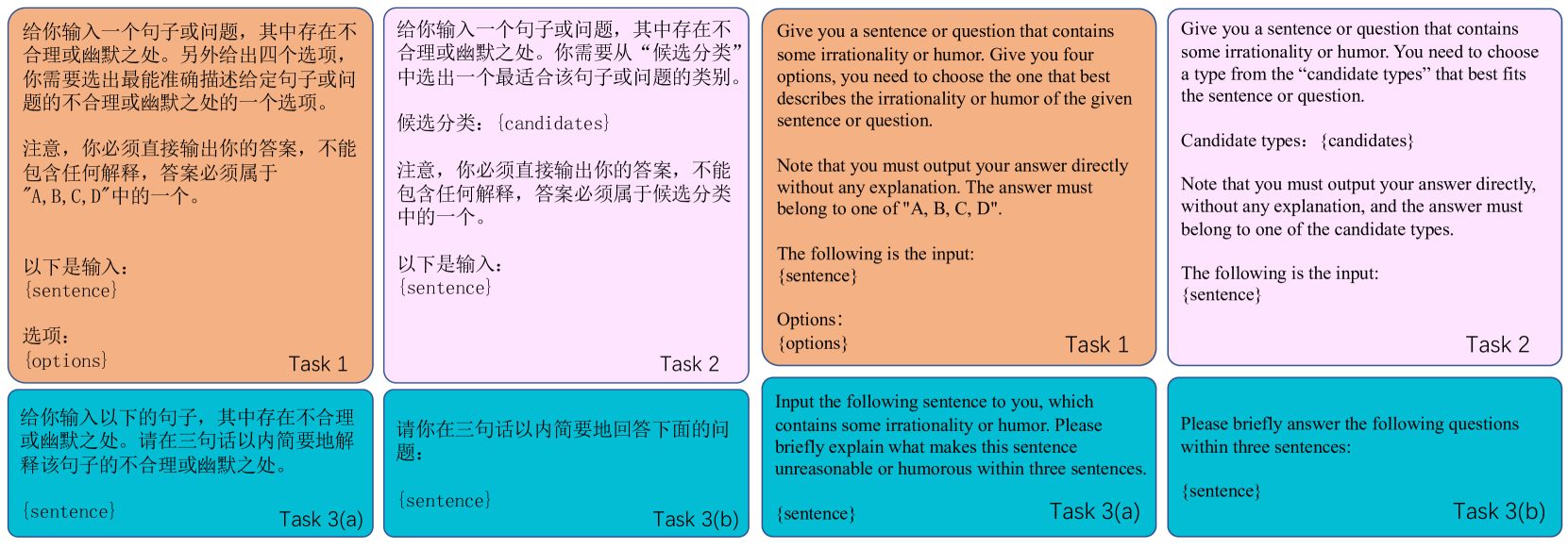
The image presents instructions for several tasks related to identifying and explaining irrationality or humor in sentences or questions. The tasks are divided into Task 1, Task 2, Task 3(a), and Task 3(b), each with slightly different instructions and response formats. The instructions are provided in both Chinese and English.
### Components/Axes
* **Task 1 (Orange Background):**
* Instructions: "Give you a sentence or question that contains some irrationality or humor. Give you four options, you need to choose the one that best describes the irrationality or humor of the given sentence or question."
* Note: "Note that you must output your answer directly without any explanation. The answer must belong to one of 'A, B, C, D'."
* Input: "{sentence}"
* Options: "{options}"
* **Task 2 (Pink Background):**
* Instructions: "Give you a sentence or question that contains some irrationality or humor. You need to choose a type from the 'candidate types' that best fits the sentence or question."
* Candidate types: "{candidates}"
* Note: "Note that you must output your answer directly, without any explanation, and the answer must belong to one of the candidate types."
* Input: "{sentence}"
* **Task 3(a) (Teal Background):**
* Instructions: "Input the following sentence to you, which contains some irrationality or humor. Please briefly explain what makes this sentence unreasonable or humorous within three sentences."
* Input: "{sentence}"
* **Task 3(b) (Teal Background):**
* Instructions: "Please briefly answer the following questions within three sentences:"
* Input: "{sentence}"
### Detailed Analysis or ### Content Details
The image is divided into four sections, each representing a different task. Each task provides instructions, specifies the expected input format (a sentence or question), and outlines the required output.
* **Task 1 (Orange):** Requires selecting the best description of the irrationality or humor from four options (A, B, C, D).
* **Task 2 (Pink):** Requires selecting the best-fitting type from a set of "candidate types."
* **Task 3(a) (Teal):** Requires a brief explanation (within three sentences) of the irrationality or humor in a given sentence.
* **Task 3(b) (Teal):** Requires briefly answering questions within three sentences.
The instructions are also provided in Chinese, mirroring the English instructions.
* **Task 1 (Chinese):**
* 给你输入一个句子或问题,其中存在不合理或幽默之处。另外给出四个选项,你需要选出最能准确描述给定句子或问题的不合理或幽默之处的一个选项。
* 注意,你必须直接输出你的答案,不能包含任何解释,答案必须属于"A, B, C, D”中的一个。
* 以下是输入: {sentence}
* 选项: {options}
* **Task 2 (Chinese):**
* 给你输入一个句子或问题,其中存在不合理或幽默之处。你需要从“候选分类”中选出一个最适合该句子或问题的类别。
* 候选分类: {candidates}
* 注意,你必须直接输出你的答案,不能包含任何解释,答案必须属于候选分类中的一个。
* 以下是输入: {sentence}
* **Task 3(a) (Chinese):**
* 给你输入以下的句子,其中存在不合理或幽默之处。请在三句话以内简要地解释该句子的不合理或幽默之处。
* {sentence}
* **Task 3(b) (Chinese):**
* 请你在三句话以内简要地回答下面的问题:
* {sentence}
### Key Observations
* The tasks focus on identifying and explaining irrationality or humor.
* Tasks 1 and 2 require selecting from predefined options, while Tasks 3(a) and 3(b) require free-form responses within a length constraint.
* The instructions are provided in both English and Chinese.
### Interpretation
The image outlines a set of tasks designed to assess a system's ability to understand and explain humor and irrationality. The tasks vary in complexity, ranging from multiple-choice selection to free-form explanation. The inclusion of both English and Chinese instructions suggests a multilingual application or evaluation. The tasks are likely part of a larger evaluation framework for natural language understanding and generation systems.