## Diagram: Task Instructions - Irrationality/Humor Detection
### Overview
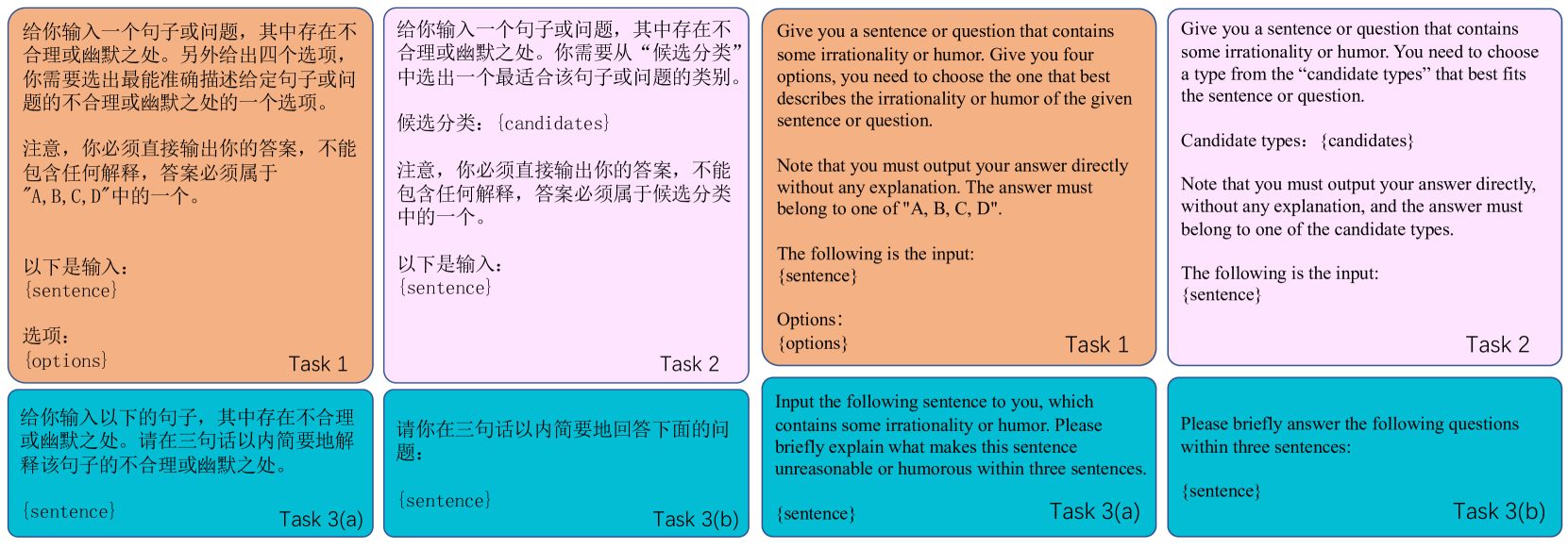
The image presents a diagram outlining instructions for a task involving the detection of irrationality or humor in sentences. The diagram is structured into four distinct task blocks (Task 1, Task 2, Task 3(a), Task 3(b)), each with specific input requirements and output expectations. The primary language is Chinese, with some English phrases included in the task descriptions.
### Components/Axes
The diagram is divided into four rectangular blocks, labeled "Task 1", "Task 2", "Task 3(a)", and "Task 3(b)". Each block contains Chinese text describing the task, input fields labeled "{sentence}" and "{options}", and a section for the output. The rightmost two tasks also include a section labeled "candidates" with a list of options.
### Detailed Analysis or Content Details
Let's transcribe and translate the Chinese text in each task block:
**Task 1:**
* **Chinese:** 给你输入一个子或问题,其中存在不合理或幽默之处。另外给出以下选项,你需要选出最能描述符合子或问题的合理或幽默之处的一个选项。
* **English Translation:** "You will be given a sentence or question containing some irrationality or humor. In addition, you will be given the following options, and you need to choose the option that best describes the irrationality or humor in the sentence or question."
* **Input:** "{sentence}"
* **Options:** "{options}"
**Task 2:**
* **Chinese:** 给你输入一个子或问题,其中存在不合理或幽默之处。你需要从“候选分类”中选出一个最适合该子或问题的类别。
* **English Translation:** "You will be given a sentence or question containing some irrationality or humor. You need to choose the most suitable category from the 'candidate types'."
* **Input:** "{sentence}"
* **Candidates:** "{candidates}"
* **Note (Chinese):** 注意,你必须直接输出你的答案,不能包含任何解释,答案必须属于“A, B, C, D”中的一个。
* **English Translation of Note:** "Note that you must output your answer directly without any explanation. The answer must belong to one of 'A, B, C, D'."
**Task 3(a):**
* **Chinese:** 给你输入以下句子,其中存在不合理或幽默之处。请用三句话以内简要地解释为什么合理或幽默之处。
* **English Translation:** "You will be given the following sentence, which contains some irrationality or humor. Please briefly explain within three sentences why there is irrationality or humor."
* **Input:** "{sentence}"
* **Options:** "{options}"
**Task 3(b):**
* **Chinese:** 请你在三句话以内简要地回答下面的问题:
* **English Translation:** "Please briefly answer the following questions within three sentences:"
* **Input:** "{sentence}"
* **Input:** "{sentence}"
**Common Elements:**
* The input field "{sentence}" appears in all four tasks, indicating that a sentence will be provided as input.
* The "{options}" field appears in Tasks 1 and 3(a), suggesting multiple-choice options will be provided.
* The "{candidates}" field appears in Task 2, indicating a list of candidate categories.
### Key Observations
The diagram clearly outlines a multi-stage task for evaluating a model's ability to understand and identify irrationality or humor in text. The tasks range from multiple-choice selection (Task 1 & 2) to short-form explanation (Task 3a & 3b). The emphasis on direct answers without explanation in Task 2 suggests a focus on accuracy and efficiency.
### Interpretation
The diagram represents a structured approach to assessing a system's comprehension of nuanced linguistic features like irrationality and humor. The progression of tasks, from selection to explanation, suggests a desire to evaluate both the system's ability to *detect* these features and its ability to *reason* about them. The inclusion of both multiple-choice and open-ended questions allows for a more comprehensive evaluation. The use of Chinese alongside English suggests the task is intended to be applicable to multiple languages, or that the system being evaluated is multilingual. The constraints on response length (three sentences) indicate a focus on concise and focused answers. The diagram is a clear set of instructions for a human annotator or an automated system designed to perform this type of linguistic analysis.