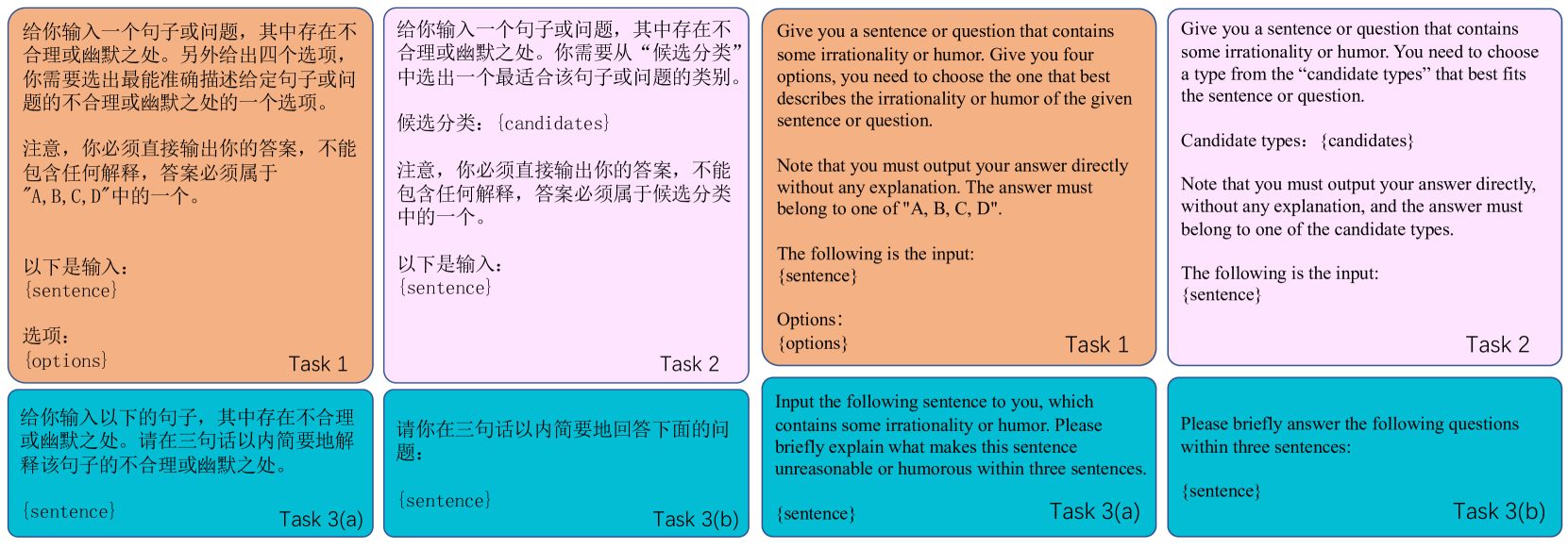
## Screenshot: Multilingual Task Interface
### Overview
The image shows a structured interface with multiple sections containing text in English, Chinese, and Japanese. Each section is labeled with task identifiers (e.g., Task 1, Task 2, Task 3(a), Task 3(b)) and includes instructions, input placeholders, and formatting examples.
### Components/Axes
- **Sections**:
- **Left Column**: English text with task instructions and placeholders.
- **Middle Column**: Mixed English and Chinese text with task instructions.
- **Right Column**: English text with task instructions and placeholders.
- **Text Elements**:
- **Task Labels**: "Task 1", "Task 2", "Task 3(a)", "Task 3(b)".
- **Placeholders**: `{sentence}`, `{options}`, `{candidates}`.
- **Instructions**: Directions for inputting sentences, selecting options, or analyzing text.
- **Languages**:
- English (primary), Chinese (simplified), Japanese (kanji/katakana).
### Detailed Analysis
#### Task 1 (Left Column)
- **English Text**:
- Instructions to input a sentence or question with specific constraints (e.g., "combined with irrationality or humor").
- Placeholders: `{sentence}`, `{options}`.
- **Chinese Text**:
- Translation of the English instructions, emphasizing sentence input and option selection.
- **Japanese Text**:
- Translation of the English instructions, using kanji/katakana for technical terms.
#### Task 2 (Middle Column)
- **English Text**:
- Instructions to input a sentence or question with constraints (e.g., "contain some irrationality or humor").
- Placeholders: `{sentence}`, `{candidates}`.
- **Chinese Text**:
- Translation of the English instructions, focusing on sentence input and candidate selection.
- **Japanese Text**:
- Translation of the English instructions, using technical terms in kanji/katakana.
#### Task 3(a) (Right Column)
- **English Text**:
- Instructions to input a sentence and briefly explain its irrationality/humor.
- Placeholder: `{sentence}`.
- **Chinese Text**:
- Translation of the English instructions, emphasizing sentence input and explanation.
- **Japanese Text**:
- Translation of the English instructions, using formal language for technical tasks.
#### Task 3(b) (Bottom Right)
- **English Text**:
- Instructions to answer questions within three sentences.
- Placeholder: `{sentence}`.
- **Chinese Text**:
- Translation of the English instructions, focusing on concise responses.
- **Japanese Text**:
- Translation of the English instructions, using polite form for task completion.
### Key Observations
1. **Multilingual Consistency**: All tasks are translated into Chinese and Japanese, maintaining identical structure and intent.
2. **Placeholder Usage**: `{sentence}` and `{options}` are repeated across tasks, suggesting reusable templates.
3. **Task Hierarchy**: Tasks 1 and 2 focus on input generation, while Tasks 3(a) and 3(b) emphasize analysis and concise responses.
4. **Formatting**: Sections are visually separated by color (orange, purple, blue) to distinguish tasks.
### Interpretation
This interface appears to be part of a natural language processing (NLP) or machine learning system, likely for training or evaluating models on tasks involving sentence generation, option selection, and text analysis. The multilingual design suggests the system is intended for cross-lingual evaluation or localization. The use of placeholders (`{sentence}`, `{options}`) indicates modularity, allowing dynamic content insertion. The task progression from input generation to analysis implies a workflow for iterative model refinement.
**Note**: No numerical data, charts, or diagrams are present. The image focuses on textual instructions and structural organization.