## Diagram: Software Engineering Task Automation Workflow
### Overview
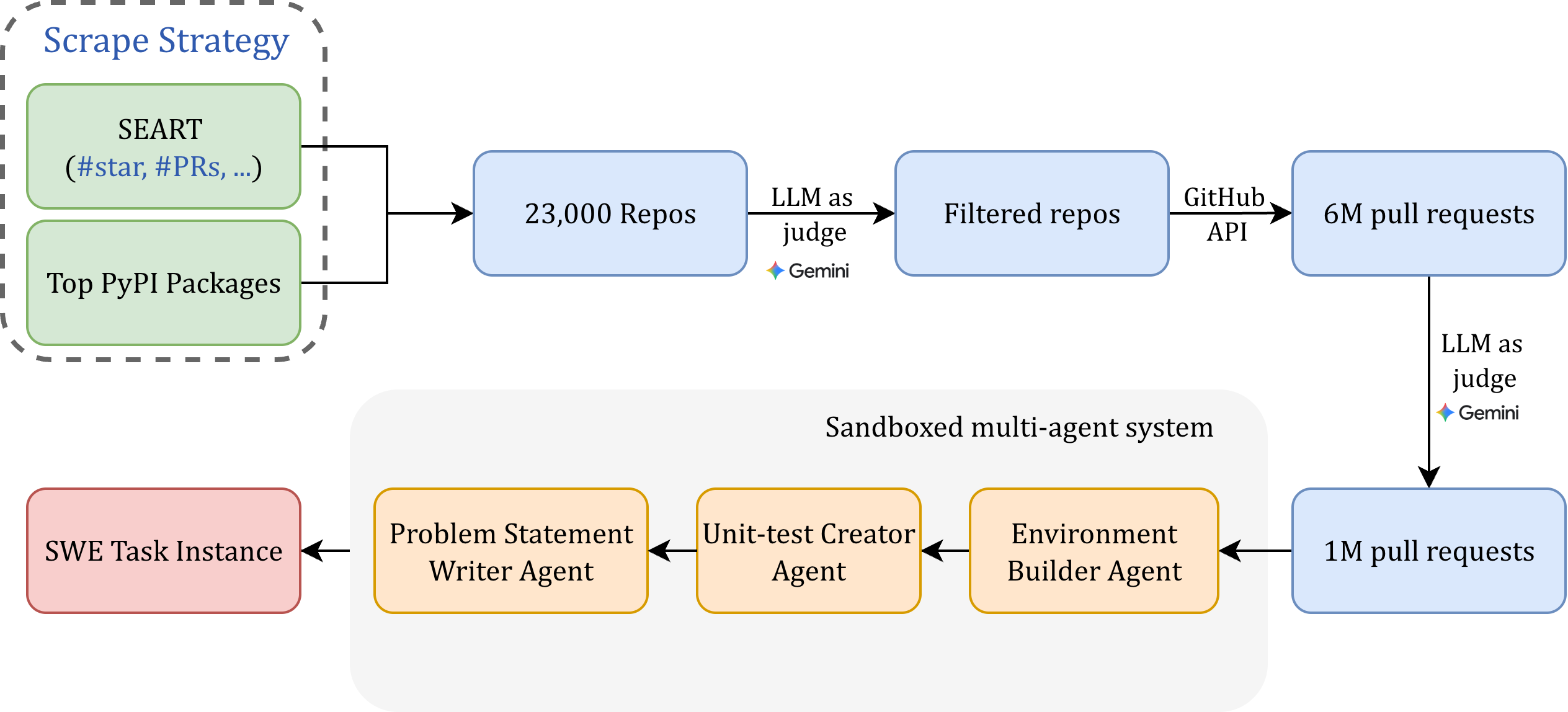
The image is a flowchart illustrating a software engineering task automation workflow. It begins with scraping strategies, proceeds through repository filtering and pull request processing, and culminates in a sandboxed multi-agent system for task execution.
### Components/Axes
* **Header:** "Scrape Strategy" enclosed in a dashed rounded rectangle.
* "SEART (#star, #PRs, ...)" - Green rounded rectangle.
* "Top PyPI Packages" - Green rounded rectangle.
* **Main Flow:**
* "23,000 Repos" - Blue rounded rectangle.
* "Filtered repos" - Blue rounded rectangle.
* "6M pull requests" - Blue rounded rectangle.
* "1M pull requests" - Blue rounded rectangle.
* **Sandboxed Multi-Agent System:** Enclosed in a light gray rounded rectangle.
* "Problem Statement Writer Agent" - Orange rounded rectangle.
* "Unit-test Creator Agent" - Orange rounded rectangle.
* "Environment Builder Agent" - Orange rounded rectangle.
* **Output:**
* "SWE Task Instance" - Red rounded rectangle.
* **Connectors:** Arrows indicating the flow of data and processes.
* **Labels:**
* "LLM as judge" with a diamond symbol next to "Gemini" (appears twice).
* "GitHub API"
### Detailed Analysis
1. **Scrape Strategy:**
* The process begins with two sources: "SEART (#star, #PRs, ...)" and "Top PyPI Packages".
* These are enclosed within a dashed rounded rectangle labeled "Scrape Strategy".
2. **Repository Filtering:**
* The output of the scrape strategy leads to "23,000 Repos".
* These repositories are then filtered using an LLM (Large Language Model) as a judge, specifically "Gemini", resulting in "Filtered repos".
3. **Pull Request Processing:**
* The "Filtered repos" are processed via the "GitHub API" to generate "6M pull requests".
* These pull requests are further filtered using an LLM ("Gemini") to produce "1M pull requests".
4. **Sandboxed Multi-Agent System:**
* The "1M pull requests" feed into a "Sandboxed multi-agent system".
* This system comprises three agents: "Environment Builder Agent", "Unit-test Creator Agent", and "Problem Statement Writer Agent".
* The output of this system is a "SWE Task Instance".
5. **Flow Direction:**
* The flow is generally from left to right, starting with the scrape strategy and ending with the SWE task instance.
* Within the multi-agent system, the flow appears to be from "Environment Builder Agent" to "Unit-test Creator Agent" to "Problem Statement Writer Agent".
### Key Observations
* The diagram highlights the use of LLMs ("Gemini") for judging and filtering at multiple stages of the workflow.
* The number of repositories and pull requests decreases significantly after each filtering stage.
* The multi-agent system is sandboxed, suggesting a controlled environment for task execution.
### Interpretation
The diagram illustrates an automated process for generating software engineering tasks. It begins by gathering data from repositories and packages, filters this data using LLMs, and then uses a multi-agent system to create specific task instances. The use of LLMs for judging and filtering suggests an attempt to prioritize relevant and high-quality data. The sandboxed environment indicates a focus on safety and control during task execution. The reduction in the number of repositories and pull requests at each stage suggests a refinement process aimed at focusing on the most promising candidates for task generation.