## Diagram: Reflective Learning Process
### Overview
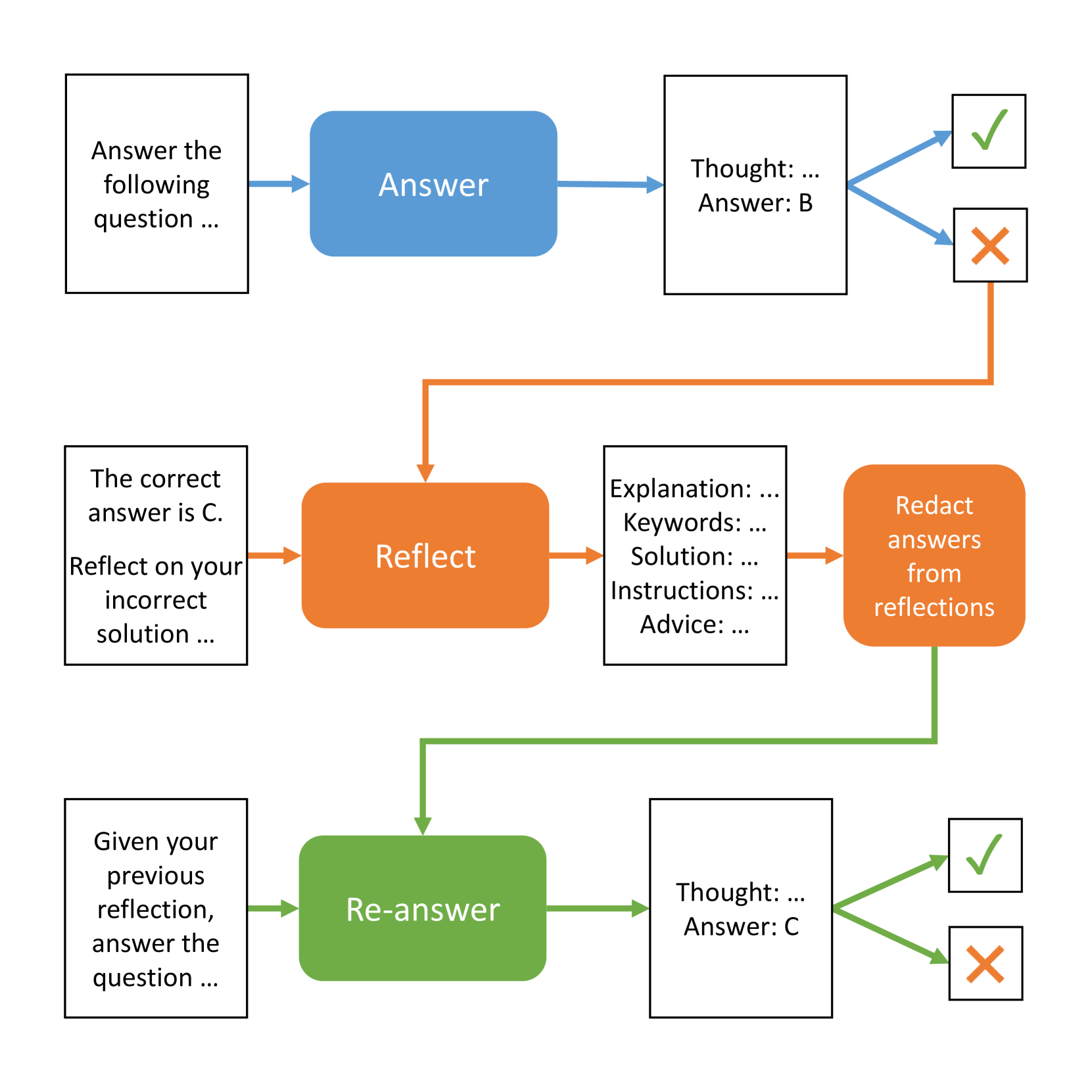
The image is a flowchart illustrating a reflective learning process. It starts with answering a question, reflecting on the answer, and then re-answering the question based on the reflection. The process includes feedback loops and considerations for incorrect solutions.
### Components/Axes
The diagram consists of rectangular and rounded rectangular boxes connected by arrows, representing steps in the learning process. The colors of the boxes and arrows indicate different stages or actions.
* **Boxes:**
* White rectangular boxes contain text describing the task or thought process.
* Rounded rectangular boxes represent actions or stages in the process.
* **Arrows:** Indicate the flow of the process.
* **Colors:**
* Blue: Initial answering stage.
* Orange: Reflection stage.
* Green: Re-answering stage.
* **Symbols:**
* Green checkmark: Represents a correct answer.
* Orange X: Represents an incorrect answer.
### Detailed Analysis or ### Content Details
The flowchart can be broken down into three main sections, each representing a cycle of answering, reflecting, and re-answering.
**1. Initial Answer (Blue):**
* **Box 1 (Top-Left):** Contains the text "Answer the following question..."
* **Arrow 1 (Right):** A blue arrow leads from Box 1 to a blue rounded rectangle.
* **Box 2 (Blue Rounded Rectangle):** Labeled "Answer".
* **Arrow 2 (Right):** A blue arrow leads from the "Answer" box to a white rectangular box.
* **Box 3 (Top-Right):** Contains the text "Thought: ... Answer: B".
* **Branching Arrows (Blue):** Two blue arrows branch out from Box 3. One points to a green checkmark, and the other points to an orange X.
**2. Reflection (Orange):**
* **Box 4 (Bottom-Left):** Contains the text "The correct answer is C. Reflect on your incorrect solution..."
* **Arrow 3 (Right):** An orange arrow leads from Box 4 to an orange rounded rectangle.
* **Box 5 (Orange Rounded Rectangle):** Labeled "Reflect".
* **Arrow 4 (Right):** An orange arrow leads from the "Reflect" box to a white rectangular box.
* **Box 6 (Center-Right):** Contains the text "Explanation: ... Keywords: ... Solution: ... Instructions: ... Advice: ..."
* **Arrow 5 (Right):** An orange arrow leads from Box 6 to an orange rounded rectangle.
* **Box 7 (Orange Rounded Rectangle):** Labeled "Redact answers from reflections".
* **Arrow 6 (Down):** An orange arrow leads from the "Answer" box to the "Reflect" box.
**3. Re-Answer (Green):**
* **Box 8 (Bottom-Left):** Contains the text "Given your previous reflection, answer the question..."
* **Arrow 7 (Right):** A green arrow leads from Box 8 to a green rounded rectangle.
* **Box 9 (Green Rounded Rectangle):** Labeled "Re-answer".
* **Arrow 8 (Right):** A green arrow leads from the "Re-answer" box to a white rectangular box.
* **Box 10 (Bottom-Right):** Contains the text "Thought: ... Answer: C".
* **Branching Arrows (Green):** Two green arrows branch out from Box 10. One points to a green checkmark, and the other points to an orange X.
### Key Observations
* The process starts with an initial attempt to answer a question.
* If the initial answer is incorrect (indicated by the orange X), the process moves to a reflection stage.
* The reflection stage involves analyzing the incorrect solution and considering explanations, keywords, solutions, instructions, and advice.
* After reflection, the answers are redacted from the reflections.
* The process concludes with a re-attempt to answer the question, incorporating the insights gained from the reflection.
* The final answer is evaluated, with a green checkmark indicating a correct answer.
### Interpretation
The diagram illustrates a structured approach to learning through reflection. It emphasizes the importance of analyzing mistakes, understanding the underlying concepts, and applying that understanding to improve future attempts. The process is iterative, allowing for continuous improvement and deeper understanding. The diagram highlights the value of reflection in correcting errors and reinforcing learning. The "Redact answers from reflections" step suggests a need to separate the initial, potentially flawed, answers from the reflective analysis to avoid bias in the re-answering stage. The diagram suggests that even after reflection, there is a possibility of an incorrect answer, indicating that learning is an ongoing process.