\n
## Diagram: Reflective Reasoning Process
### Overview
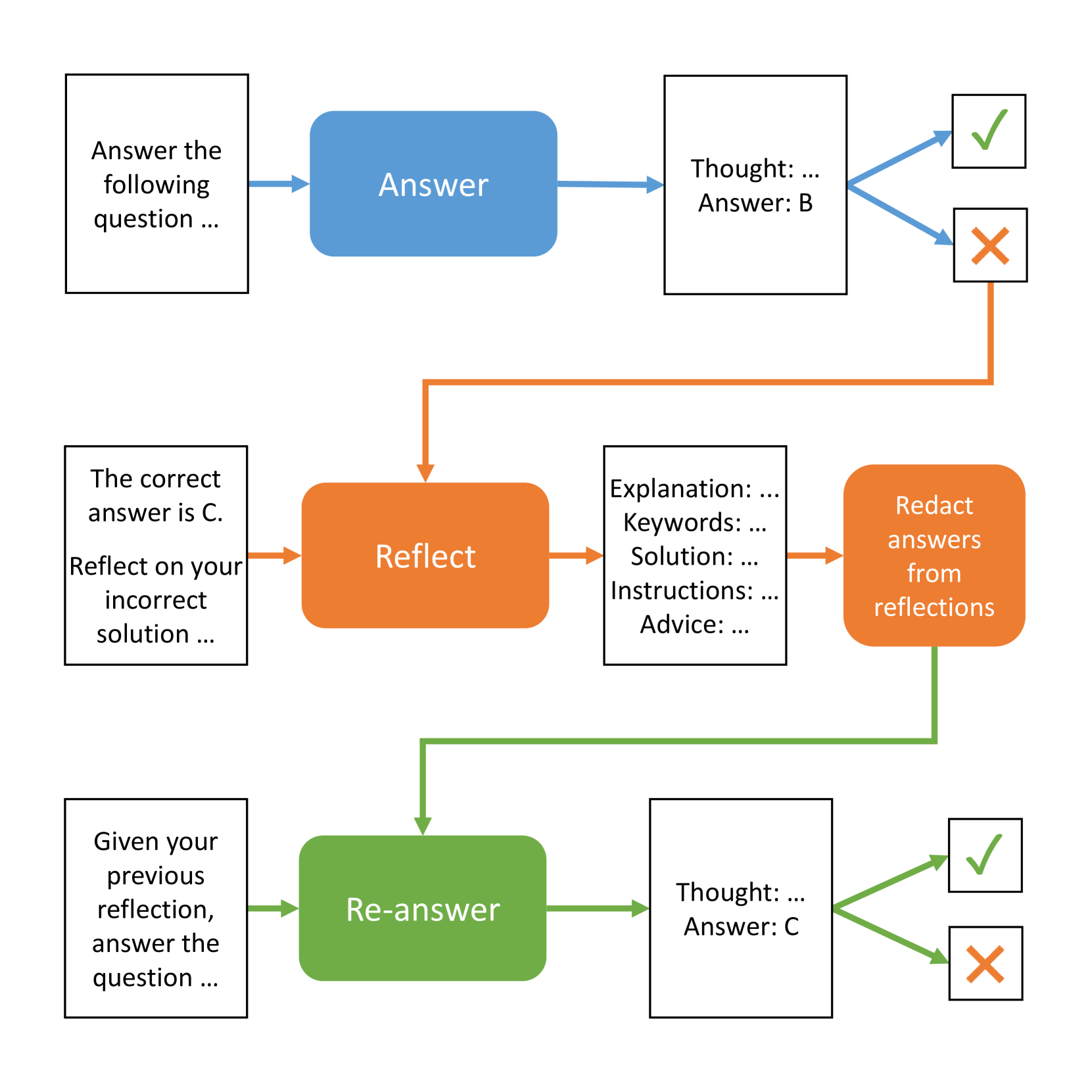
The image depicts a flowchart illustrating a reflective reasoning process, likely used in the training or evaluation of a language model. The process involves answering a question, receiving feedback, reflecting on the answer, and re-answering the question. The diagram highlights the flow of information and the iterative nature of the process.
### Components/Axes
The diagram consists of rectangular nodes representing steps in the process, connected by arrows indicating the flow of execution. Each node contains text describing the action or state. There are also two rectangular boxes on the right side of the diagram, representing the outcome of the answer, with a checkmark or an 'X' symbol.
### Detailed Analysis or Content Details
The diagram can be broken down into the following steps:
1. **"Answer the following question..."** (Blue Rectangle, Top-Left): This is the initial step, where a question is presented. An arrow leads to the "Answer" node.
2. **"Answer"** (Blue Rectangle, Top-Center): This node represents the model's response. An arrow leads to an evaluation step. The text within this node is "Thought: ... Answer: B".
3. **Evaluation (Right-Top):** The answer is evaluated, resulting in either a checkmark (correct) or an 'X' (incorrect). The arrow from "Answer" splits into two, one leading to the checkmark and one to the 'X'.
4. **"The correct answer is C. Reflect on your incorrect solution..."** (Orange Rectangle, Center-Left): This step is triggered when the answer is incorrect (indicated by the 'X'). It prompts reflection on the error. An arrow leads to the "Reflect" node.
5. **"Reflect"** (Orange Rectangle, Center): This node represents the reflection process. The text within this node is "Explanation: ... Keywords: ... Solution: ... Instructions: ... Advice: ...". An arrow leads to a redaction step.
6. **"Redact answers from reflections"** (Orange Rectangle, Center-Right): This step involves removing the answer from the reflection to prevent the model from simply recalling the answer.
7. **"Given your previous reflection, answer the question..."** (Green Rectangle, Bottom-Left): This step prompts the model to re-answer the question, incorporating the insights gained from the reflection. An arrow leads to the "Re-answer" node.
8. **"Re-answer"** (Green Rectangle, Bottom-Center): This node represents the model's re-answer. The text within this node is "Thought: ... Answer: C".
9. **Evaluation (Right-Bottom):** The re-answer is evaluated, resulting in either a checkmark (correct) or an 'X' (incorrect). The arrow from "Re-answer" splits into two, one leading to the checkmark and one to the 'X'.
The arrows indicate a clear flow: Initial Answer -> Evaluation -> (If Incorrect) Reflection -> Redaction -> Re-answer -> Evaluation.
### Key Observations
The diagram emphasizes the importance of reflection in improving reasoning abilities. The process is iterative, allowing the model to learn from its mistakes and refine its answers. The redaction step is crucial for preventing the model from simply memorizing the correct answer. The color coding (Blue -> Orange -> Green) visually represents the progression through the process.
### Interpretation
This diagram illustrates a sophisticated approach to training or evaluating a language model. It moves beyond simple question-answering to incorporate a reflective learning loop. The inclusion of "Thought" and "Answer" within the nodes suggests that the model is capable of generating explanations for its reasoning, which is a key aspect of explainable AI. The redaction step is a clever technique to ensure that the model is genuinely learning and not just memorizing. The diagram suggests a commitment to building models that can not only provide correct answers but also understand *why* those answers are correct. The iterative nature of the process implies that the model is expected to improve its performance over time through repeated cycles of answering, reflecting, and re-answering. The diagram is a visual representation of a learning algorithm designed to enhance reasoning capabilities.