\n
## Diagram: Iterative Answer Correction Process Flowchart
### Overview
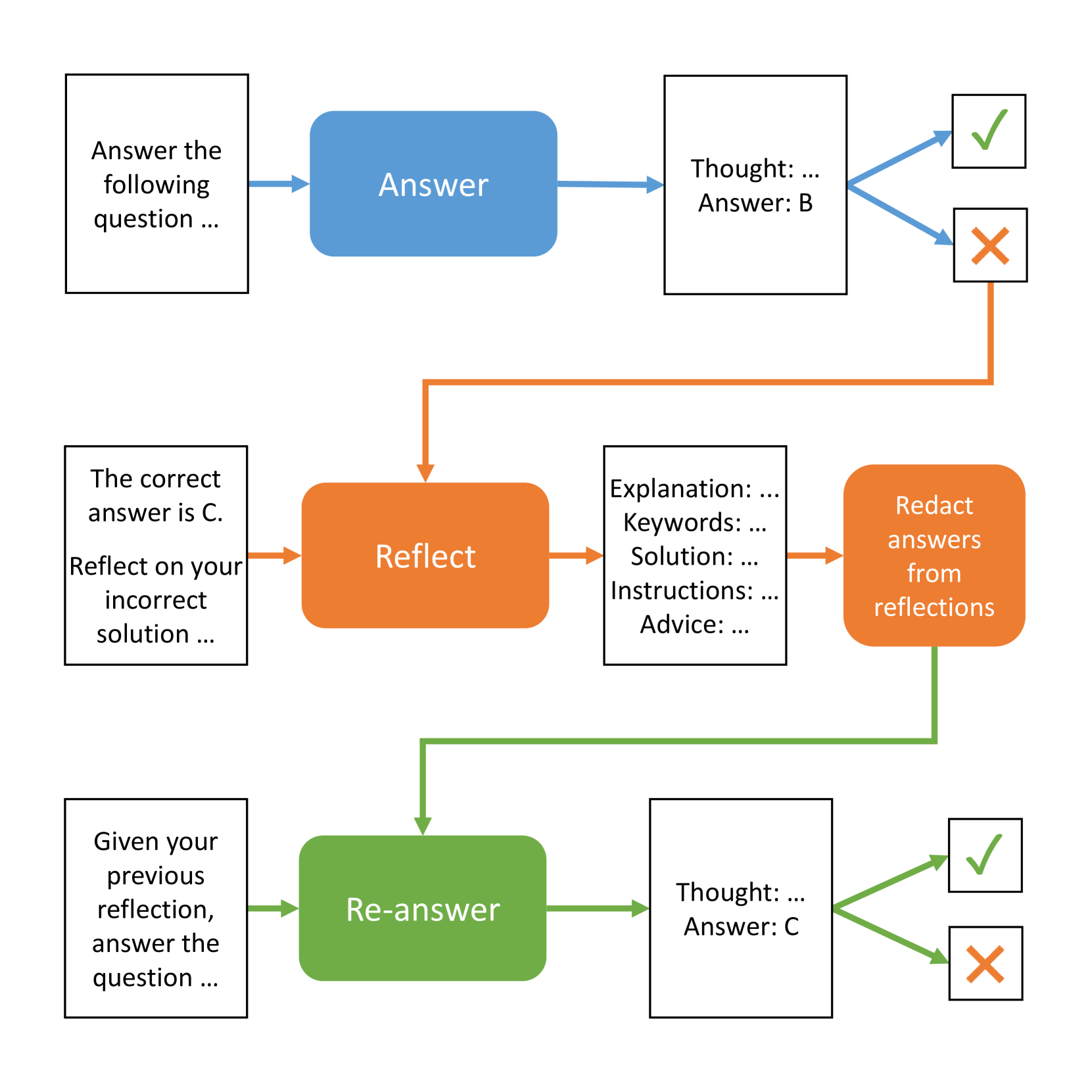
The image displays a three-stage flowchart illustrating a process for answering questions, receiving feedback on incorrect answers, reflecting on the error, and then re-answering. The process is color-coded by stage: blue for the initial answer, orange for reflection, and green for the re-answer. The flow is primarily left-to-right and top-to-bottom, with a critical feedback loop from an incorrect outcome back to the reflection stage.
### Components/Axes
The diagram is composed of rectangular boxes (some with rounded corners) connected by directional arrows. The boxes contain textual instructions or outputs. The arrows indicate the flow of the process.
**Color Legend (Implied by Stage):**
* **Blue:** Initial Answer Stage
* **Orange:** Reflection Stage
* **Green:** Re-answer Stage
* **Green Checkmark (✓):** Symbol for a correct outcome.
* **Red Cross (✗):** Symbol for an incorrect outcome.
**Spatial Layout:**
* The diagram is divided into three horizontal bands or "swimlanes," one for each major stage.
* The **Initial Answer (Blue)** stage occupies the top band.
* The **Reflection (Orange)** stage occupies the middle band.
* The **Re-answer (Green)** stage occupies the bottom band.
* A feedback arrow (orange) connects the incorrect outcome (✗) of the first stage to the input of the Reflection stage.
### Detailed Analysis
**Stage 1: Initial Answer (Top Band, Blue Flow)**
1. **Input Box (Top-Left):** A standard rectangle containing the text: `Answer the following question ...`
2. **Process Box (Top-Center):** A blue, rounded rectangle labeled `Answer`.
3. **Output Box (Top-Right):** A standard rectangle containing the text:
`Thought: ...`
`Answer: B`
4. **Decision Point:** Two arrows branch from the Output Box:
* An arrow points to a small square containing a **green checkmark (✓)**, representing a correct answer.
* An arrow points to a small square containing a **red cross (✗)**, representing an incorrect answer.
**Stage 2: Reflection (Middle Band, Orange Flow)**
* **Trigger:** An orange arrow originates from the **red cross (✗)** in Stage 1 and points to the input of this stage.
1. **Input Box (Middle-Left):** A standard rectangle containing the text:
`The correct answer is C.`
`Reflect on your incorrect solution ...`
2. **Process Box (Middle-Center):** An orange, rounded rectangle labeled `Reflect`.
3. **Output Box (Middle-Right):** A standard rectangle containing a structured list:
`Explanation: ...`
`Keywords: ...`
`Solution: ...`
`Instructions: ...`
`Advice: ...`
4. **Process Box (Far-Right):** An orange, rounded rectangle labeled `Redact answers from reflections`.
**Stage 3: Re-answer (Bottom Band, Green Flow)**
* **Trigger:** A green arrow originates from the "Redact answers from reflections" box in Stage 2 and points to the input of this stage.
1. **Input Box (Bottom-Left):** A standard rectangle containing the text: `Given your previous reflection, answer the question ...`
2. **Process Box (Bottom-Center):** A green, rounded rectangle labeled `Re-answer`.
3. **Output Box (Bottom-Right):** A standard rectangle containing the text:
`Thought: ...`
`Answer: C`
4. **Decision Point:** Two arrows branch from this Output Box:
* An arrow points to a small square containing a **green checkmark (✓)**.
* An arrow points to a small square containing a **red cross (✗)**.
### Key Observations
1. **Iterative Correction Loop:** The core mechanism is a loop triggered by an incorrect answer (✗). The process does not end on failure but routes to a dedicated reflection and correction phase.
2. **Structured Reflection:** The reflection output is not free-form; it is categorized into specific components (Explanation, Keywords, Solution, Instructions, Advice), suggesting a methodical analysis of the error.
3. **Redaction Step:** The "Redact answers from reflections" step is crucial. It implies that the raw reflection may contain the incorrect answer or other information that must be filtered out before attempting to re-answer, preventing the model from simply repeating its mistake.
4. **Color-Coded State Tracking:** The consistent use of blue, orange, and green for arrows and process boxes provides a clear visual cue for which phase of the process is active.
5. **Identical Structure, Different Content:** The input/output boxes for Stage 1 and Stage 3 are structurally identical, but the content differs. Stage 3's input explicitly references the prior reflection, and its output shows a corrected answer (`Answer: C`), demonstrating the intended outcome of the process.
### Interpretation
This flowchart models a **self-correcting learning system**, likely for a language model or AI agent. It formalizes a "chain of thought" or "self-reflection" technique aimed at improving accuracy.
* **What it demonstrates:** The process explicitly separates *answering*, *error diagnosis*, and *corrected answering*. It moves beyond simple trial-and-error by instituting a mandatory, structured reflection phase upon failure. The redaction step is particularly insightful, as it acknowledges that the model's internal reasoning (the reflection) might be contaminated by its initial incorrect hypothesis and must be sanitized.
* **How elements relate:** The flow is causal and conditional. The initial answer's correctness determines the path. The reflection stage is entirely dependent on an incorrect outcome. The re-answer stage is dependent on the processed output of the reflection. This creates a closed-loop system for improvement.
* **Notable implications:** This diagram is a blueprint for building more robust and reliable AI systems. It operationalizes the concept of "learning from mistakes" within a single inference cycle. The final green checkmark (✓) in the Re-answer stage represents the system's goal: achieving the correct answer (`C`) not on the first try, but through a structured process of error and correction. The presence of a potential second red cross (✗) in the final stage also honestly acknowledges that the correction process itself may not always succeed, implying the loop could, in theory, be repeated.