## Image Processing Sequence: Iterative Noise Reduction on a Handwritten Digit
### Overview
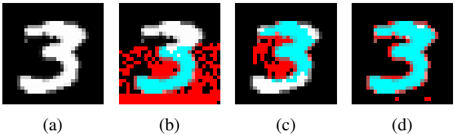
The image displays a sequence of four horizontally arranged panels, labeled (a) through (d), illustrating a progressive image processing or segmentation operation on a pixelated, handwritten digit "3". The sequence demonstrates the isolation of the primary digit (foreground) from background noise or artifacts.
### Components/Axes
* **Panel Layout:** Four square panels arranged in a single row from left to right.
* **Labels:** Each panel has a lowercase letter label centered beneath it: `(a)`, `(b)`, `(c)`, `(d)`.
* **Color Scheme (Inferred Legend):**
* **Cyan/Light Blue:** Represents the target foreground object (the digit "3").
* **Red:** Represents identified noise, artifacts, or background pixels to be removed.
* **White/Grayscale:** Present in the initial panel, representing the original pixel intensity values.
* **Black:** Represents the background.
### Detailed Analysis
The sequence shows a clear, stepwise progression:
* **Panel (a) - Original Input:**
* **Content:** A grayscale, pixelated image of the digit "3". The digit is rendered in white and light gray pixels against a black background. There is visible "noise" or imperfection, seen as scattered gray pixels around the main stroke of the digit.
* **Trend/State:** Baseline input with no color segmentation applied.
* **Panel (b) - Initial Segmentation/Noise Identification:**
* **Content:** The image is now color-segmented. The core shape of the digit "3" is colored in solid cyan. A significant amount of red pixels are scattered densely around and within the digit's structure, particularly in the lower half and the interior curve. These red pixels correspond to the noisy gray areas from panel (a).
* **Trend:** A large quantity of pixels have been classified as noise (red). The segmentation appears coarse, flagging many pixels that are part of the digit's anti-aliased edges.
* **Panel (c) - Intermediate Refinement:**
* **Content:** The amount of red noise pixels is substantially reduced compared to panel (b). The cyan digit shape is cleaner and more defined. Some red pixels remain, primarily clustered in the lower-left interior curve of the "3" and a few scattered on the outer edges.
* **Trend:** A clear reduction in red (noise) pixels, indicating a filtering or refinement step has been applied. The digit's form is becoming more precise.
* **Panel (d) - Final Output / Cleaned Result:**
* **Content:** The image shows the cyan digit "3" with only a very small number of isolated red pixels remaining (approximately 5-10 visible). The digit's shape is now clean and well-defined against the black background.
* **Trend:** The noise reduction process appears largely complete. The final output is a segmented, clean representation of the digit.
### Key Observations
1. **Spatial Consistency:** The core shape and position of the digit "3" remain perfectly aligned across all four panels, confirming they are iterations on the same source image.
2. **Noise Distribution:** In panel (b), the red noise is not uniformly distributed; it is heavily concentrated in regions where the original grayscale image (a) had lower-contrast, fuzzy edges (e.g., the bottom curve and interior).
3. **Progressive Cleaning:** The process is iterative. The jump from (b) to (c) removes the bulk of the noise, while the step from (c) to (d) performs fine-grained cleanup.
4. **Color as Classification:** The use of distinct, non-grayscale colors (cyan and red) is a visualization technique to clearly separate the algorithm's classification of "foreground object" vs. "noise/artifact."
### Interpretation
This sequence visually documents the stages of an image segmentation or denoising algorithm, likely applied in the context of optical character recognition (OCR) or computer vision preprocessing.
* **What it demonstrates:** The algorithm successfully identifies and isolates the primary structure of a handwritten digit from a noisy, low-resolution input. The progression from (a) to (d) shows the transformation from raw pixel data to a cleaned, classified output suitable for further analysis.
* **Relationship between elements:** Panel (a) is the input. Panels (b), (c), and (d) represent successive states of an algorithmic process, where red pixels are iteratively identified and removed based on some criteria (e.g., intensity, connectivity, or predicted probability). The cyan region is the preserved "signal."
* **Notable pattern:** The algorithm appears to first make a broad, conservative classification (marking many potential noise pixels in red in panel b), then refine this classification in subsequent steps to avoid eroding the true digit structure. This is a common strategy to balance noise removal with feature preservation.
* **Underlying purpose:** The final panel (d) represents the ideal input for a classifier: a clean, binary (foreground/background) representation of the character, which would significantly improve the accuracy of a subsequent digit recognition model compared to using the noisy original from panel (a).