## Heatmap: Similarity Matrices for Network Security
### Overview
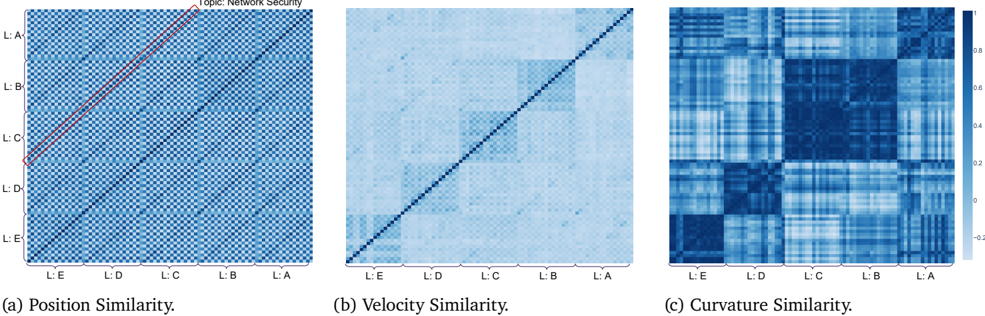
The image presents three heatmaps visualizing the similarity between different elements (A, B, C, D, E) within the context of "Network Security". The heatmaps represent position similarity, velocity similarity, and curvature similarity, respectively. The color intensity indicates the degree of similarity, with darker shades representing higher similarity.
### Components/Axes
* **Labels (Y-axis):** L: A, L: B, L: C, L: D, L: E (from top to bottom)
* **Labels (X-axis):** L: E, L: D, L: C, L: B, L: A (from left to right)
* **Color Scale (Right of Curvature Similarity):** Ranges from approximately -0.2 to 0.8, with darker blue indicating higher values.
* **Titles:**
* (a) Position Similarity.
* (b) Velocity Similarity.
* (c) Curvature Similarity.
* **Topic (Top-left of Position Similarity):** Topic: Network Security
### Detailed Analysis
#### (a) Position Similarity
* The heatmap displays a checkerboard pattern.
* The diagonal from the top-left (A, E) to the bottom-right (E, A) shows a consistent pattern.
* The similarity between adjacent elements (e.g., A and B, B and C) appears relatively consistent.
* The color intensity alternates between lighter and darker shades of blue, creating the checkerboard effect.
#### (b) Velocity Similarity
* The heatmap shows a strong diagonal from the top-left (A, E) to the bottom-right (E, A), indicating high similarity in velocity for the same elements.
* The off-diagonal elements show lower similarity compared to the diagonal.
* The overall color intensity is lighter compared to the position similarity heatmap.
* There are some blocks of higher similarity off the diagonal, suggesting some correlation in velocity between different elements.
#### (c) Curvature Similarity
* The heatmap shows a more complex pattern compared to the other two.
* There are distinct blocks of high and low similarity.
* The top-left corner (A, E to B, D) shows high similarity.
* The bottom-right corner (D, B to E, A) also shows high similarity.
* The off-diagonal elements show varying degrees of similarity, with some areas showing high correlation and others showing low correlation.
* The color scale indicates that the similarity values range from approximately -0.2 to 0.8.
### Key Observations
* **Position Similarity:** Shows a regular, repeating pattern, suggesting a structured relationship between the elements' positions.
* **Velocity Similarity:** Highlights the self-similarity of elements' velocities, with some degree of correlation between different elements.
* **Curvature Similarity:** Reveals a more complex relationship, with distinct clusters of high and low similarity, indicating that curvature is a more differentiating factor.
### Interpretation
The heatmaps provide insights into the relationships between different elements (A, B, C, D, E) within a network security context, based on their position, velocity, and curvature.
* The **position similarity** suggests a structured arrangement or interaction pattern among the elements. The checkerboard pattern might indicate alternating states or roles.
* The **velocity similarity** emphasizes the consistency of each element's own velocity, but also reveals some correlation between different elements, possibly due to coordinated actions or dependencies.
* The **curvature similarity** is the most informative, as it highlights distinct clusters of high and low similarity. This suggests that curvature is a key differentiating factor, potentially reflecting different behaviors or roles within the network. The high similarity in the top-left and bottom-right corners might indicate that elements in those groups share similar curvature characteristics.
The data suggests that while position and velocity provide some insights, curvature is the most discriminating feature for understanding the relationships between elements in the network security context. Further investigation into the specific meanings of "position," "velocity," and "curvature" in this context would be necessary to fully interpret the results.