\n
## Diagram: Knowledge Graph Trie Caching System
### Overview
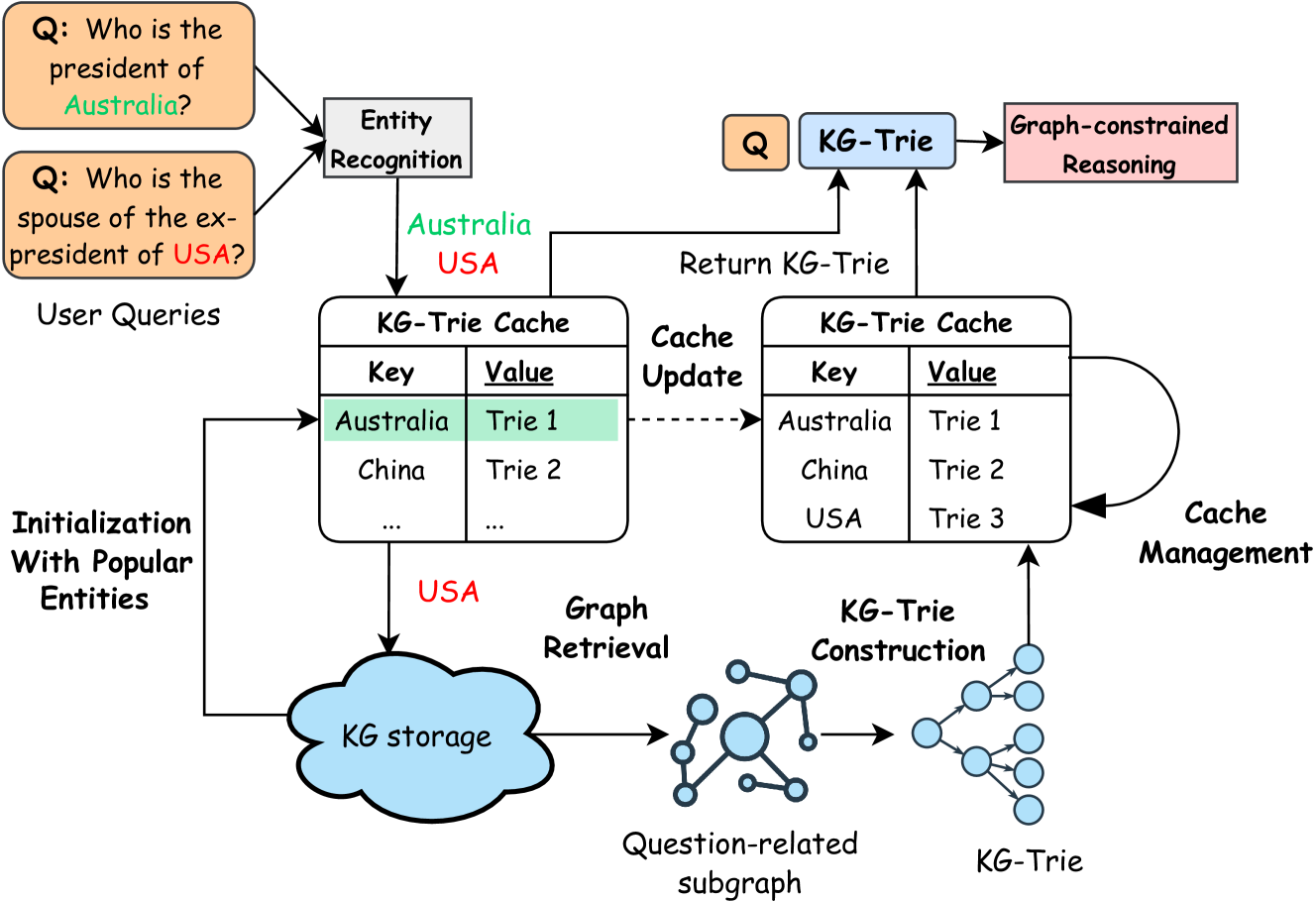
This diagram illustrates a system for caching Knowledge Graph (KG) Tries to accelerate question answering. The system takes user queries, performs entity recognition, retrieves relevant subgraphs from KG storage, constructs KG-Tries, caches them, and then uses graph-constrained reasoning to answer the query. The diagram shows the flow of data and control between different components.
### Components/Axes
The diagram consists of the following components:
* **User Queries:** Represented by two example questions: "Who is the president of Australia?" and "Who is the spouse of the ex-president of USA?".
* **Entity Recognition:** A box labeled "Entity Recognition" that identifies entities in the user queries.
* **KG-Trie Cache (x2):** Two rectangular boxes labeled "KG-Trie Cache" representing the cache storage. Each cache contains a "Key" and "Value" column.
* **KG Storage:** A cloud-shaped object labeled "KG storage" representing the main knowledge graph database.
* **Question-related subgraph:** A network of nodes and edges representing a subgraph extracted from the KG storage.
* **KG-Trie:** A tree-like structure representing the KG-Trie constructed from the subgraph.
* **Cache Management:** A box labeled "Cache Management" that handles cache updates.
* **Graph-constrained Reasoning:** A box labeled "Graph-constrained Reasoning" that uses the KG-Trie to answer the query.
The diagram also includes directional arrows indicating the flow of data and control.
### Detailed Analysis or Content Details
**1. User Queries:**
* Query 1: "Who is the president of Australia?"
* Query 2: "Who is the spouse of the ex-president of USA?"
**2. Entity Recognition:**
* Identified entities: Australia, USA.
**3. KG-Trie Cache (Initialization):**
* Key: Australia, Value: Trie 1
* Key: China, Value: Trie 2
* Key: ..., Value: ... (Indicates more entries exist)
**4. KG-Trie Cache (After Update):**
* Key: Australia, Value: Trie 1
* Key: China, Value: Trie 2
* Key: USA, Value: Trie 3
**5. KG Storage:**
* The KG storage is represented as a cloud, implying a large and complex knowledge graph.
**6. Graph Retrieval:**
* The arrow from KG storage to "Question-related subgraph" indicates that a relevant subgraph is retrieved based on the identified entities.
**7. KG-Trie Construction:**
* The arrow from "Question-related subgraph" to "KG-Trie" indicates that a KG-Trie is constructed from the subgraph.
**8. Cache Update:**
* A dashed arrow from the first "KG-Trie Cache" to the second "KG-Trie Cache" indicates a cache update process.
**9. Graph-constrained Reasoning:**
* The arrow from "KG-Trie" to "Graph-constrained Reasoning" indicates that the KG-Trie is used for reasoning.
### Key Observations
* The system utilizes a cache to store KG-Tries for frequently accessed entities (Australia, China, USA).
* The cache is updated when new queries require the construction of new KG-Tries.
* The system retrieves relevant subgraphs from the KG storage based on the entities identified in the user queries.
* The KG-Trie structure is used to facilitate graph-constrained reasoning.
* The diagram shows a two-stage caching process, potentially for redundancy or different caching strategies.
### Interpretation
The diagram illustrates a system designed to improve the efficiency of question answering over a knowledge graph. By caching KG-Tries, the system avoids the need to repeatedly retrieve and construct these structures for common entities. This caching mechanism significantly reduces the latency of query processing. The use of graph-constrained reasoning suggests that the system leverages the relationships within the knowledge graph to provide more accurate and informative answers. The two-stage caching system might be implemented to handle cache misses or to provide a backup in case of cache failures. The diagram highlights the key components and data flow involved in this process, providing a clear understanding of how the system operates. The system is designed to handle natural language queries, extract relevant entities, and utilize a knowledge graph to provide answers. The diagram does not provide specific performance metrics or scalability information, but it suggests a well-structured and optimized approach to knowledge graph-based question answering.