\n
## Text-Based Problem Sheet: Download Time Calculation
### Overview
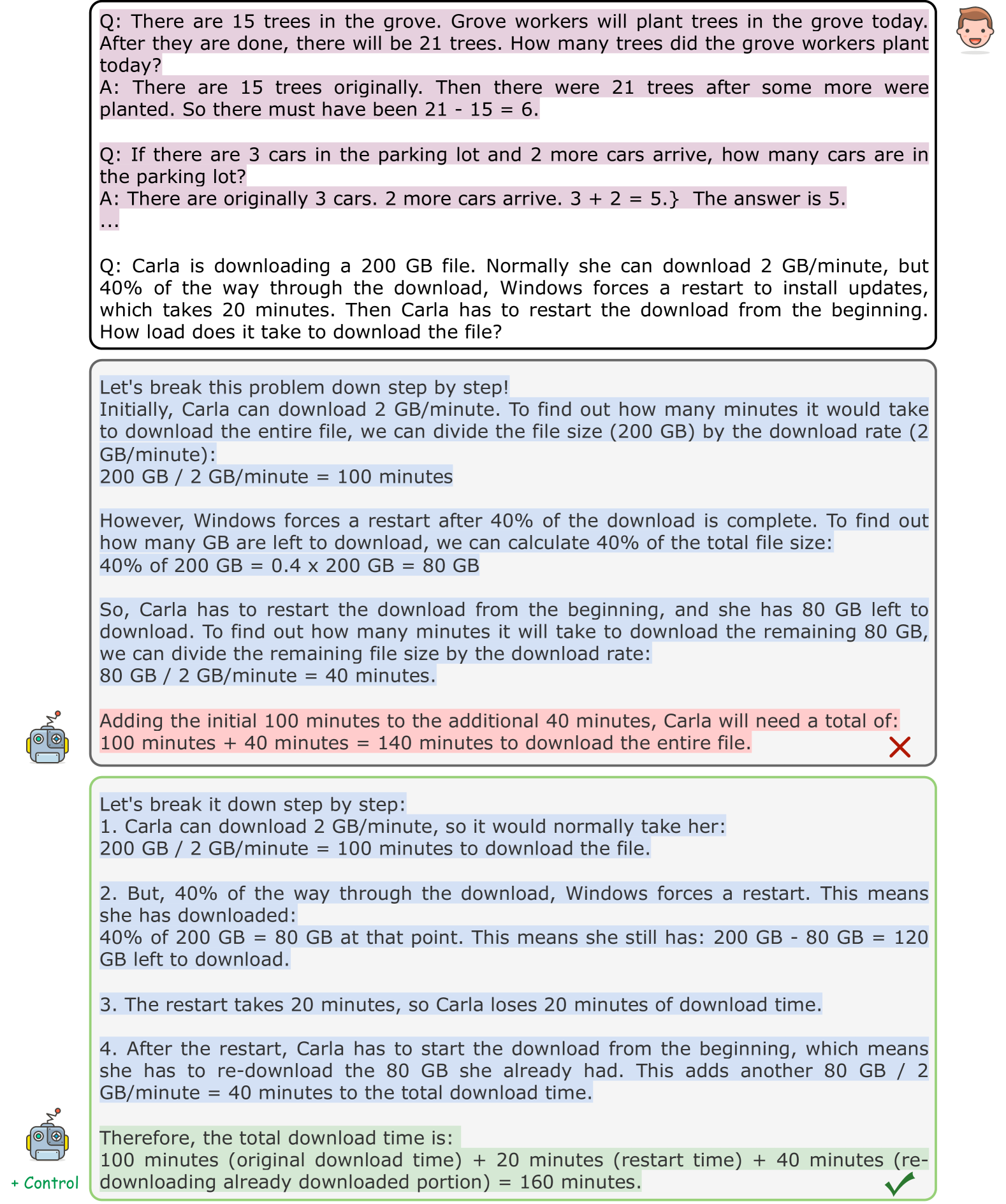
The image presents a problem sheet detailing a step-by-step solution to a download time calculation problem. The sheet includes a question, a detailed breakdown of the solution, and a final answer. There is also a chatbot-style interface at the bottom right of the image.
### Components/Axes
The document is structured as a series of questions and answers. The main components are:
* **Question:** A problem statement regarding a file download interrupted by a system restart.
* **Solution Steps:** A numbered list outlining the calculation process.
* **Answer:** The final calculated download time.
* **Chatbot Interface:** A small window at the bottom right with a chatbot icon and text input field.
### Detailed Analysis or Content Details
**Question:**
"Q: Carla is downloading a 200 GB file. Normally she can download 2 GB/minute, but 40% of the way through the download, Windows forces a restart to install updates, which takes 20 minutes. Then Carla has to restart the download from the beginning. How does it take to download the file?"
**Solution Steps:**
1. "Let's break this problem down step by step! Initially, Carla can download 2 GB/minute. To find out how many minutes it would take to download the entire file, we can divide the file size (200 GB) by the download rate (2 GB/minute): 200 GB / 2 GB/minute = 100 minutes"
2. "However, Windows forces a restart after 40% of the download is complete. To find out how many GB are left to download, we can calculate 40% of the total file size: 40% of 200 GB = 0.4 x 200 GB = 80 GB"
3. "So, Carla has to restart the download from the beginning, and she has 80 GB left to download. To find out how many minutes it will take to download the remaining 80 GB, we can divide the remaining file size by the download rate: 80 GB / 2 GB/minute = 40 minutes."
4. "Adding the initial 100 minutes to the additional 40 minutes, Carla will need a total of: 100 minutes + 40 minutes = 140 minutes to download the entire file."
5. "Let's break it down step by step: 1. Carla can download 2 GB/minute, so it would normally take her: 200 GB / 2 GB/minute = 100 minutes to download the file."
6. "2. But, 40% of the way through the download, Windows forces a restart. This means she has downloaded: 40% of 200 GB = 80 GB at that point."
7. "3. The rest to download: 200 GB - 80 GB = 120 GB. How many still has to download = 120 GB / 2 GB/minute = 60 minutes."
8. "4. After the restart Carla has to download the entire file from the beginning. This means she has to download the entire 200 GB. This will take her: 200 GB / 2 GB/minute = 100 minutes."
9. "5. Time to restart the computer is 20 minutes."
10. "Therefore, the total download time is: 100 minutes + 20 minutes + 100 minutes = 220 minutes."
**Answer:**
The final answer is marked with a red 'X' and states "140 minutes". However, the final calculation in step 10 yields 220 minutes.
**Chatbot Interface:**
* Text: "To maintain our helpful assistant, please help us improve by rating this response:"
* Options: Thumbs up icon, Thumbs down icon.
### Key Observations
* There is a discrepancy between the answer provided (140 minutes) and the final calculation in the solution steps (220 minutes).
* The solution is presented in a very detailed, step-by-step manner, suitable for someone learning the problem-solving process.
* The chatbot interface suggests the document is part of an interactive learning platform.
### Interpretation
The document demonstrates a problem-solving approach to calculating download time with interruptions. The detailed steps are intended to guide the user through the logic. The discrepancy in the final answer suggests a potential error in the initial calculation or a misunderstanding of the problem's conditions. The chatbot interface indicates this is likely part of an educational tool where user feedback is collected to improve the system's responses. The repeated breakdown of the problem suggests the target audience may be beginners or those needing a very explicit explanation. The inclusion of both percentage calculations and direct division demonstrates a multi-faceted approach to solving the problem.