\n
## Diagram: Categorization of Problematic Online Content
### Overview
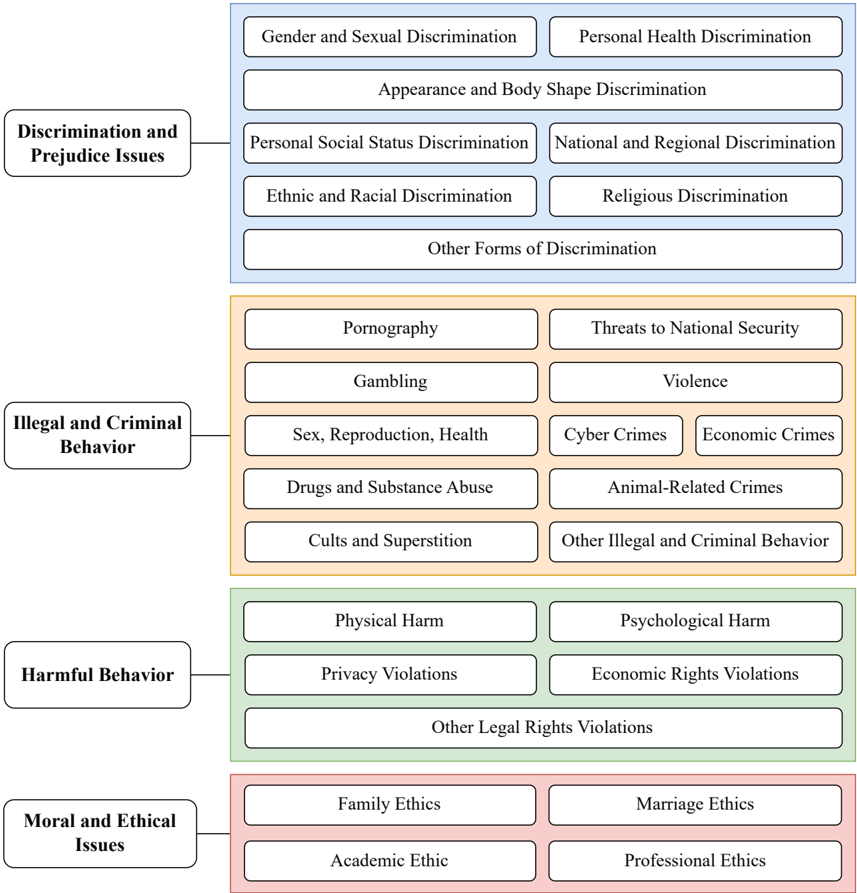
The image presents a diagram categorizing different types of problematic online content into four main groups: Discrimination and Prejudice Issues, Illegal and Criminal Behavior, Harmful Behavior, and Moral and Ethical Issues. Each main category is further divided into several sub-categories, represented as rectangular blocks. The diagram appears to be a visual framework for classifying online content based on its nature and potential harm.
### Components/Axes
The diagram is structured around four primary categories, positioned vertically. Each category has a label in a dark blue box on the left side. Within each category, several sub-categories are arranged horizontally in light blue or light orange rectangular blocks. There are no explicit axes in the traditional sense, but the vertical arrangement represents a broad classification scheme, and the horizontal arrangement represents specific instances within each category.
### Detailed Analysis or Content Details
**1. Discrimination and Prejudice Issues (Dark Blue)**
* Gender and Sexual Discrimination
* Personal Health Discrimination
* Appearance and Body Shape Discrimination
* Personal Social Status Discrimination
* National and Regional Discrimination
* Ethnic and Racial Discrimination
* Religious Discrimination
* Other Forms of Discrimination
**2. Illegal and Criminal Behavior (Dark Blue)**
* Pornography
* Threats to National Security
* Gambling
* Violence
* Sex, Reproduction, Health
* Cyber Crimes
* Economic Crimes
* Drugs and Substance Abuse
* Animal-Related Crimes
* Cults and Superstition
* Other Illegal and Criminal Behavior
**3. Harmful Behavior (Dark Blue)**
* Physical Harm
* Psychological Harm
* Privacy Violations
* Economic Rights Violations
* Other Legal Rights Violations
**4. Moral and Ethical Issues (Dark Red)**
* Family Ethics
* Marriage Ethics
* Academic Ethic
* Professional Ethics
The background color of each main category is different: light grey for Discrimination, light orange for Illegal/Criminal, light green for Harmful, and light pink for Moral/Ethical.
### Key Observations
The diagram provides a comprehensive, though not exhaustive, list of problematic online content. The categorization is somewhat subjective, as some issues could potentially fall into multiple categories (e.g., cybercrimes related to discrimination). The "Other..." categories within each section suggest that the list is not intended to be fully inclusive. The color coding of the main categories helps to visually distinguish between the different types of issues.
### Interpretation
This diagram likely serves as a framework for content moderation, policy development, or legal classification of online content. It highlights the diverse range of harmful and problematic behaviors that can occur online. The categorization suggests an attempt to create a structured approach to addressing these issues. The inclusion of "Other..." categories acknowledges the evolving nature of online harms and the need for flexibility in classification. The diagram implies a hierarchical structure, with broad categories encompassing more specific instances of problematic content. The use of different colors for the main categories may indicate varying levels of severity or different regulatory approaches. The diagram doesn't provide any quantitative data or trends, but rather a qualitative overview of the landscape of online harms.