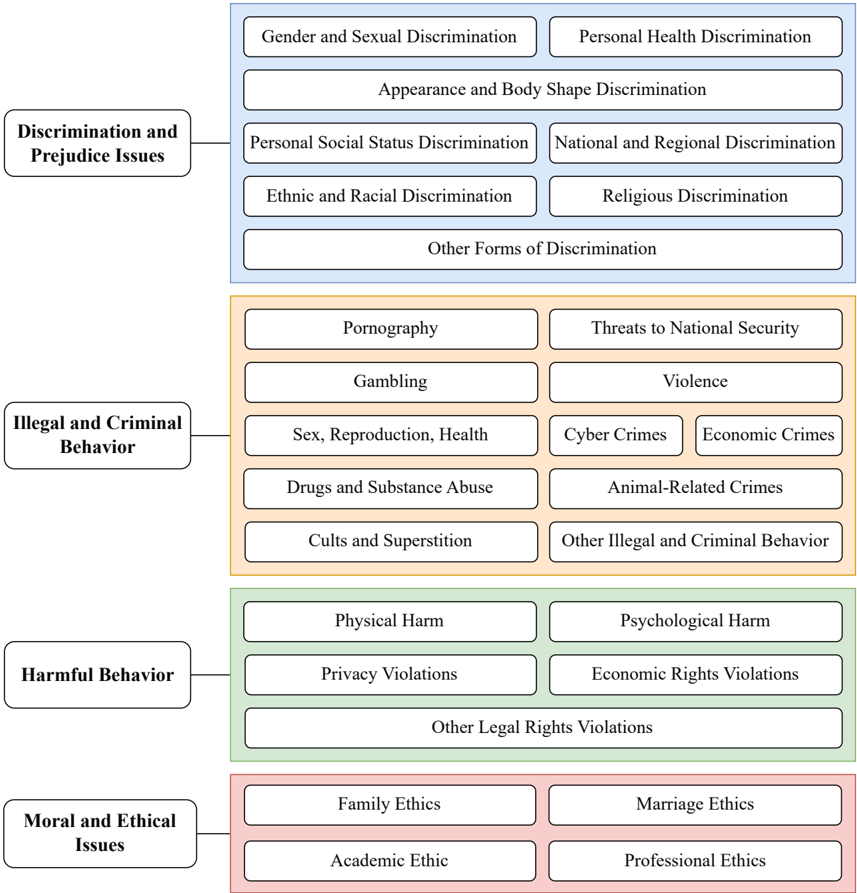
## Diagram: Categorization of Sensitive Content Issues
### Overview
The image is a hierarchical classification diagram, likely for content moderation, policy frameworks, or ethical guidelines. It organizes various types of sensitive or problematic content into four primary categories, each with a set of specific subcategories. The diagram uses a left-to-right flow, with main category labels on the left connected to grouped subcategories on the right, which are visually distinguished by colored background boxes.
### Components/Axes
The diagram has no numerical axes or data points. Its components are textual labels organized in a tree structure.
**Primary Categories (Left Column):**
1. **Discrimination and Prejudice Issues** (Top, connected to a light blue box)
2. **Illegal and Criminal Behavior** (Second, connected to a light orange box)
3. **Harmful Behavior** (Third, connected to a light green box)
4. **Moral and Ethical Issues** (Bottom, connected to a light pink box)
**Subcategory Groupings (Right Column, within colored boxes):**
* **Light Blue Box (for Discrimination and Prejudice Issues):** Contains 8 subcategories arranged in a grid.
* **Light Orange Box (for Illegal and Criminal Behavior):** Contains 12 subcategories arranged in a grid.
* **Light Green Box (for Harmful Behavior):** Contains 5 subcategories arranged in a grid.
* **Light Pink Box (for Moral and Ethical Issues):** Contains 4 subcategories arranged in a grid.
### Detailed Analysis
**1. Discrimination and Prejudice Issues (Light Blue Box)**
* **Subcategories (Top to Bottom, Left to Right):**
* Gender and Sexual Discrimination
* Personal Health Discrimination
* Appearance and Body Shape Discrimination
* Personal Social Status Discrimination
* National and Regional Discrimination
* Ethnic and Racial Discrimination
* Religious Discrimination
* Other Forms of Discrimination
**2. Illegal and Criminal Behavior (Light Orange Box)**
* **Subcategories (Top to Bottom, Left to Right):**
* Pornography
* Threats to National Security
* Gambling
* Violence
* Sex, Reproduction, Health
* Cyber Crimes
* Economic Crimes
* Drugs and Substance Abuse
* Animal-Related Crimes
* Cults and Superstition
* Other Illegal and Criminal Behavior
**3. Harmful Behavior (Light Green Box)**
* **Subcategories (Top to Bottom, Left to Right):**
* Physical Harm
* Psychological Harm
* Privacy Violations
* Economic Rights Violations
* Other Legal Rights Violations
**4. Moral and Ethical Issues (Light Pink Box)**
* **Subcategories (Top to Bottom, Left to Right):**
* Family Ethics
* Marriage Ethics
* Academic Ethic
* Professional Ethics
### Key Observations
* **Hierarchical Structure:** The diagram presents a clear two-level hierarchy: broad categories on the left and specific instances on the right.
* **Visual Grouping:** Color-coding (blue, orange, green, pink) is used effectively to visually separate and associate subcategories with their parent category.
* **Comprehensiveness:** The categories aim to be exhaustive, as indicated by the inclusion of "Other..." subcategories in three of the four main groups (Discrimination, Illegal Behavior, Harmful Behavior).
* **Layout:** The subcategories are neatly arranged in a grid-like pattern within their colored boxes, suggesting an organized taxonomy. The "Illegal and Criminal Behavior" section is the most densely populated.
### Interpretation
This diagram serves as a **taxonomy for classifying sensitive or prohibited content**. Its structure suggests it could be the foundational framework for:
* **Content Moderation Policies:** Defining what types of content a platform must identify and act upon.
* **Risk Assessment Matrices:** Categorizing potential harms for evaluation.
* **Ethical or Legal Compliance Checklists:** Ensuring systems or policies address a wide spectrum of issues.
The relationships are purely categorical and hierarchical. The primary categories move from societal-level issues (Discrimination) to legal violations (Illegal Behavior), to direct harms (Harmful Behavior), and finally to normative social codes (Moral/Ethical Issues). This progression may reflect a prioritization from externally enforced laws to internally governed norms.
**Notable Anomalies/Observations:**
* The category "Sex, Reproduction, Health" under "Illegal and Criminal Behavior" is interesting. It implies that in the context this diagram was created for, certain topics related to sex and health are considered inherently criminal or illegal, which may point to a specific regional or platform-specific policy context.
* The separation of "Harmful Behavior" from "Illegal and Criminal Behavior" is significant. It acknowledges that actions can cause harm (e.g., privacy violations, psychological harm) without necessarily being classified as a crime in all jurisdictions, highlighting a focus on impact rather than just legal status.
* The "Moral and Ethical Issues" category deals with interpersonal and professional conduct, suggesting the framework extends beyond public content to potentially govern user interactions or professional behavior within a system.
In essence, this is a **mapping of societal taboos, legal prohibitions, and ethical boundaries** into a structured format, likely intended to guide automated systems or human reviewers in making consistent judgments about content or behavior.