TECHNICAL ASSET FINGERPRINT
b6a8fcb0ee9f86e56828f52f
Click to view fullscreen
Press ESC or click to close
FOUND IN PAPERS
EXPERT: healer-alpha-free VERSION 1
RUNTIME: free/openrouter/healer-alpha
INTEL_VERIFIED
## Diagram: Contrasting World Models in AI — Naive Realism vs. Emptiness Prior
### Overview
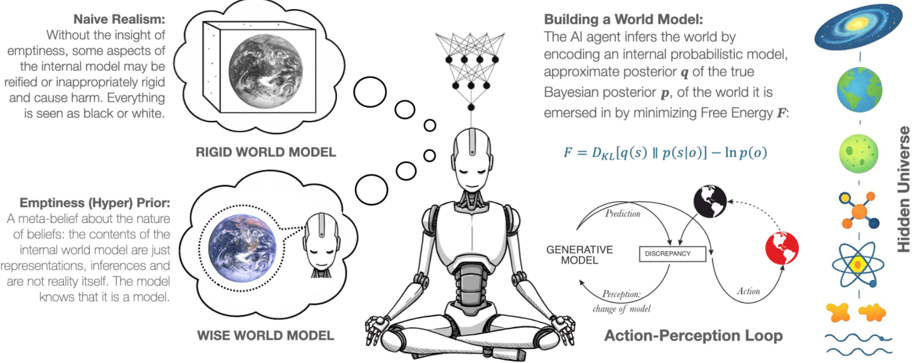
This is a conceptual diagram illustrating two contrasting philosophical approaches to how an AI agent might model the world, centered around a meditating humanoid robot. The left side contrasts a "Rigid World Model" (based on Naive Realism) with a "Wise World Model" (based on an Emptiness or Hyper Prior). The right side explains the process of "Building a World Model" using probabilistic inference and Free Energy minimization, connected to an "Action-Perception Loop." A vertical strip on the far right, labeled "Hidden Universe," depicts various scales of reality.
### Components/Axes
The diagram is organized into three main regions:
1. **Left Region (Two Contrasting Models):**
* **Top Thought Bubble (Rigid World Model):**
* **Label:** `Naive Realism:`
* **Text:** `Without the insight of emptiness, some aspects of the internal model may be reified or inappropriately rigid and cause harm. Everything is seen as black or white.`
* **Visual:** A thought bubble containing a 3D wireframe cube enclosing a photorealistic image of Earth.
* **Bottom Thought Bubble (Wise World Model):**
* **Label:** `Emptiness (Hyper) Prior:`
* **Text:** `A meta-belief about the nature of beliefs: the contents of the internal world model are just representations, inferences and are not reality itself. The model knows that it is a model.`
* **Visual:** A thought bubble containing a dotted-outline circle enclosing a photorealistic image of Earth, with a small icon of the meditating robot's head inside the circle, looking at the Earth.
2. **Central Region:**
* **Visual:** A detailed line drawing of a humanoid robot sitting in a cross-legged, meditative pose. It is the focal point, with thought bubbles connecting to the left-side models and a neural network diagram above its head connecting to the right-side explanation.
3. **Right Region (Model Building Process):**
* **Header:** `Building a World Model:`
* **Descriptive Text:** `The AI agent infers the world by encoding an internal probabilistic model, approximate posterior q of the true Bayesian posterior p, of the world it is emerged in by minimizing Free Energy F:`
* **Mathematical Formula:** `F = D_KL[q(s) || p(s|o)] - ln p(o)`
* **Action-Perception Loop Diagram:**
* **Components:** A cycle with four labeled nodes: `GENERATIVE MODEL`, `DISCREPANCY`, `Action`, and `Perception`.
* **Flow Arrows & Labels:**
* `Prediction` (from GENERATIVE MODEL to DISCREPANCY)
* `change of model` (from Perception to GENERATIVE MODEL)
* `Action` (from DISCREPANCY to a red globe icon)
* `Perception` (from the red globe icon back to DISCREPANCY)
* **Icons:** A black-and-white globe icon (top) and a red globe icon (right) are part of the loop.
* **Far Right Vertical Strip:**
* **Label (rotated text):** `Hidden Universe`
* **Icons (from top to bottom):** A spiral galaxy, planet Earth, a green cell-like sphere, a molecular model, an atom model, two puzzle pieces, and wavy lines.
### Detailed Analysis
* **Text Transcription:** All text in the image is in English. The transcription is provided verbatim in the Components section above.
* **Mathematical Formula:** The Free Energy formula is transcribed as `F = D_KL[q(s) || p(s|o)] - ln p(o)`. `D_KL` denotes the Kullback-Leibler divergence. `q(s)` is the approximate posterior, `p(s|o)` is the true posterior given observations `o`, and `ln p(o)` is the log model evidence.
* **Spatial Grounding:**
* The "Naive Realism" text and its associated "Rigid World Model" bubble are in the **top-left** quadrant.
* The "Emptiness (Hyper) Prior" text and its "Wise World Model" bubble are in the **bottom-left** quadrant.
* The meditating robot is **centered**.
* The "Building a World Model" header and formula are in the **top-right** quadrant.
* The "Action-Perception Loop" diagram is in the **bottom-right** quadrant.
* The "Hidden Universe" strip runs along the **far-right edge**.
* **Component Relationships:** The central robot is visually linked to both world models (via thought bubbles) and to the model-building process (via a neural network diagram above its head connecting to the text). The "Action-Perception Loop" is presented as the mechanism through which the world model is built and refined.
### Key Observations
1. **Philosophical Dichotomy:** The core of the diagram is a contrast between two meta-cognitive stances for an AI: one that mistakes its model for reality ("Naive Realism") and one that maintains awareness of its model's representational nature ("Emptiness Prior").
2. **Visual Metaphors for Models:**
* The **Rigid World Model** is depicted as Earth trapped inside a hard, geometric cube, symbolizing reification and inflexibility.
* The **Wise World Model** shows Earth within a permeable, dotted boundary, with the AI's own icon inside observing it, symbolizing self-awareness of the model's constructed nature.
3. **Process Integration:** The diagram integrates high-level philosophy (left) with a specific technical framework (right)—the Free Energy Principle and active inference. The "Action-Perception Loop" is the operational engine that implements the "Wise World Model" by continuously minimizing discrepancy (surprise or free energy).
4. **Scale of Reality:** The "Hidden Universe" strip provides context, suggesting the world model must account for phenomena across vastly different scales, from cosmological to quantum.
### Interpretation
This diagram argues that for an AI to develop a robust and safe world model, it must adopt a form of **epistemic humility**—a "Hyper Prior" that its internal representations are not identical to external reality. This is framed as "Emptiness," a concept borrowed from Buddhist philosophy, meaning the model lacks inherent, independent existence.
The technical implementation of this wise stance is through **probabilistic generative models** and the **Free Energy Principle**. The AI doesn't just passively receive data; it actively acts on the world (`Action`) to test its predictions and reduce uncertainty (`DISCREPANCY`), thereby updating its model (`Perception`, `change of model`). The formula `F = D_KL[q(s) || p(s|o)] - ln p(o)` mathematically captures this goal: minimizing the difference between its belief (`q(s)`) and the true state given data (`p(s|o)`), while also maximizing the probability of the data under its model (`p(o)`).
The key takeaway is that a "Wise World Model" is not a perfect, static mirror of the "Hidden Universe," but a dynamic, self-aware, and probabilistic tool for navigating it. The danger highlighted is "Naive Realism," where an AI's rigid model could lead to harmful, black-and-white decisions because it fails to recognize its own limitations and the complex, multi-scale nature of reality it attempts to represent.
DECODING INTELLIGENCE...