## Technical Diagram: Rocket Schematic (Cross-Section)
### Overview
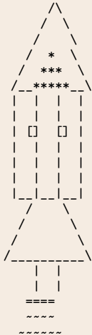
The image is a black-and-white line drawing on a light beige background, depicting a simplified, schematic cross-section of a rocket or projectile. The diagram uses dashed lines to indicate internal or hidden structures and solid lines for certain key components. There is no embedded text, numerical data, or labels. The only non-geometric symbols are three asterisks (`*`) arranged vertically in the upper section.
### Components/Axes
The diagram is vertically oriented and can be segmented into three primary regions from top to bottom:
1. **Nose Cone / Payload Section (Top):**
* A large, dashed-line triangle forms the pointed top.
* Inside this triangle, three asterisks (`*`) are stacked vertically along the central axis.
* Below the asterisks, a horizontal dashed line separates this section from the next.
2. **Mid-Body / Equipment Bay (Center):**
* A rectangular section defined by dashed vertical and horizontal lines.
* This section is divided into three vertical columns by two internal dashed lines.
* In the left and right columns, two small, solid-line squares are positioned symmetrically, roughly at the vertical midpoint of this section. The central column is empty.
3. **Propulsion / Exhaust Section (Bottom):**
* A smaller, inverted dashed-line triangle forms the base.
* Below this triangle, two short, vertical solid lines descend, suggesting engine nozzles or support structures.
* At the very bottom, a series of short, horizontal dashed lines are stacked, likely representing exhaust plumes or a launch platform.
### Detailed Analysis
* **Line Style:** The predominant use of dashed lines (`---`) suggests this is a cutaway or transparent view, revealing internal layout rather than external form.
* **Symmetry:** The diagram exhibits strong bilateral symmetry along its vertical central axis.
* **Component Placement:**
* The three asterisks are centered in the uppermost (nose cone) region.
* The two solid squares are placed symmetrically in the outer columns of the central rectangular bay.
* The two vertical solid lines at the base are also symmetrically placed.
* **Absence of Text:** There are no labels, titles, axis markers, legends, or numerical annotations present in the image.
### Key Observations
1. **Symbolic Elements:** The three asterisks (`*`) are the only non-structural symbols. Their meaning is not defined within the image but could represent sensors, windows, warheads, or payload indicators in a technical context.
2. **Structural Segmentation:** The clear division into three distinct geometric sections (triangle, rectangle, inverted triangle) implies a functional separation of the vehicle's systems (e.g., guidance/payload, avionics/fuel, propulsion).
3. **Use of Solid vs. Dashed Lines:** Solid lines are used sparingly for the two squares and the two bottom vertical lines, potentially highlighting these as critical, non-structural, or external components (e.g., access hatches, thruster nozzles).
### Interpretation
This diagram is a high-level, abstract schematic intended to convey the basic internal layout and component arrangement of a rocket-like vehicle. It prioritizes conceptual understanding over engineering precision.
* **What it Demonstrates:** The image illustrates a modular design philosophy. The distinct sections suggest separate functional modules: a pointed forward section for aerodynamics and payload (marked by the asterisks), a central bay for systems or fuel (with symmetrically placed components), and a rear propulsion section.
* **Relationships:** The vertical stacking defines the vehicle's primary axis of thrust and movement. The symmetry implies balanced mass distribution and redundant systems (the two squares).
* **Notable Anomalies:** The complete lack of annotation is the most significant feature. This suggests the diagram is either a template, an icon, or part of a larger document where labels are provided externally. The asterisks are the only ambiguous element, acting as placeholders for unspecified but important features in the nose cone.
* **Peircean Reading:** As an icon, it represents a rocket through simplified geometric forms. As an index, the dashed lines point to an internal view. The asterisks are symbolic (a sign) whose meaning must be inferred from context outside this image—likely representing something potent, targeted, or numerous located at the vehicle's front.
**Final Note:** This image contains no extractable factual data, trends, or textual information beyond the geometric shapes and the three asterisk symbols. Its value is purely in conveying a structural concept through visual abstraction.