\n
## Diagram: Stylized Rocket Representation
### Overview
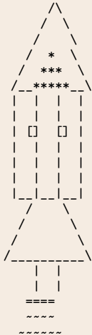
The image depicts a highly stylized representation of a rocket, constructed from various dashed line patterns and symbols. It appears to be a schematic or illustrative diagram rather than a precise technical drawing. There are no axes, scales, or legends present. The diagram is purely visual and does not contain numerical data.
### Components/Axes
The diagram consists of the following visual elements:
* **Rocket Body:** Formed by a combination of dashed lines of varying lengths and patterns. The body is roughly symmetrical.
* **Nose Cone:** Represented by a dashed triangular shape at the top.
* **Fins:** Three sets of dashed lines at the bottom, representing fins. The line patterns vary (solid, short dashes, wavy dashes).
* **Central Rectangles:** Two small rectangles positioned centrally within the rocket body.
* **Symbols:** A single asterisk (*) at the top of the rocket, and a series of four asterisks (****) below it.
### Detailed Analysis or Content Details
The diagram is composed of the following line types:
* **Long Dashes:** Used to outline the main body of the rocket.
* **Short Dashes:** Used for the fins and some internal structure.
* **Solid Lines:** Used for the lowest fin section.
* **Wavy Dashes:** Used for the lowest fin section.
* **Rectangles:** Two small rectangles are present in the center of the rocket.
* **Asterisks:** One asterisk is at the very top, and four asterisks are below it.
There are no numerical values or specific measurements provided. The diagram is purely illustrative.
### Key Observations
The diagram's use of different dashed line patterns suggests a possible attempt to differentiate sections or components of the rocket. The asterisks may represent some form of indicator or marking. The overall design is very simple and lacks detail.
### Interpretation
This diagram likely serves as a basic visual representation of a rocket, possibly for educational purposes or as a simplified illustration. The lack of specific details or data suggests it is not intended for technical analysis or engineering design. The varying line patterns could be intended to represent different materials or structural elements, but without further context, this is speculative. The asterisks could represent points of interest or stages of flight, but again, this is an interpretation based on visual cues. The diagram is a symbolic representation rather than a precise depiction. It is a visual aid, not a data source.