\n
## Scatter Plots: Layer-wise Representation of Truth, Hallucination, and Lies
### Overview
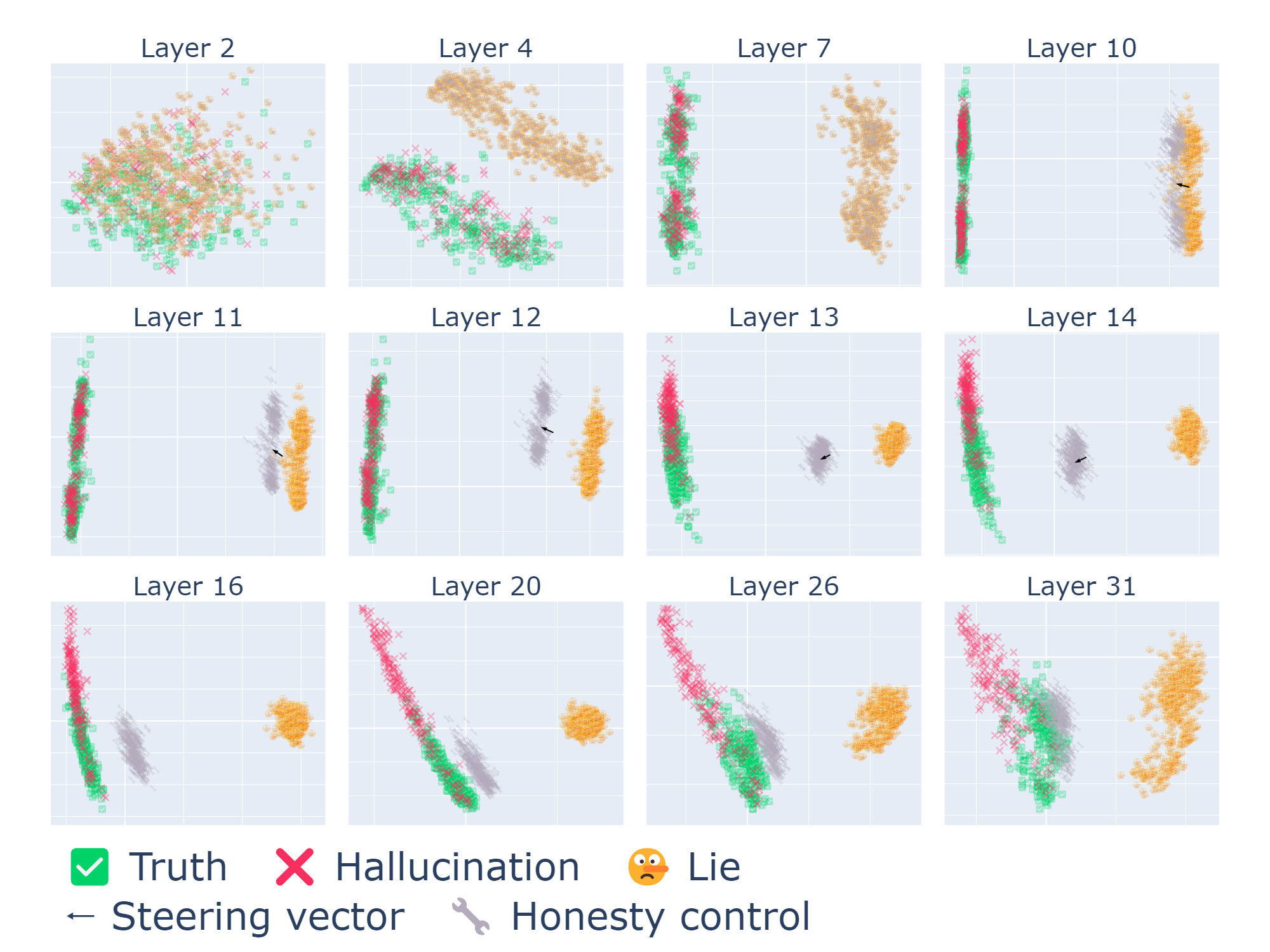
The image presents a 3x4 grid of scatter plots, each representing a different layer (2, 4, 7, 10, 11, 12, 13, 14, 16, 20, 26, and 31) within a neural network or similar system. Each plot visualizes the distribution of "Truth," "Hallucination," and "Lie" data points. Additionally, each plot includes a "Steering vector" and "Honesty control" indicator. The plots appear to be 2D projections of higher-dimensional data.
### Components/Axes
Each scatter plot has two implicit axes (X and Y), but their specific scales or labels are not provided. The plots are visually uniform in terms of axis ranges.
**Legend:** Located at the bottom-left of the image.
* **Truth:** Represented by green squares.
* **Hallucination:** Represented by pink crosses.
* **Lie:** Represented by orange circles with a sad face emoji.
* **Steering vector:** Represented by a black arrow.
* **Honesty control:** Represented by a curved black arrow with a feather-like tip.
**Titles:** Each plot is labeled with the corresponding layer number at the top-center. (Layer 2, Layer 4, Layer 7, Layer 10, Layer 11, Layer 12, Layer 13, Layer 14, Layer 16, Layer 20, Layer 26, Layer 31).
### Detailed Analysis or Content Details
Here's a layer-by-layer breakdown of the observed distributions:
* **Layer 2:** A relatively dense cluster of green "Truth" points, with scattered pink "Hallucination" points. The steering vector points roughly upwards and to the right. The honesty control points towards the truth cluster.
* **Layer 4:** The "Truth" cluster is less dense than in Layer 2. More "Hallucination" points are visible, and a small number of orange "Lie" points begin to appear. The steering vector points upwards. The honesty control points towards the truth cluster.
* **Layer 7:** The "Truth" cluster is further dispersed. "Lie" points are more numerous and form a distinct cluster. The steering vector points upwards and to the right. The honesty control points towards the truth cluster.
* **Layer 10:** The "Truth" points are highly elongated vertically. "Lie" points are numerous and form a distinct cluster. The steering vector points upwards. The honesty control points towards the truth cluster.
* **Layer 11:** The "Truth" points are elongated vertically, but less so than in Layer 10. "Lie" points are numerous and form a distinct cluster. The steering vector points upwards. The honesty control points towards the truth cluster.
* **Layer 12:** The "Truth" points are dispersed. "Lie" points are numerous and form a distinct cluster. The steering vector points upwards. The honesty control points towards the truth cluster.
* **Layer 13:** The "Truth" points are dispersed. "Lie" points are numerous and form a distinct cluster. The steering vector points upwards. The honesty control points towards the truth cluster.
* **Layer 14:** The "Truth" points are elongated vertically. "Lie" points are numerous and form a distinct cluster. The steering vector points upwards. The honesty control points towards the truth cluster.
* **Layer 16:** The "Truth" points are dispersed. "Lie" points are numerous and form a distinct cluster. The steering vector points upwards. The honesty control points towards the truth cluster.
* **Layer 20:** The "Truth" points are dispersed. "Lie" points are numerous and form a distinct cluster. The steering vector points upwards. The honesty control points towards the truth cluster.
* **Layer 26:** The "Truth" points are dispersed. "Lie" points are numerous and form a distinct cluster. The steering vector points upwards. The honesty control points towards the truth cluster.
* **Layer 31:** The "Truth" points are dispersed. "Lie" points are numerous and form a distinct cluster. The steering vector points upwards. The honesty control points towards the truth cluster.
Generally, the "Lie" points form a cluster that becomes more prominent and distinct as the layer number increases. The "Hallucination" points are less consistent in their distribution. The steering vector consistently points upwards, and the honesty control consistently points towards the truth cluster.
### Key Observations
* The proportion of "Lie" points increases significantly with layer depth.
* "Hallucination" points are present in all layers, but their density varies.
* The "Steering vector" consistently points in a similar direction across all layers.
* The "Honesty control" consistently points towards the "Truth" cluster.
* The "Truth" cluster becomes more dispersed as the layer number increases.
### Interpretation
The image suggests a process where, as information propagates through the layers of a system (likely a neural network), the tendency to generate "Lies" increases. The initial layers (2, 4) contain a relatively high proportion of "Truth" data, but as the data moves through deeper layers, the "Lie" data becomes dominant.
The "Steering vector" likely represents a guiding force attempting to maintain accuracy, while the "Honesty control" indicates a mechanism for aligning the system's output with the "Truth." The consistent direction of these vectors suggests a persistent effort to correct or mitigate the increasing "Lie" generation.
The increasing dispersion of the "Truth" points could indicate that the system is losing its ability to accurately represent the original data as it progresses through the layers. The emergence and growth of the "Lie" cluster suggest a potential issue with the system's ability to maintain fidelity or avoid generating false information.
The presence of "Hallucinations" throughout all layers suggests that the system is prone to generating incorrect or nonsensical outputs even in the early stages of processing. This could be due to noise in the data, limitations in the model's capacity, or inherent biases in the training process.
This visualization could be used to diagnose and address issues related to truthfulness and reliability in a machine learning system. It highlights the importance of monitoring and controlling the generation of false information as data flows through the layers of a complex model.