## Diagram: Iterative Response Correction
### Overview
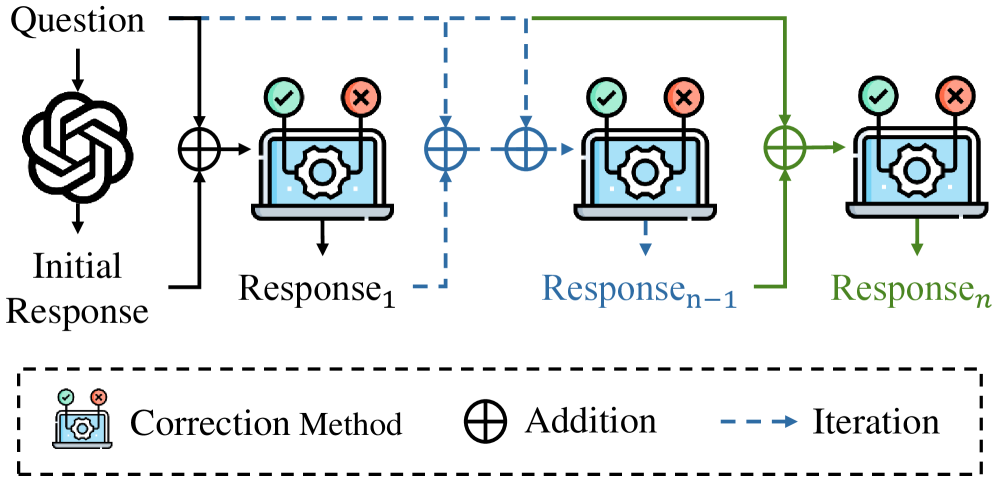
The image is a diagram illustrating an iterative process for response correction. It shows a question being processed to generate an initial response, followed by a series of correction methods and additions to refine the response iteratively.
### Components/Axes
* **Question:** Input to the system, leading to the initial response.
* **Initial Response:** The first output generated from the question.
* **Response<sub>1</sub>:** The first corrected response.
* **Response<sub>n-1</sub>:** The (n-1)th corrected response.
* **Response<sub>n</sub>:** The nth corrected response.
* **Correction Method:** Represented by a laptop icon with a gear inside the screen, a green checkmark, and a red "X" symbol.
* **Addition:** Represented by a circled plus sign.
* **Iteration:** Represented by a dashed arrow.
### Detailed Analysis
The diagram starts with a "Question" that feeds into a symbol resembling the ChatGPT logo, which produces an "Initial Response." This initial response is then processed through a "Correction Method" block, labeled "Response<sub>1</sub>". The output of this block is added to the initial response via an "Addition" operation.
The process then iterates. The output of the first addition is fed back into another "Correction Method" block, labeled "Response<sub>n-1</sub>". This block's output is again added to the previous response. This iterative process continues until the final "Correction Method" block, labeled "Response<sub>n</sub>", produces the final corrected response.
The "Correction Method" blocks each have a green checkmark and a red "X" symbol, suggesting a process of validation and rejection or acceptance of certain aspects of the response.
The iteration loops are represented by dashed lines, colored blue and green, indicating the flow of information back into the addition operations.
### Key Observations
* The diagram illustrates an iterative refinement process.
* Each iteration involves a "Correction Method" and an "Addition" operation.
* The use of checkmarks and "X" symbols suggests a filtering or validation mechanism within the "Correction Method."
### Interpretation
The diagram depicts a system where an initial response to a question is iteratively refined through a series of correction and addition steps. The "Correction Method" likely involves evaluating the response and making adjustments based on certain criteria, as indicated by the checkmark and "X" symbols. The "Addition" operation suggests that the corrections are integrated back into the response, leading to a more refined output in each iteration. This iterative approach aims to improve the quality and accuracy of the response over time. The diagram highlights the cyclical nature of the refinement process, where feedback loops are used to continuously improve the response.