## Flowchart: Iterative Response Correction Process
### Overview
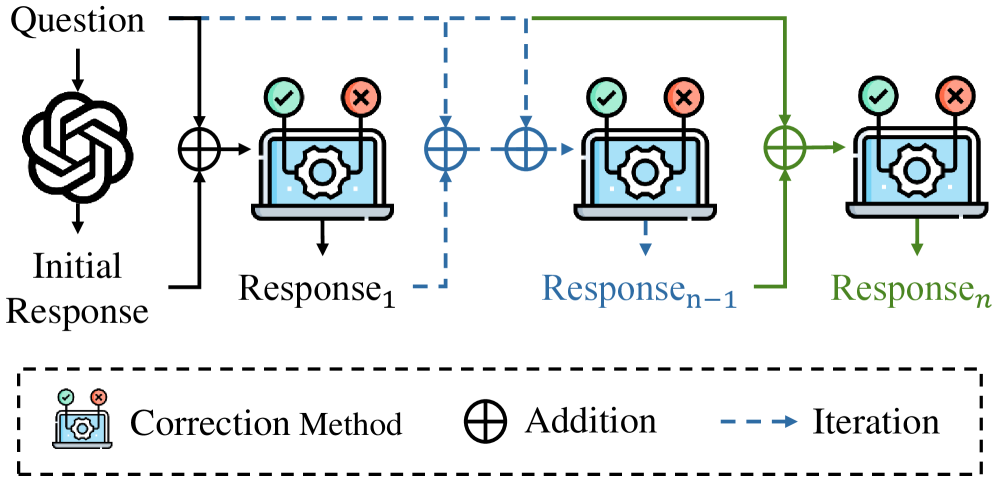
The diagram illustrates a multi-stage iterative process for refining responses to a question. It begins with an initial response and progresses through sequential corrections, culminating in a final response. Key elements include evaluation markers (✅/❌), correction mechanisms, and iterative feedback loops.
### Components/Axes
1. **Header Section**:
- **Question**: Top-left node represented by a hexagonal symbol.
- **Initial Response**: Directly below the question, depicted as a laptop with a gear icon.
2. **Main Process Flow**:
- **Response₁**: First iteration response (laptop with gear icon).
- **Responseₙ₋₁**: Second-to-last response in the sequence.
- **Responseₙ**: Final response after iterative corrections.
3. **Footer Section**:
- **Correction Method**: Dashed box containing a laptop with gear icon and dual evaluation markers (✅/❌).
- **Addition Symbol**: Plus sign (+) connecting correction method to iteration arrows.
- **Iteration Arrows**: Dashed blue arrows indicating cyclical refinement.
4. **Evaluation Legend**:
- **✅ (Green Checkmark)**: Indicates acceptable response quality.
- **❌ (Red X)**: Indicates response requiring correction.
### Detailed Analysis
- **Flow Direction**:
- Top-to-bottom vertical flow for initial response evaluation.
- Rightward horizontal flow for sequential response iterations.
- Dashed arrows create feedback loops between correction method and response iterations.
- **Key Symbols**:
- Gear icon: Represents response refinement mechanism.
- Dashed lines: Denote iterative/cyclical processes.
- Solid arrows: Indicate finalized progression to next stage.
- **Spatial Relationships**:
- Correction Method box is centrally positioned at the bottom, acting as a decision node.
- Addition symbol (+) bridges correction method to iteration arrows.
- Final Responseₙ is spatially isolated from earlier responses, emphasizing completion.
### Key Observations
1. **Iterative Nature**: The process requires multiple response evaluations (n iterations) before finalization.
2. **Binary Evaluation**: Each response undergoes strict pass/fail assessment (✅/❌).
3. **Cumulative Correction**: The Correction Method appears to aggregate feedback across all iterations.
4. **Non-linear Progression**: Dashed arrows suggest potential backtracking to previous responses.
### Interpretation
This diagram represents a quality assurance framework for automated response generation systems. The iterative correction method implies:
1. **Adaptive Learning**: The system refines responses based on continuous evaluation.
2. **Threshold-Driven Process**: Responses must meet quality standards (✅) to progress.
3. **Cumulative Knowledge**: The Correction Method likely incorporates lessons from all prior iterations.
4. **Finality Assurance**: The isolated position of Responseₙ suggests a rigorous validation gate.
The process emphasizes systematic improvement through repeated evaluation and correction, with the final response representing the culmination of multiple refinement cycles. The use of gear icons across all response stages indicates a consistent technical mechanism for response generation and refinement.