## Diagram: Algorithm Track vs. System Track
### Overview
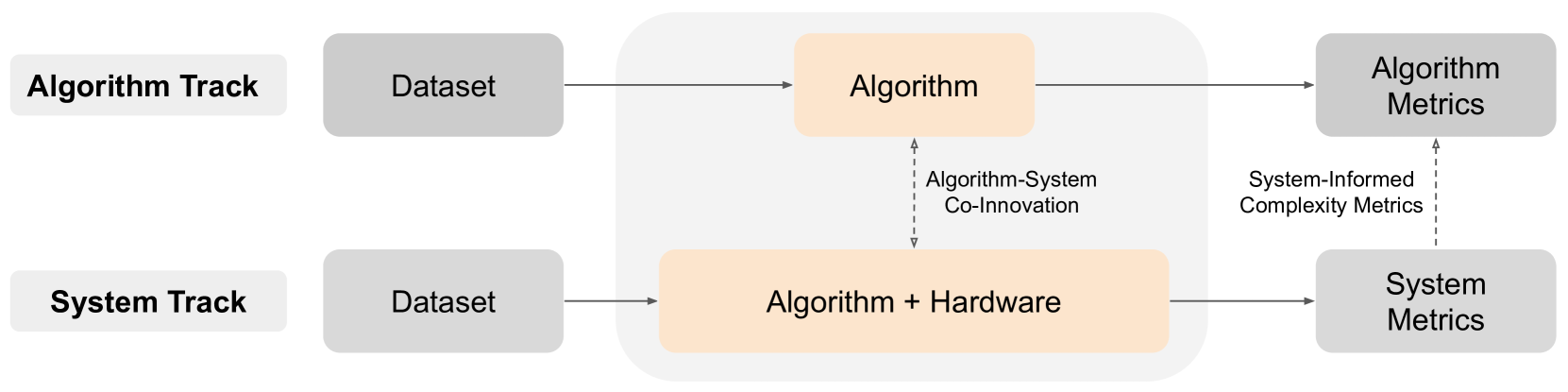
The image is a comparative flow diagram illustrating two distinct methodologies for development: the "Algorithm Track" and the "System Track." It contrasts a traditional, isolated algorithmic development process with a holistic "co-innovation" approach that integrates hardware considerations. The diagram highlights how system-level constraints and hardware awareness influence the final metrics.
### Components/Axes
The diagram is organized into two horizontal rows (tracks) and a central processing region.
* **Left Column (Inputs):**
* **Algorithm Track:** Labeled "Algorithm Track" (left of the dataset box). Contains a gray box labeled "Dataset."
* **System Track:** Labeled "System Track" (left of the dataset box). Contains a gray box labeled "Dataset."
* **Center Region (Processing - enclosed in a light gray container):**
* **Top (Algorithm Track):** An orange box labeled "Algorithm."
* **Bottom (System Track):** A larger orange box labeled "Algorithm + Hardware."
* **Right Column (Outputs):**
* **Top (Algorithm Track):** A gray box labeled "Algorithm Metrics."
* **Bottom (System Track):** A gray box labeled "System Metrics."
* **Connectors:**
* **Solid Arrows:** Indicate the primary forward flow of data from Dataset → Processing → Metrics.
* **Dashed Arrows:** Indicate cross-track influence and interaction.
### Detailed Analysis
**1. The Algorithm Track (Top Row)**
* **Flow:** The process begins with a "Dataset," which flows horizontally to the right into the "Algorithm" processing block. The output of this block flows horizontally to the right into "Algorithm Metrics."
* **Nature:** This represents a linear, software-centric development path where the algorithm is developed independently of the underlying hardware.
**2. The System Track (Bottom Row)**
* **Flow:** The process begins with a "Dataset," which flows horizontally to the right into the "Algorithm + Hardware" processing block. The output of this block flows horizontally to the right into "System Metrics."
* **Nature:** This represents a co-design approach where the algorithm and hardware are developed in tandem.
**3. Cross-Track Interactions (Vertical/Dashed)**
* **Algorithm-System Co-Innovation:** A vertical, bidirectional dashed arrow connects the "Algorithm" block (top) and the "Algorithm + Hardware" block (bottom). This indicates a feedback loop or collaborative design process between the two tracks.
* **System-Informed Complexity Metrics:** A vertical, upward-pointing dashed arrow connects the "System Metrics" block (bottom) to the "Algorithm Metrics" block (top). This indicates that the metrics derived from the system track are used to inform or refine the metrics of the algorithm track.
### Key Observations
* **Isolation vs. Integration:** The "Algorithm Track" is visually isolated from hardware considerations, whereas the "System Track" explicitly merges them.
* **Directional Influence:** The "System-Informed Complexity Metrics" arrow points *upward*, suggesting that system-level data is a prerequisite or a corrective factor for standard algorithmic metrics.
* **Co-Innovation:** The bidirectional arrow between the central processing blocks suggests that the "Algorithm" track is not entirely independent; it is influenced by the "Algorithm + Hardware" track, implying that modern algorithm design is increasingly dependent on hardware capabilities.
### Interpretation
This diagram serves as a conceptual framework for **Hardware-Software Co-Design**.
* **The Problem:** Traditional algorithmic research often optimizes for abstract metrics (like accuracy or theoretical FLOPs) without considering the physical constraints of the hardware (memory bandwidth, power consumption, latency). This is represented by the top track.
* **The Solution:** The "System Track" proposes that by designing the algorithm and hardware simultaneously, one can achieve better performance.
* **The "System-Informed" Insight:** The most critical element is the "System-Informed Complexity Metrics" arrow. It suggests that "Algorithm Metrics" are often incomplete or misleading when viewed in a vacuum. By feeding system-level metrics back into the algorithm track, researchers can create more realistic, efficient, and deployable solutions. This diagram argues that the "Algorithm Track" is insufficient on its own for modern, high-performance computing or AI applications.