\n
## Diagram: Algorithm and System Tracks
### Overview
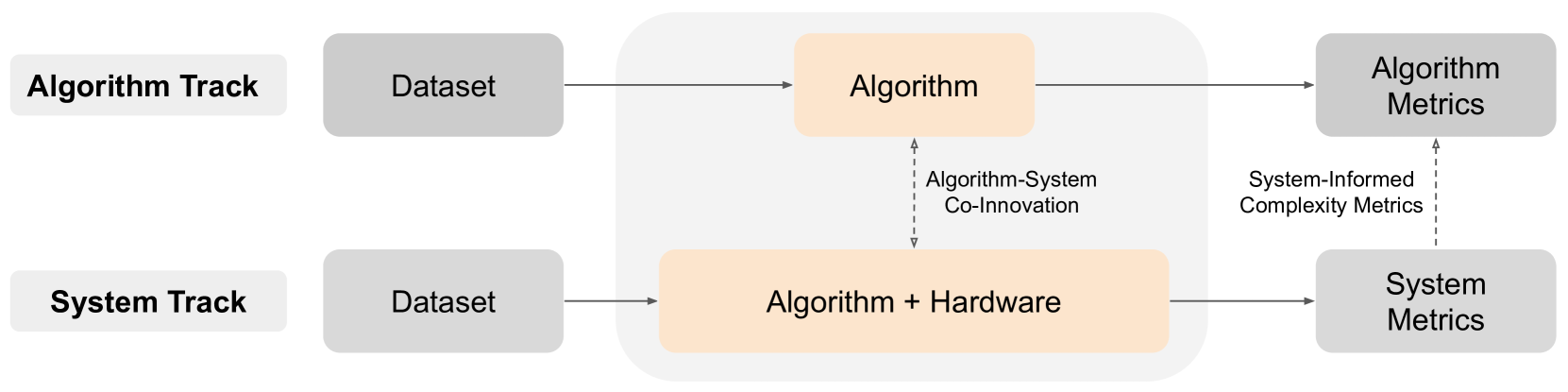
The image is a diagram illustrating two parallel tracks – an "Algorithm Track" and a "System Track" – for evaluating and developing algorithms and systems. Both tracks begin with a "Dataset" and end with corresponding "Metrics". A bidirectional relationship labeled "Algorithm-System Co-Innovation" connects the "Algorithm" and "Algorithm + Hardware" stages.
### Components/Axes
The diagram consists of the following components:
* **Algorithm Track:** A top row representing the algorithm-focused development process.
* **System Track:** A bottom row representing the system-focused development process.
* **Dataset:** The initial input for both tracks.
* **Algorithm:** The core algorithmic component in the Algorithm Track.
* **Algorithm + Hardware:** The combined algorithmic and hardware component in the System Track.
* **Algorithm Metrics:** The output metrics for the Algorithm Track.
* **System Metrics:** The output metrics for the System Track.
* **Algorithm-System Co-Innovation:** A bidirectional arrow indicating interaction between the Algorithm and Algorithm + Hardware stages.
* **System-Informed Complexity Metrics:** A dotted arrow indicating influence from the System Metrics to the Algorithm Metrics.
### Detailed Analysis or Content Details
The diagram shows a sequential flow within each track:
1. **Algorithm Track:**
* Dataset -> Algorithm -> Algorithm Metrics
* The "Algorithm" component is connected to "Algorithm + Hardware" via the "Algorithm-System Co-Innovation" label.
* "Algorithm Metrics" are influenced by "System Metrics" via the "System-Informed Complexity Metrics" label.
2. **System Track:**
* Dataset -> Algorithm + Hardware -> System Metrics
The "Algorithm-System Co-Innovation" label suggests a feedback loop or iterative process between algorithm development and system design. The "System-Informed Complexity Metrics" label indicates that system-level metrics can influence the evaluation of algorithm complexity.
### Key Observations
The diagram highlights the interplay between algorithm and system considerations. It suggests that optimizing algorithms alone is insufficient; hardware and system-level factors are crucial. The bidirectional connection between the Algorithm and Algorithm + Hardware stages emphasizes the importance of co-design and iterative refinement.
### Interpretation
This diagram represents a holistic approach to algorithm and system development. It acknowledges that algorithms do not operate in isolation but are deeply intertwined with the underlying hardware and system architecture. The "Algorithm-System Co-Innovation" link suggests that improvements in one area can drive advancements in the other. The inclusion of "System-Informed Complexity Metrics" indicates a recognition that algorithm complexity must be evaluated in the context of the overall system.
The diagram implies a shift from a purely algorithm-centric view to a more system-aware perspective. This is particularly relevant in domains where performance is heavily influenced by hardware constraints and system-level interactions, such as machine learning, embedded systems, and high-performance computing. The diagram doesn't provide quantitative data, but it conveys a conceptual framework for a more integrated and effective development process.