## Diagram: Partitioned Matrix Structure
### Overview
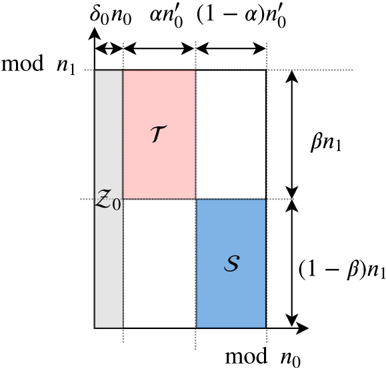
The image displays a technical diagram of a rectangular matrix partitioned into sub-blocks, likely representing a structured matrix used in mathematical or computational contexts (e.g., lattice-based cryptography, coding theory, or numerical linear algebra). The matrix is divided by vertical and horizontal lines into distinct regions, each labeled with mathematical notation indicating dimensions and identifiers. The diagram uses color-coding to differentiate specific submatrices.
### Components/Axes
The diagram is a rectangle with axes labeled with modular arithmetic terms and dimension parameters.
**Horizontal Axis (Top):**
- The top edge is divided into three segments with widths labeled from left to right:
1. `δ₀n₀`
2. `αn₀'`
3. `(1 - α)n₀'`
- The entire horizontal span is labeled at the bottom as `mod n₀`.
**Vertical Axis (Left):**
- The left edge is divided into two segments with heights labeled from top to bottom:
1. `βn₁`
2. `(1 - β)n₁`
- The entire vertical span is labeled at the top-left as `mod n₁`.
**Internal Partitions & Labels:**
- A vertical dashed line separates the first column (width `δ₀n₀`) from the rest.
- A horizontal dashed line separates the top row (height `βn₁`) from the bottom row.
- These partitions create six primary regions. Three are explicitly labeled:
1. **Left Column (Gray):** Spans the full height. Labeled `Z₀` in the lower half.
2. **Top-Middle Block (Pink):** Located in the top row, middle column. Labeled `T`.
3. **Bottom-Right Block (Blue):** Located in the bottom row, right column. Labeled `S`.
- The remaining three regions (top-right, bottom-middle, and the upper part of the left column) are unlabeled and shown in white.
### Detailed Analysis
**Spatial Layout and Dimensions:**
- The matrix has a total width of `n₀` (implied by `mod n₀`), partitioned as `δ₀n₀ + αn₀' + (1-α)n₀'`.
- The matrix has a total height of `n₁` (implied by `mod n₁`), partitioned as `βn₁ + (1-β)n₁`.
- The submatrix `Z₀` is a tall, narrow block in the first column. Its width is `δ₀n₀` and its height is the full matrix height `n₁`.
- The submatrix `T` is a rectangular block. Its width is `αn₀'` and its height is `βn₁`.
- The submatrix `S` is a rectangular block. Its width is `(1-α)n₀'` and its height is `(1-β)n₁`.
**Color-Legend Correspondence:**
- **Gray:** Corresponds to the label `Z₀`. This is the entire first column.
- **Pink:** Corresponds to the label `T`. This is the block at the intersection of the top row and middle column.
- **Blue:** Corresponds to the label `S`. This is the block at the intersection of the bottom row and right column.
### Key Observations
1. **Parameterized Structure:** The dimensions of all blocks are defined by parameters (`α`, `β`, `δ₀`) and base sizes (`n₀`, `n₁`, `n₀'`). This suggests a generalized or scalable matrix structure.
2. **Non-Uniform Partitioning:** The partitions are not equal. The parameters `α` and `β` (likely between 0 and 1) control the relative sizes of the `T` and `S` blocks.
3. **Modular Context:** The labels `mod n₀` and `mod n₁` strongly indicate that the matrix operations or entries are considered within modular arithmetic rings or fields, common in cryptography and coding theory.
4. **Asymmetry:** The labeled blocks `T` and `S` are placed diagonally (top-middle and bottom-right), leaving the top-right and bottom-middle blocks empty/unlabeled. This is a specific, intentional design.
### Interpretation
This diagram illustrates the structure of a **block matrix** used in a specialized mathematical algorithm. The parameters `α`, `β`, and `δ₀` are tuning knobs that define the relative sizes of the submatrices `Z₀`, `T`, and `S`.
* **Purpose:** Such a structure is typical in algorithms that exploit matrix sparsity or specific algebraic properties. For example, in lattice-based cryptography, matrices with this kind of "split" structure (like in the NTRU or Ring-LWE settings) are used to create public keys where the secret key is a small, sparse matrix (`T` and `S` might represent parts of a secret or error vector).
* **Relationships:** The matrix is likely the public component of a cryptographic scheme. The submatrices `T` and `S` (colored) are probably "small" or "sparse" relative to the full matrix dimensions, defined by the small parameters `α` and `β`. The block `Z₀` may contain random or structured data. The modular labels confirm the algebraic setting.
* **Anomaly/Notable Feature:** The deliberate empty blocks (top-right, bottom-middle) are significant. They indicate that the matrix is not fully dense; its structure is constrained, which is crucial for both the security and efficiency of the underlying algorithm. The diagram visually encodes the precise sparsity pattern.
**Language Note:** The text in the image consists solely of mathematical notation and symbols (Greek letters, Latin variables, subscripts). No natural language is present.