## Screenshot: Shared Clip Qualitative Example
### Overview
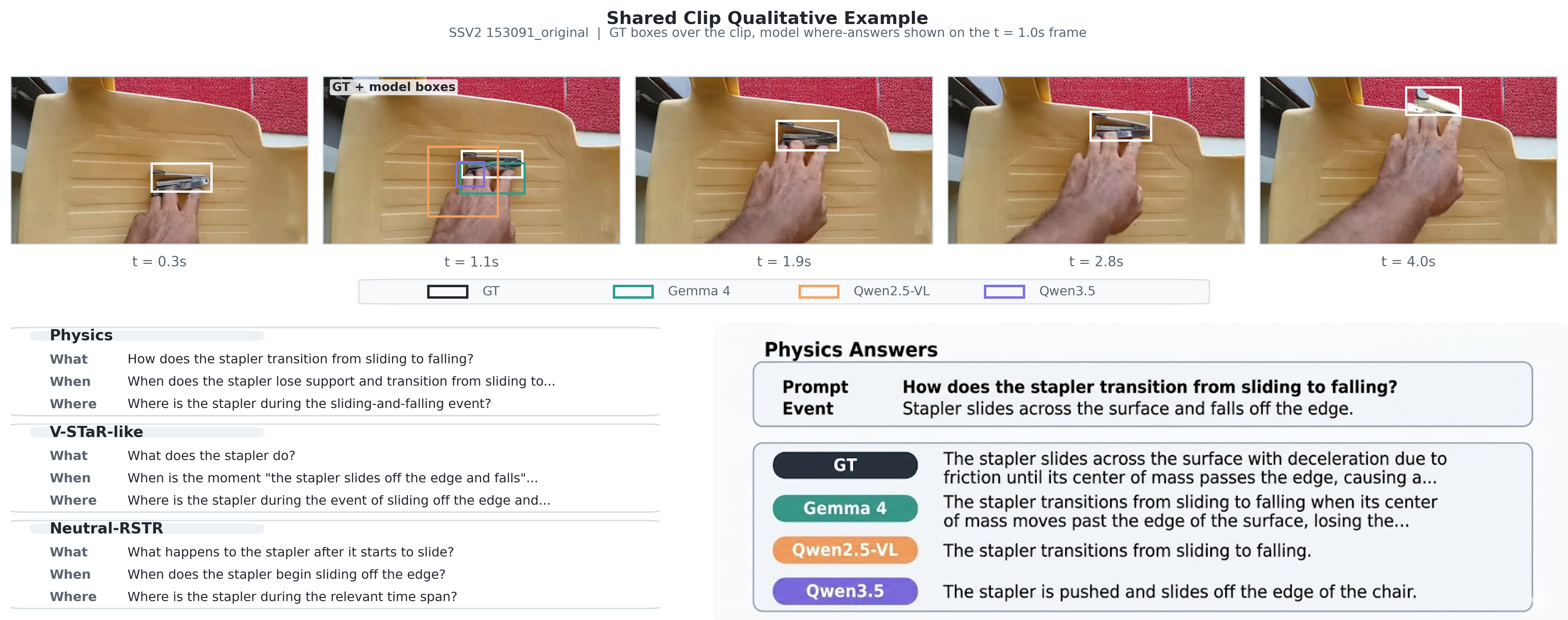
The image displays a qualitative analysis of a video clip showing a human hand interacting with a stapler on a yellow surface. It includes:
- A sequence of 5 frames with timestamps (0.3s to 4.0s)
- Model prediction boxes overlaid on the clip
- Text-based question-answering sections
- Model performance comparisons
### Components/Axes
1. **Header**:
- Title: "Shared Clip Qualitative Example"
- File identifier: "SSV2 153091_original"
- Note: "GT boxes over the clip, model where-answers shown on the t = 1.0s frame"
2. **Main Content**:
- **Frames**:
- 5 sequential images showing hand/stapler interaction
- Timestamps: t = 0.3s, 1.1s, 1.9s, 2.8s, 4.0s
- Model prediction boxes (colored) overlaid on objects
- **Legend**:
- Position: Bottom center
- Color coding:
- Black: GT (Ground Truth)
- Green: Gemma 4
- Orange: Qwen2.5-VL
- Purple: Qwen3.5
3. **Text Sections**:
- **Left Panel**:
- Three question categories:
1. **Physics**:
- What: "How does the stapler transition from sliding to falling?"
- When: "When does the stapler lose support and transition from sliding to to..."
- Where: "Where is the stapler during the sliding-and-falling event?"
2. **V-STaR-like**:
- What: "What does the stapler do?"
- When: "When is the moment 'the stapler slides off the edge and falls'..."
- Where: "Where is the stapler during the event of sliding off the edge and..."
3. **Neutral-RSTR**:
- What: "What happens to the stapler after it starts to slide?"
- When: "When does the stapler begin sliding off the edge?"
- Where: "Where is the stapler during the relevant time span?"
- **Right Panel**:
- **Physics Answers**:
- Prompt: "How does the stapler transition from sliding to falling?"
- Ground Truth (GT): "The stapler slides across the surface with deceleration due to friction until its center of mass passes the edge, causing a..."
- Gemma 4: "The stapler transitions from sliding to falling when its center of mass moves past the edge of the surface, losing the..."
- Qwen2.5-VL: "The stapler transitions from sliding to falling."
- Qwen3.5: "The stapler is pushed and slides off the edge of the chair."
### Detailed Analysis
1. **Frame Analysis**:
- At t=0.3s: Stapler initially placed on surface
- t=1.1s: Multiple model boxes (GT, Gemma 4, Qwen2.5-VL, Qwen3.5) show varying predictions
- t=1.9s: GT box maintains accurate position
- t=2.8s: Model boxes diverge in position prediction
- t=4.0s: Stapler partially off surface; models show different interpretations
2. **Model Performance**:
- GT (Ground Truth) consistently most accurate
- Gemma 4 provides detailed physical explanation
- Qwen2.5-VL gives concise answer
- Qwen3.5 introduces positional inaccuracy ("chair" instead of "surface")
3. **Question-Answer Structure**:
- All question categories follow "What/When/Where" format
- Physics questions focus on mechanics of motion
- V-STaR-like emphasizes event description
- Neutral-RSTR focuses on object state changes
### Key Observations
1. Model predictions show increasing divergence over time
2. GT maintains consistent accuracy across frames
3. Qwen3.5 introduces positional error in final frame
4. Answer quality correlates with box prediction accuracy
5. V-STaR-like questions require more descriptive answers
### Interpretation
This visualization demonstrates:
1. **Temporal Tracking Performance**: Models struggle with long-term object tracking, particularly during motion transitions
2. **Physics Understanding**: GT and Gemma 4 show better grasp of physical principles (friction, center of mass)
3. **Answer Quality Gradient**: More accurate predictions correlate with more detailed/accurate answers
4. **Model Specialization**: Qwen3.5's "chair" error suggests potential domain confusion
5. **Evaluation Framework**: The structured question categories (Physics/V-STaR/Neutral) provide multidimensional assessment of model capabilities
The data suggests that while all models can identify basic object interactions, only GT and Gemma 4 demonstrate nuanced understanding of physical principles governing the stapler's motion. The increasing prediction errors over time highlight challenges in maintaining object tracking during dynamic events.