## Diagram: Robotic Hand Interaction with Sphere
### Overview
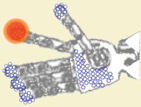
The image depicts a technical diagram of a robotic hand interacting with a red spherical object. The hand is shown in a grasping motion, with articulated fingers and a segmented structure. A red sphere is positioned near the fingertips, suggesting a contact or manipulation scenario. Blue circular markers are distributed across the hand and sphere, likely representing sensors, contact points, or data collection nodes. The background is a neutral light beige.
### Components/Axes
- **Robotic Hand**:
- Segmented structure with visible joints and actuators.
- Fingers are spread in a grasping posture.
- Blue circular markers are concentrated on the palm, fingertips, and joints.
- **Red Sphere**:
- Positioned near the fingertips, partially overlapping with the hand.
- Blue markers are also present on the sphere’s surface.
- **Blue Circular Markers**:
- Uniformly distributed across the hand and sphere.
- No labels or legends are visible to clarify their exact purpose.
### Detailed Analysis
- **Robotic Hand Design**:
- The hand’s segmented structure implies modularity, with distinct sections for articulation.
- Blue markers on the palm and fingertips suggest pressure or proximity sensors.
- Joints (e.g., knuckles) have fewer markers, possibly indicating torque or position sensors.
- **Sphere Interaction**:
- The red sphere’s placement and overlapping with the hand indicate a focus on object manipulation.
- Blue markers on the sphere may represent contact points or environmental feedback.
- **Color Coding**:
- Red sphere: Likely denotes the target object or a specific material property (e.g., elasticity).
- Blue markers: Uniform color suggests a single sensor type or data category.
### Key Observations
1. **Sensor Distribution**: Blue markers are denser on the fingertips and palm, aligning with areas critical for tactile feedback.
2. **Grasping Dynamics**: The hand’s posture and sphere placement imply a study of grasp stability or force application.
3. **Lack of Labels**: No textual annotations are present, limiting direct interpretation of sensor functions or system parameters.
### Interpretation
The diagram emphasizes the robotic hand’s design for object interaction, with sensor placement prioritizing tactile feedback zones. The red sphere’s role as a test object highlights applications in precision manipulation or adaptive grasping. The absence of textual data suggests the diagram is a conceptual or schematic representation, requiring supplementary documentation for technical specifics. The blue markers’ uniformity implies a standardized sensor array, though their exact function (e.g., force, temperature, proximity) remains undefined without legends.
**Note**: No textual information (labels, legends, axis titles) is present in the image. All analysis is based on visual components and spatial relationships.