## Scatter Plots: Peak Frequency Comparison Between Ears in Different Environments
### Overview
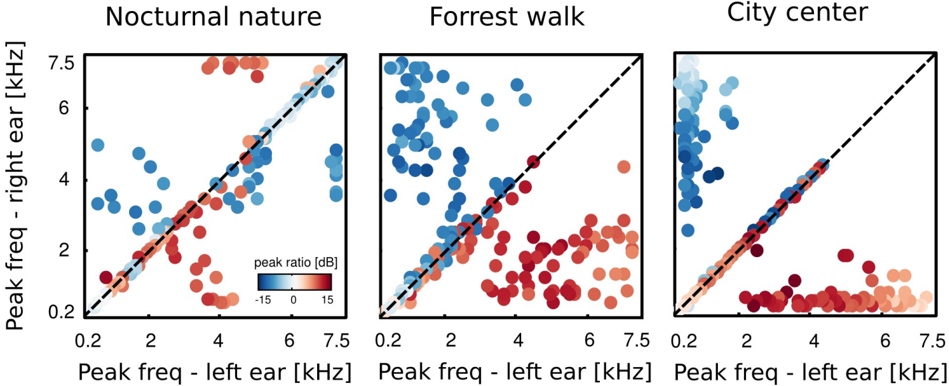
The image presents three scatter plots comparing the peak frequency perceived by the left and right ears in different environments: "Nocturnal nature," "Forrest walk," and "City center." Each plot displays data points colored according to the "peak ratio" in decibels (dB), ranging from -15 dB (blue) to +15 dB (red). The x-axis represents the peak frequency perceived by the left ear, and the y-axis represents the peak frequency perceived by the right ear, both measured in kilohertz (kHz). A dashed diagonal line is present in each plot, representing the scenario where both ears perceive the same peak frequency.
### Components/Axes
* **Titles:**
* Top-left plot: "Nocturnal nature"
* Top-middle plot: "Forrest walk"
* Top-right plot: "City center"
* **X-axis (all plots):** "Peak freq - left ear [kHz]"
* Scale: 0.2, 2, 4, 6, 7.5
* **Y-axis (all plots):** "Peak freq - right ear [kHz]"
* Scale: 0.2, 2, 4, 6, 7.5
* **Color Legend:** Located between the top-left and top-middle plots.
* Label: "peak ratio [dB]"
* Color gradient: Blue (-15 dB) to Red (15 dB), with a midpoint at 0 dB.
* **Diagonal Line:** Dashed line representing equal peak frequencies in both ears.
### Detailed Analysis
**1. Nocturnal Nature:**
* **Trend:** Data points are scattered. There is a cluster of red points (positive peak ratio) below the diagonal line, indicating that the left ear perceives a higher peak frequency than the right ear for these points. Blue points (negative peak ratio) are mostly above the diagonal line, indicating the right ear perceives a higher peak frequency.
* **Data Points:**
* Red points (peak ratio ~15 dB): Cluster around left ear frequency 4-7.5 kHz and right ear frequency 0.2-2 kHz.
* Blue points (peak ratio ~-15 dB): Scattered, with some around left ear frequency 0.2-4 kHz and right ear frequency 4-7.5 kHz.
**2. Forrest Walk:**
* **Trend:** Data points are more scattered than in the "City center" plot. There is a concentration of blue points above the diagonal line and red points below.
* **Data Points:**
* Blue points (peak ratio ~-15 dB): Predominantly located above the diagonal line, with left ear frequency ranging from 0.2-4 kHz and right ear frequency ranging from 2-7.5 kHz.
* Red points (peak ratio ~15 dB): Predominantly located below the diagonal line, with left ear frequency ranging from 2-7.5 kHz and right ear frequency ranging from 0.2-2 kHz.
**3. City Center:**
* **Trend:** Data points are clustered closely around the diagonal line, especially in the lower-left region. This indicates that the peak frequencies perceived by both ears are similar in this environment.
* **Data Points:**
* Points near the diagonal line: Concentrated between 0.2 and 4 kHz for both ears. The color gradient shows a mix of blue and red points along the diagonal, indicating a smaller peak ratio difference between the ears.
* Red points (peak ratio ~15 dB): Cluster below the diagonal line, with left ear frequency ranging from 2-7.5 kHz and right ear frequency ranging from 0.2-2 kHz.
* Blue points (peak ratio ~-15 dB): Cluster above the diagonal line, with left ear frequency ranging from 0.2-4 kHz and right ear frequency ranging from 4-7.5 kHz.
### Key Observations
* In "Nocturnal nature" and "Forrest walk," there is a clear separation of data points based on the peak ratio, with blue points generally above the diagonal and red points below.
* In "City center," the data points are more tightly clustered around the diagonal, suggesting a smaller difference in peak frequency perception between the two ears.
* The "peak ratio" appears to be correlated with the relative peak frequencies perceived by each ear. A positive peak ratio (red) indicates the left ear perceives a higher peak frequency, while a negative peak ratio (blue) indicates the right ear perceives a higher peak frequency.
### Interpretation
The plots suggest that the environment significantly influences the difference in peak frequency perception between the left and right ears. In the "City center," the peak frequencies perceived by both ears are more similar, possibly due to the more uniform and consistent soundscape. In contrast, "Nocturnal nature" and "Forrest walk" exhibit greater differences in peak frequency perception, potentially due to the more varied and directional nature of sounds in these environments. The peak ratio (dB) provides a measure of the relative dominance of peak frequencies perceived by each ear, with positive values indicating left-ear dominance and negative values indicating right-ear dominance. The data suggests that the brain may be processing sound differently in these environments, potentially to better localize and interpret sounds.