## Diagram: Formal Proof Process with Math Library Integration
### Overview
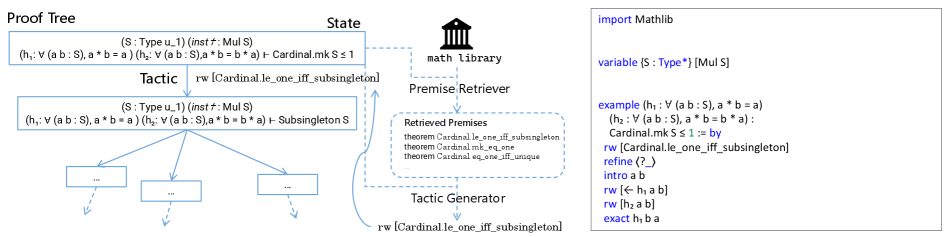
The image depicts a technical diagram illustrating a formal proof process using a math library, combined with code snippets. It shows a hierarchical structure of proof states, tactics, and theorem retrieval, alongside a code example demonstrating the application of these concepts.
### Components/Axes
1. **Left Diagram (Proof Tree/State)**:
- **Proof Tree**:
- Top box: `(S : Type u_1) (inst : Mul S)` with hypotheses `h₁ : ∀ (a b : S), a * b = a` and `h₂ : ∀ (a b : S), a * b = b * a`.
- Middle box: Tactic `rw [Cardinal.le_one_iff_subsingleton]` applied to the same hypotheses.
- Bottom box: State with refined hypotheses using `Subsingleton S`.
- **State**:
- Arrows indicate transitions between proof states, with dashed lines connecting to the "Premise Retriever" and "Tactic Generator."
- **Premise Retriever**:
- Lists retrieved theorems: `Cardinal.le_one_iff_subsingleton`, `Cardinal.mk_eq_one`, and `Cardinal.eq_one_iff_unique`.
- **Tactic Generator**:
- Outputs `rw [Cardinal.le_one_iff_subsingleton]` based on the state.
2. **Right Code Block**:
- Imports `Mathlib`.
- Defines a variable `S : Type*` and an example with hypotheses `h₁` and `h₂`.
- Uses tactics: `rw [Cardinal.le_one_iff_subsingleton]`, `refine`, `intro`, and `exact`.
### Detailed Analysis
- **Proof Tree Structure**:
- The proof tree starts with a type `S` and an instance `Mul S`, representing a multiplicative structure.
- Hypotheses `h₁` and `h₂` assert commutativity (`a * b = a` and `a * b = b * a`), which are refined using the `Subsingleton` property.
- The tactic `rw [Cardinal.le_one_iff_subsingleton]` links the proof to the math library's cardinality lemma, which states that a type has cardinality ≤ 1 if and only if it is a subsingleton.
- **Code Integration**:
- The code mirrors the diagram's logic, importing the math library and defining an example with the same hypotheses.
- The `rw` tactic in the code corresponds to the proof tree's refinement step, applying the cardinality lemma to simplify the proof.
### Key Observations
- **Flow of Proof**:
- The diagram shows a bottom-up approach: starting with hypotheses, applying tactics, and refining the state using library theorems.
- The dashed lines suggest iterative refinement, where the tactic generator produces new steps based on the current state.
- **Math Library Role**:
- The `Cardinal.le_one_iff_subsingleton` theorem is central, connecting the proof's hypotheses to the library's properties of types with ≤1 elements.
- **Code-Theorem Alignment**:
- The code's `rw` tactic directly references the lemma from the diagram, demonstrating how formal proofs are implemented in code.
### Interpretation
This diagram and code illustrate a formal verification workflow where:
1. **Hypotheses** are structured in a proof tree, with each state representing a refinement step.
2. **Tactics** (e.g., `rw`, `refine`) manipulate these hypotheses using theorems from a math library.
3. **Premise Retrieval** ensures that library theorems (like cardinality properties) are available to simplify proofs.
4. The code example validates the process by implementing the same logic, showing how formal proofs are translated into executable code.
The integration of the math library enables automated reasoning about algebraic structures (e.g., commutativity, subsingletons), while the diagram visualizes the logical flow of proof construction. This setup is typical in proof assistants like Lean or Coq, where code and formal proofs are tightly coupled.