## Flowchart: Rule Extraction Methods from Feedforward Neural Networks
### Overview
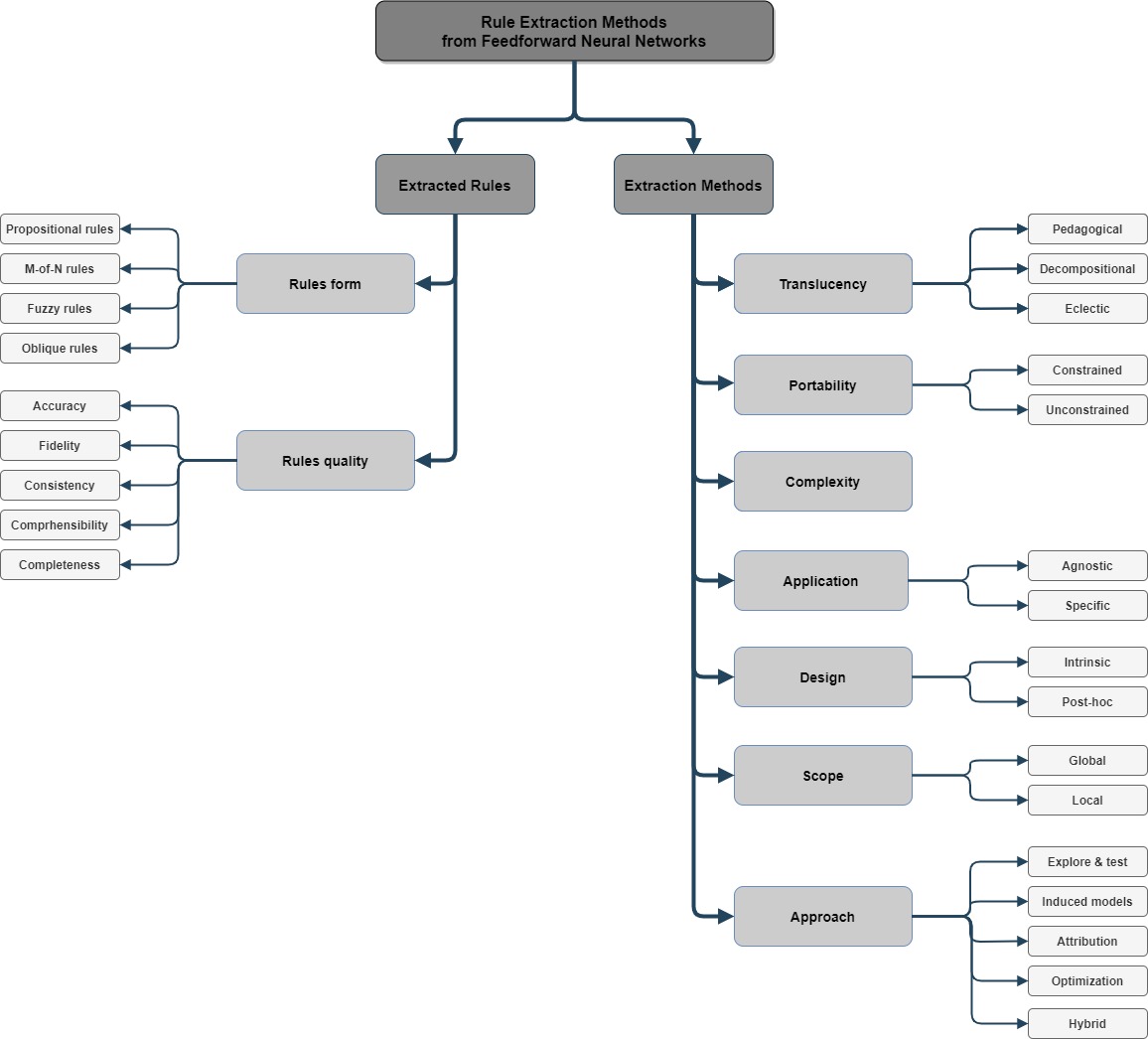
The flowchart illustrates a hierarchical taxonomy of rule extraction methods from feedforward neural networks, divided into two primary branches: **Extracted Rules** and **Extraction Methods**. Each branch further subdivides into specific categories and subcategories, detailing technical criteria and classifications.
### Components/Axes
1. **Main Title**: "Rule Extraction Methods from Feedforward Neural Networks" (center-top).
2. **Primary Branches**:
- **Extracted Rules** (left branch):
- **Rules form**: Propositional rules, M-of-N rules, Fuzzy rules, Oblique rules.
- **Rules quality**: Accuracy, Fidelity, Consistency, Comprehensibility, Completeness.
- **Extraction Methods** (right branch):
- **Translucency**: Pedagogical, Decompositional, Eclectic.
- **Portability**: Constrained, Unconstrained.
- **Complexity**: (No subcategories listed).
- **Application**: Agnostic, Specific.
- **Design**: Intrinsic, Post-hoc.
- **Scope**: Global, Local.
- **Approach**: Explore & test, Induced models, Attribution, Optimization, Hybrid.
### Detailed Analysis
- **Extracted Rules**:
- **Rules form** categorizes rules by structural type (e.g., propositional vs. fuzzy).
- **Rules quality** evaluates extracted rules using metrics like accuracy, fidelity, and comprehensibility.
- **Extraction Methods**:
- **Translucency** describes interpretability approaches (e.g., pedagogical for teaching, decompositional for breaking down models).
- **Portability** distinguishes between constrained (domain-specific) and unconstrained (generalizable) methods.
- **Application** and **Design** differentiate between agnostic (model-agnostic) vs. specific (model-dependent) and intrinsic (built-in) vs. post-hoc (after-the-fact) methods.
- **Scope** and **Approach** further classify methods by their applicability (global/local) and technical strategy (e.g., optimization, hybrid models).
### Key Observations
- The flowchart emphasizes **diverse criteria** for evaluating extracted rules (e.g., quality metrics) and extraction methods (e.g., translucency, portability).
- **Extraction Methods** are subdivided into technical, practical, and strategic dimensions (e.g., design, scope, approach).
- No numerical data or trends are present; the diagram focuses on categorical relationships.
### Interpretation
This flowchart provides a structured framework for understanding how rules are extracted from neural networks and how their quality and applicability are assessed. The **Extracted Rules** branch highlights the types of rules and their evaluative criteria, while the **Extraction Methods** branch emphasizes methodological diversity, from interpretability (translucency) to practical deployment (portability). The absence of numerical data suggests the diagram is conceptual, intended to guide researchers or practitioners in selecting or designing rule extraction strategies based on technical and application-specific requirements.