## Diagram: Rule Extraction Methods from Feedforward Neural Networks
### Overview
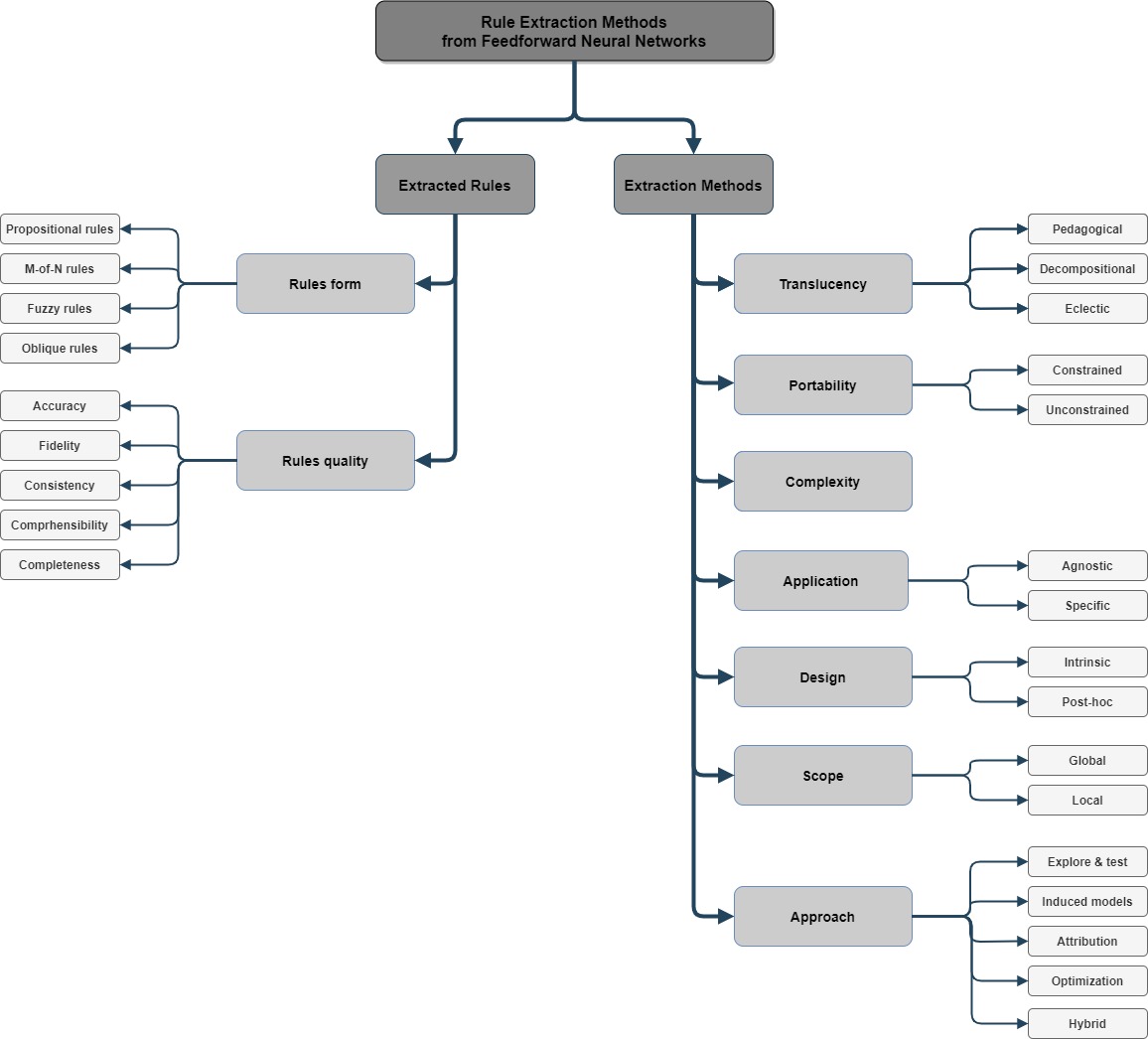
The image is a flowchart illustrating rule extraction methods from feedforward neural networks. It categorizes these methods based on "Extracted Rules" and "Extraction Methods," further branching into subcategories and specific types.
### Components/Axes
* **Title:** Rule Extraction Methods from Feedforward Neural Networks (located at the top-center of the image)
* **Main Categories:**
* Extracted Rules (left side)
* Extraction Methods (right side)
* **Subcategories for Extracted Rules:**
* Rules form
* Propositional rules
* M-of-N rules
* Fuzzy rules
* Oblique rules
* Rules quality
* Accuracy
* Fidelity
* Consistency
* Comprehensibility
* Completeness
* **Subcategories for Extraction Methods:**
* Translucency
* Pedagogical
* Decompositional
* Eclectic
* Portability
* Constrained
* Unconstrained
* Complexity
* Application
* Agnostic
* Specific
* Design
* Intrinsic
* Post-hoc
* Scope
* Global
* Local
* Approach
* Explore & test
* Induced models
* Attribution
* Optimization
* Hybrid
### Detailed Analysis
The diagram starts with the main title at the top, branching into two main categories: "Extracted Rules" and "Extraction Methods." Each of these categories is further divided into subcategories, which then branch out into specific types or characteristics.
* **Extracted Rules:**
* "Rules form" includes types of rules such as Propositional, M-of-N, Fuzzy, and Oblique rules.
* "Rules quality" includes metrics such as Accuracy, Fidelity, Consistency, Comprehensibility, and Completeness.
* **Extraction Methods:**
* "Translucency" includes Pedagogical, Decompositional, and Eclectic methods.
* "Portability" includes Constrained and Unconstrained methods.
* "Complexity" is a standalone category without further branching.
* "Application" includes Agnostic and Specific applications.
* "Design" includes Intrinsic and Post-hoc designs.
* "Scope" includes Global and Local scopes.
* "Approach" includes Explore & test, Induced models, Attribution, Optimization, and Hybrid approaches.
### Key Observations
* The diagram provides a hierarchical classification of rule extraction methods.
* The "Extracted Rules" branch focuses on the nature and quality of the extracted rules.
* The "Extraction Methods" branch focuses on the techniques and characteristics of the extraction process.
* The diagram is comprehensive, covering various aspects of rule extraction from feedforward neural networks.
### Interpretation
The diagram serves as a taxonomy of rule extraction methods, providing a structured overview of the field. It highlights the different dimensions along which these methods can be classified, such as the form and quality of the extracted rules, as well as the characteristics of the extraction process itself. This information is valuable for researchers and practitioners in the field of machine learning and neural networks, as it helps them understand the landscape of rule extraction methods and choose the most appropriate method for their specific needs. The diagram suggests that rule extraction is a multifaceted problem with considerations spanning rule representation, rule quality, and the extraction methodology itself.