## Comic Strip: Programming Language Legal Dispute
### Overview
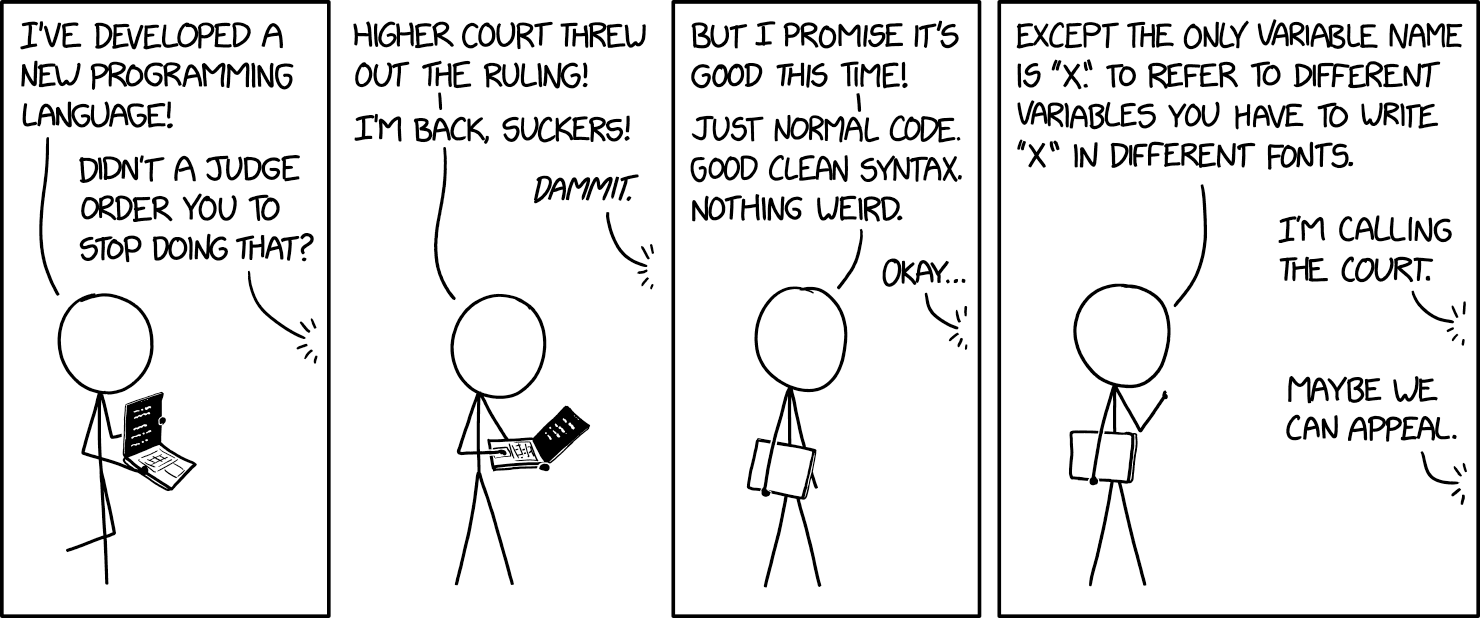
This is a four-panel comic strip in a minimalist black-and-white stick-figure style. It depicts a humorous narrative about a programmer who creates a new programming language, faces legal action, and attempts to circumvent the ruling with a technically compliant but absurdly impractical design. The comic satirizes both overly complex programming language design and legal technicalities.
### Components/Axes
- **Format**: Four sequential panels arranged horizontally.
- **Characters**: Two stick figures. One is the programmer (holding a laptop in panels 1-2, holding a book/folder in panels 3-4). The other is an off-screen interlocutor (represented only by dialogue bubbles with jagged tails indicating speech from outside the frame).
- **Visual Elements**: Simple line drawings. The programmer's laptop shows a generic code editor interface in the first two panels. The book/folder in the last two panels is blank.
- **Text**: All text is in uppercase, handwritten-style font within speech bubbles. Sound effects ("DAMMIT.") are written directly in the panel.
### Detailed Analysis / Content Details
**Panel 1 (Leftmost):**
- **Scene**: Programmer stands holding an open laptop.
- **Dialogue (Programmer)**: "I'VE DEVELOPED A NEW PROGRAMMING LANGUAGE!"
- **Dialogue (Off-screen)**: "DIDN'T A JUDGE ORDER YOU TO STOP DOING THAT?"
- **Visual Note**: The off-screen speaker's bubble has a jagged tail pointing to the right edge of the panel.
**Panel 2:**
- **Scene**: Programmer looks triumphant, still holding the laptop.
- **Dialogue (Programmer)**: "HIGHER COURT THREW OUT THE RULING! I'M BACK, SUCKERS!"
- **Sound Effect**: "DAMMIT." written near the right edge, with small lines indicating it's an exclamation from the off-screen character.
- **Visual Note**: The programmer's posture is more animated, suggesting excitement.
**Panel 3:**
- **Scene**: Programmer now holds a closed book or folder, looking reassuring.
- **Dialogue (Programmer)**: "BUT I PROMISE IT'S GOOD THIS TIME! JUST NORMAL CODE. GOOD CLEAN SYNTAX. NOTHING WEIRD."
- **Dialogue (Off-screen)**: "OKAY..."
- **Visual Note**: The off-screen character's bubble has a hesitant, trailing tail.
**Panel 4 (Rightmost):**
- **Scene**: Programmer holds the book/folder and gestures with one hand.
- **Dialogue (Programmer)**: "EXCEPT THE ONLY VARIABLE NAME IS 'X.' TO REFER TO DIFFERENT VARIABLES YOU HAVE TO WRITE 'X' IN DIFFERENT FONTS."
- **Dialogue (Off-screen)**: "I'M CALLING THE COURT." followed by "MAYBE WE CAN APPEAL."
- **Visual Note**: The final off-screen dialogue is split into two bubbles, indicating a resigned, two-part statement.
### Key Observations
1. **Narrative Arc**: The comic follows a clear sequence: announcement → legal conflict → resolution/return → new absurd condition → immediate rejection.
2. **Humor Mechanism**: The joke relies on a bait-and-switch. The programmer claims to have a "normal" language after legal trouble, but the sole rule (using fonts to distinguish variables) is a parody of overly clever or impractical language features.
3. **Visual Storytelling**: The programmer's prop changes from a laptop (active coding) to a book/folder (presenting a specification), visually signaling a shift from action to explanation.
4. **Pacing**: The off-screen character's reactions progress from questioning ("Didn't a judge...") to reluctant acceptance ("Okay...") to immediate legal retaliation ("I'm calling the court."), driving the comedic timing.
### Interpretation
This comic is a satire targeting two interconnected themes:
1. **Programming Language Design**: It mocks the creation of languages with gimmicky or unnecessarily complex syntax rules that prioritize novelty over usability. The "different fonts for the same variable name" idea is an extreme example of a feature that is technically possible but practically unusable, highlighting the difference between theoretical cleverness and practical engineering.
2. **Legal and Technical Loopholes**: The narrative humorously explores the idea of complying with the letter of a legal ruling while violating its spirit. The programmer technically stops "doing that" (presumably creating bad languages) by creating a language with one absurd rule, which is a different kind of "bad." The off-screen character's immediate move to involve the court again suggests that such loopholes are transparent and frustrating.
The comic suggests that true innovation in technical fields requires genuine improvement, not just clever circumvention of constraints. The programmer's enthusiasm is framed as misguided, while the off-screen character represents a pragmatic, if exasperated, voice of reason. The final panel's punchline underscores that some ideas are so fundamentally flawed that they invite immediate rejection, regardless of their technical compliance with previous agreements.