\n
## Diagram: Key-Value Store Data Flow
### Overview
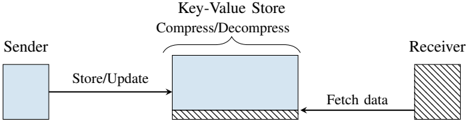
This diagram illustrates the data flow between a Sender, a Key-Value Store, and a Receiver. The Key-Value Store performs compression and decompression operations on the data. The diagram uses arrows to indicate the direction of data transfer and labels to describe the actions performed.
### Components/Axes
The diagram consists of three main components:
* **Sender:** Represented by a solid rectangle, positioned on the left side of the diagram.
* **Key-Value Store:** Represented by a large light-blue rectangle in the center. It has a hatched section at the bottom.
* **Receiver:** Represented by a rectangle filled with diagonal lines, positioned on the right side of the diagram.
The following labels are present:
* **Key-Value Store:** Located above the central rectangle.
* **Compress/Decompress:** A curved label above the Key-Value Store, with a brace connecting it to the rectangle.
* **Store/Update:** Labelled on the arrow originating from the Sender and pointing towards the Key-Value Store.
* **Fetch data:** Labelled on the arrow originating from the Key-Value Store and pointing towards the Receiver.
### Detailed Analysis or Content Details
The diagram shows a unidirectional data flow:
1. The Sender sends data to the Key-Value Store, labeled as "Store/Update".
2. The Key-Value Store processes the data, indicated by the "Compress/Decompress" label. The hatched section at the bottom of the Key-Value Store may represent stored data.
3. The Key-Value Store then sends data to the Receiver, labeled as "Fetch data".
There are no numerical values or specific data points present in the diagram. It is a conceptual representation of a data flow process.
### Key Observations
The diagram highlights the role of the Key-Value Store as an intermediary that handles data storage, updates, compression, and decompression. The use of arrows clearly indicates the direction of data transfer. The hatched section within the Key-Value Store suggests a storage component.
### Interpretation
The diagram demonstrates a simplified model of how data is managed using a Key-Value Store. The Sender initiates a data operation (store or update), the Key-Value Store processes the data, and the Receiver retrieves the data. The compression/decompression step suggests that the Key-Value Store optimizes data storage and retrieval. This architecture is common in distributed systems and caching mechanisms where efficient data access is crucial. The diagram does not specify the type of data being stored or the specific compression algorithms used. It is a high-level overview of the data flow, focusing on the core components and their interactions.