## Diagram: Data Flow with Key-Value Store
### Overview
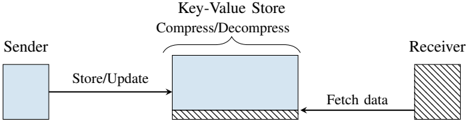
The image is a technical system architecture diagram illustrating a data flow process between three primary components: a Sender, a central Key-Value Store, and a Receiver. The diagram uses simple geometric shapes and labeled arrows to depict the direction and nature of data operations.
### Components/Axes
The diagram is composed of three main rectangular blocks arranged horizontally from left to right, connected by directional arrows with action labels.
1. **Sender** (Leftmost component):
* **Shape**: A simple, light-blue filled rectangle.
* **Label**: "Sender" is written above the rectangle.
* **Position**: Located on the far left of the diagram.
2. **Key-Value Store** (Central component):
* **Shape**: A larger, light-blue filled rectangle. The bottom portion of this rectangle has a diagonal hatched pattern (lines sloping from top-left to bottom-right).
* **Label**: "Key-Value Store" is written above the rectangle.
* **Additional Annotation**: A curly brace (`{`) is drawn above the rectangle, spanning its width. The text "Compress/Decompress" is written above this brace, indicating an internal process within the store.
* **Position**: Centered in the diagram, between the Sender and Receiver.
3. **Receiver** (Rightmost component):
* **Shape**: A rectangle filled with a diagonal hatched pattern (lines sloping from top-right to bottom-left), distinct from the pattern in the Key-Value Store.
* **Label**: "Receiver" is written above the rectangle.
* **Position**: Located on the far right of the diagram.
### Detailed Analysis: Flow and Actions
The data flow and operations are defined by three labeled arrows:
1. **Arrow 1 (Sender to Key-Value Store)**:
* **Direction**: A solid black arrow points from the right side of the "Sender" rectangle to the left side of the "Key-Value Store" rectangle.
* **Label**: The text "Store/Update" is written above this arrow.
* **Interpretation**: The Sender initiates the process by sending data to the Key-Value Store for storage or to update an existing entry.
2. **Internal Process (Within Key-Value Store)**:
* **Representation**: The curly brace and the label "Compress/Decompress" above the Key-Value Store.
* **Interpretation**: Data within the store undergoes compression when stored and decompression when retrieved. This is a core function of this component.
3. **Arrow 2 (Key-Value Store to/from Receiver)**:
* **Direction**: A solid black arrow points from the right side of the "Key-Value Store" rectangle to the left side of the "Receiver" rectangle.
* **Label**: The text "Fetch data" is written above this arrow.
* **Interpretation**: The Receiver actively requests ("fetches") data from the Key-Value Store. The arrow direction indicates the data flows from the store to the receiver upon this request.
### Key Observations
* **Asymmetric Flow**: The process is not a simple linear pipeline. The Sender pushes data in ("Store/Update"), but the Receiver pulls data out ("Fetch data").
* **Component Differentiation**: The "Receiver" and the bottom of the "Key-Value Store" share a similar hatched pattern, which may visually group them or indicate a shared property (e.g., both being persistent storage or having a specific access method), though this is not explicitly stated.
* **Centralized Logic**: The "Compress/Decompress" function is encapsulated within the Key-Value Store, suggesting it is a transparent service to both the Sender and Receiver.
### Interpretation
This diagram models a common decoupled data architecture pattern. The **Sender** (e.g., an application, sensor, or data producer) is responsible for writing data. The **Key-Value Store** acts as an intermediary persistence layer that not only stores data but also manages its efficiency through compression. The **Receiver** (e.g., a consumer application, analytics service, or UI) operates independently, querying the store for the data it needs.
The separation allows the Sender and Receiver to operate at different paces and scales. The inclusion of compression/decompression within the store highlights a design consideration for optimizing storage space and/or network transfer costs during the "Fetch data" operation. The hatched pattern on the Receiver might imply it is a different class of component—perhaps a batch processor or a system with different access patterns compared to the real-time Sender. The overall flow emphasizes a pull-based model for data consumption, which is typical in systems where consumers control their data intake rate.