## Diagram Type: Key-Value Store
### Overview
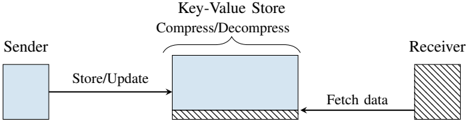
The diagram illustrates the process of data transmission between a sender and a receiver, involving a key-value store for data compression and decompression.
### Components/Axes
- **Sender**: A component that sends data.
- **Receiver**: A component that receives data.
- **Key-Value Store**: A central component that stores and retrieves data.
- **Compress/Decompress**: A process that compresses data for transmission and decompresses it upon receipt.
- **Store/Update**: The action of storing or updating data in the key-value store.
- **Fetch data**: The action of retrieving data from the key-value store.
### Detailed Analysis or ### Content Details
The sender sends data to the key-value store, which compresses the data using a compress/decompress process. The compressed data is then sent to the receiver, where it is decompressed and fetched from the key-value store. The receiver then processes the data.
### Key Observations
- The key-value store acts as a central hub for data storage and retrieval.
- The compress/decompress process is essential for efficient data transmission over networks.
- The store/update and fetch data actions are critical for maintaining and accessing the data in the key-value store.
### Interpretation
The diagram demonstrates the concept of data compression and decompression in a key-value store architecture. It highlights the importance of a central storage component and the need for efficient data transmission processes. The key-value store allows for quick access and retrieval of data, while the compress/decompress process ensures that data can be transmitted over networks without significant loss of information. The store/update and fetch data actions ensure that the data in the key-value store is up-to-date and accessible when needed.