TECHNICAL ASSET FINGERPRINT
b885906247f028f2905d1e36
Click to view fullscreen
Press ESC or click to close
FOUND IN PAPERS
EXPERT: gemini-3.1-pro-preview VERSION 1
RUNTIME: gemini/gemini-3.1-pro-preview
INTEL_VERIFIED
## Heatmap: Bridge Node Appearance Over Early Iterations
### Overview
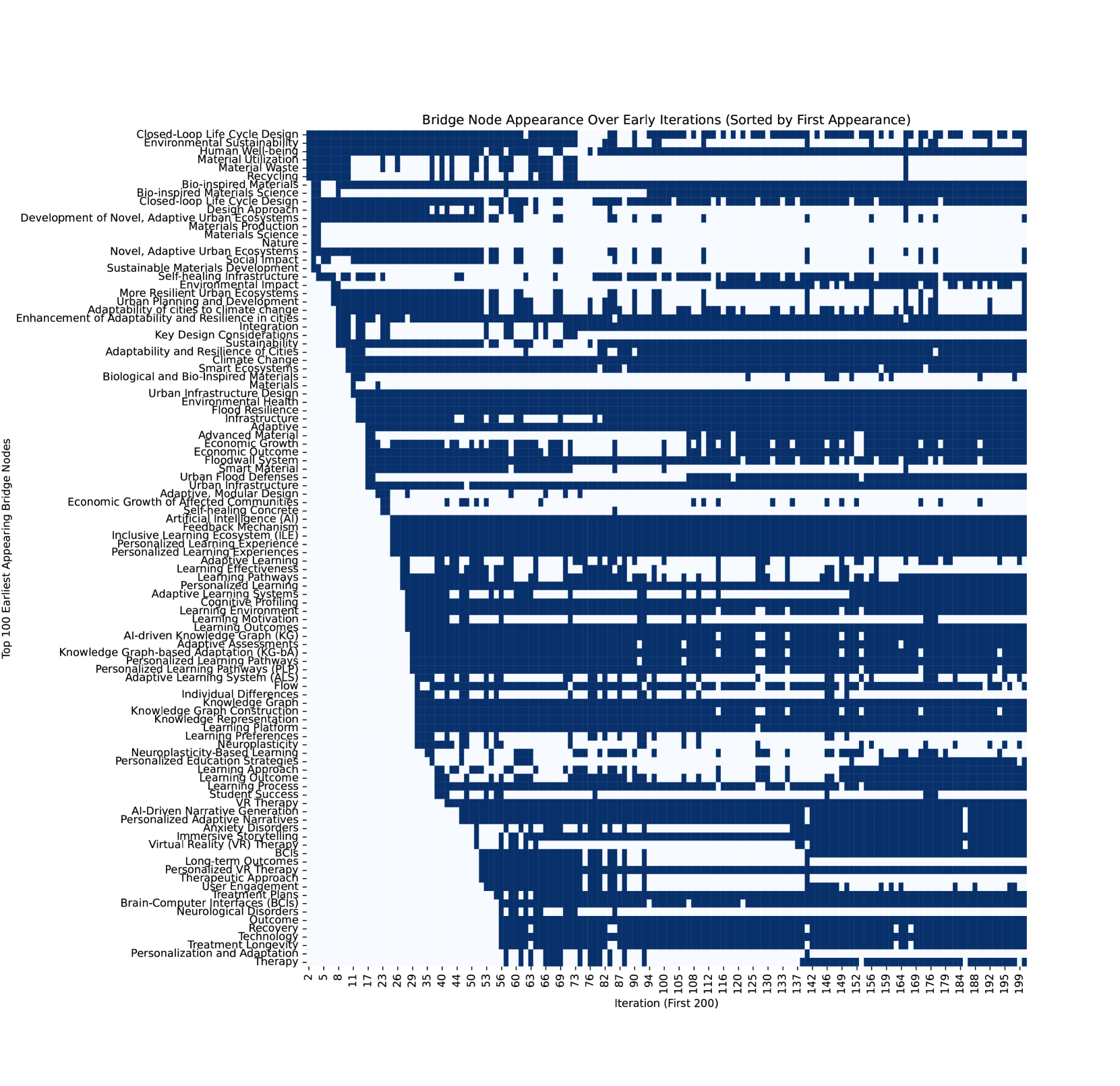
This image is a binary heatmap titled "Bridge Node Appearance Over Early Iterations (Sorted by First Appearance)". It visualizes the presence or absence of 100 specific conceptual "Bridge Nodes" across the first 200 iterations of a process. The data is sorted so that nodes appearing in the earliest iterations are at the top, creating a distinct cascading "waterfall" or "staircase" visual pattern from the top-left to the bottom-right. Dark blue indicates the presence/activation of a node, while white indicates its absence.
### Components/Axes
* **Header / Title (Top Center):** "Bridge Node Appearance Over Early Iterations (Sorted by First Appearance)"
* **Y-Axis (Left):**
* **Title:** "Top 100 Earliest Appearing Bridge Nodes"
* **Labels:** 100 distinct text labels representing concepts, technologies, and domains. (Transcribed fully in the Content Details section).
* **X-Axis (Bottom):**
* **Title:** "Iteration (First 200)"
* **Markers (Ticks):** Non-linear, discrete numerical markers representing specific iteration steps. The visible ticks are: 2, 5, 8, 11, 17, 23, 26, 29, 35, 40, 44, 50, 53, 56, 60, 63, 66, 69, 73, 76, 82, 87, 90, 94, 100, 105, 108, 112, 116, 120, 125, 130, 133, 137, 142, 146, 149, 152, 156, 159, 164, 169, 176, 179, 184, 188, 192, 195, 199.
* **Legend / Data Representation:** There is no explicit legend box. However, spatial grounding and visual context dictate:
* **Dark Blue Rectangle:** Node is present/active at that specific iteration.
* **White Space:** Node is absent/inactive at that specific iteration.
### Content Details
#### Trend Verification & Spatial Grounding
1. **The Cascading Edge:** The most prominent visual trend is the left-most edge of the blue data points. It slopes downward and to the right. The top-most node first appears at iteration 2 (far left). The bottom-most node first appears around iteration 56 (center-left).
2. **Continuity vs. Fragmentation:**
* Some rows feature a solid dark blue line from their first appearance all the way to iteration 199 (far right). This indicates permanent retention of the concept once introduced.
* Other rows are highly fragmented, appearing as dashed blue lines (e.g., the 4th row down, "Material Utilization"). This indicates concepts that are temporarily relevant, discarded, and revisited.
#### Y-Axis Label Transcription (Ordered Top to Bottom)
*Note: The list reveals distinct thematic clustering as one moves down the axis.*
1. Closed-Loop Life Cycle Design
2. Environmental Sustainability
3. Human Well-being
4. Material Utilization
5. Material Waste
6. Recycling
7. Bio-inspired Materials
8. Bio-inspired Materials Science
9. Closed-loop Life Cycle Design *(Note: Lowercase 'l' in loop, distinct from item 1)*
10. Design Approach
11. Development of Novel, Adaptive Urban Ecosystems
12. Materials Production
13. Materials Science
14. Nature
15. Novel, Adaptive Urban Ecosystems
16. Social Impact
17. Sustainable Materials Development
18. Self-healing Infrastructure
19. Environmental Impact
20. More Resilient Urban Ecosystems
21. Urban Planning and Development
22. Adaptability of cities to climate change
23. Enhancement of Adaptability and Resilience in cities
24. Integration
25. Key Design Considerations
26. Sustainability
27. Adaptability and Resilience of Cities
28. Climate Change
29. Smart Ecosystems
30. Biological and Bio-Inspired Materials
31. Resilience
32. Urban Infrastructure Design
33. Environmental Health
34. Flood Resilience
35. Infrastructure
36. Adaptive
37. Advanced Material
38. Economic Growth
39. Economic Outcome
40. Floodwall System
41. Smart Material
42. Urban Flood Defenses
43. Urban Infrastructure
44. Adaptive, Modular Design
45. Economic Growth of Affected Communities
46. Learning Pathways
47. Artificial Intelligence (AI)
48. Feedback Mechanism
49. Inclusive Learning Ecosystem (ILE)
50. Personalized Learning Environment
51. Personalized Learning Experiences
52. Adaptive Learning
53. Learning Effectiveness
54. Learning Process
55. Personalized Learning
56. Adaptive Learning Systems
57. Cognitive Profiling
58. Learning Environment
59. Learning Motivation
60. Learning Outcomes
61. AI-driven Knowledge Graph (KG)
62. Adaptive Interventions
63. Knowledge Graph-based Adaptation (KG-bA)
64. Personalized Learning Pathways
65. Personalized Learning Pathways (PLP)
66. Adaptive Learning System (ALS)
67. Flow
68. Individual Differences
69. Knowledge Graph
70. Knowledge Graph Construction
71. Knowledge Representation
72. Learning Platform
73. Learning Approach
74. Neuroplasticity
75. Neuroplasticity-Based Learning
76. Personalized Education Strategies
77. Learning Approach *(Repeated)*
78. Learning Outcome
79. Learning Process *(Repeated)*
80. Student Success
81. AI
82. AI-Driven Narrative Generation
83. Personalized Adaptive Narratives
84. Anxiety Disorders
85. Immersive Storytelling
86. Virtual Reality (VR) Therapy
87. BCIs
88. Long-term Outcomes
89. Personalized VR Therapy
90. Therapeutic Approach
91. User Engagement
92. Treatment Efficacy
93. Brain-Computer Interfaces (BCIs)
94. Neurological Disorders
95. Outcome
96. Recovery
97. Technology
98. Treatment Longevity
99. Personalization and Adaptation
100. Therapy
### Key Observations
* **Thematic Shifts over Time:** The graph visually captures a system moving through distinct conceptual phases.
* **Iterations 2-11 (Top rows):** Focus is heavily on Materials Science, Sustainability, and Ecology.
* **Iterations 11-26 (Upper-middle rows):** The focus shifts to Urban Planning, Infrastructure, and Climate Resilience.
* **Iterations 26-44 (Lower-middle rows):** A massive shift occurs toward Artificial Intelligence, Education, and Personalized Learning.
* **Iterations 44-60 (Bottom rows):** The final shift moves into Medical/Therapeutic domains, specifically VR Therapy, Brain-Computer Interfaces (BCIs), and Neurological Disorders.
* **Foundational vs. Ephemeral Nodes:**
* Nodes like "Urban Infrastructure Design" (Row 32), "Artificial Intelligence (AI)" (Row 47), and "Virtual Reality (VR) Therapy" (Row 86) become solid blue blocks immediately upon introduction. They are foundational to the iterations that follow.
* Nodes like "Economic Growth" (Row 38) and "Learning Effectiveness" (Row 53) are highly fragmented, appearing and disappearing frequently, suggesting they are context-dependent variables rather than core structural pillars.
* **Redundancy:** There are near-duplicates in the system's generated nodes (e.g., "Learning Process" appears at row 54 and row 79; "Closed-Loop Life Cycle Design" appears at row 1 and row 9 with different capitalization).
### Interpretation
This heatmap likely represents the diagnostic output of an iterative, generative AI process—such as an automated literature review, a knowledge graph construction algorithm, or an evolutionary ideation agent.
The term "Bridge Node" is the critical clue. The algorithm appears to be tasked with connecting disparate fields of study. It does not explore randomly; it follows a logical, chained progression. It begins with physical materials and sustainability, uses "Urban Ecosystems" as a bridge to infrastructure, uses "Smart Ecosystems/AI" as a bridge to learning and cognitive profiling, and finally uses "Neuroplasticity" as a bridge into clinical therapies (VR and BCIs).
The solid blue lines represent the "anchors" of the knowledge graph—once the system discovers "Artificial Intelligence," it keeps it active in its working memory for all subsequent iterations. The fragmented lines represent the system testing specific applications or sub-topics (like "Floodwall System" or "Anxiety Disorders") against those anchors, dropping them when they don't yield useful connections, and picking them up again later.
Ultimately, the chart demonstrates a successful, directed traversal across four major academic/technical disciplines within 60 iterations, after which it spends iterations 60-200 refining and cross-referencing those established domains.
DECODING INTELLIGENCE...