\n
## Directed Acyclic Graph (DAG): Causal Model of College Admission
### Overview
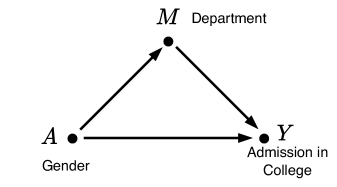
The image displays a simple directed acyclic graph (DAG) or causal diagram. It consists of three nodes (represented by black dots) connected by three directed arrows, forming a triangular structure. The diagram illustrates hypothesized causal relationships between three variables: Gender, Department, and Admission in College.
### Components/Axes
The diagram has no traditional axes, legends, or scales. Its components are nodes and directed edges (arrows).
**Nodes (Variables):**
1. **Node A**: Located at the bottom-left of the diagram. It is labeled with the letter "**A**" and the descriptive text "**Gender**".
2. **Node M**: Located at the top-center of the diagram. It is labeled with the letter "**M**" and the descriptive text "**Department**".
3. **Node Y**: Located at the bottom-right of the diagram. It is labeled with the letter "**Y**" and the descriptive text "**Admission in College**".
**Directed Edges (Arrows):**
1. An arrow originates from **Node A (Gender)** and points to **Node M (Department)**.
2. An arrow originates from **Node M (Department)** and points to **Node Y (Admission in College)**.
3. An arrow originates from **Node A (Gender)** and points directly to **Node Y (Admission in College)**.
### Detailed Analysis
The diagram is a visual representation of a causal model. The arrows indicate the direction of hypothesized influence or causation.
* **Path 1 (Indirect Effect):** `A (Gender) → M (Department) → Y (Admission in College)`. This path suggests that Gender may influence which Department a person applies to or is assigned to, and that Department, in turn, influences the likelihood of Admission.
* **Path 2 (Direct Effect):** `A (Gender) → Y (Admission in College)`. This path suggests a direct influence of Gender on Admission outcomes, independent of Department.
The structure implies that the variable "Department" (M) is a potential **mediator** for the effect of "Gender" (A) on "Admission" (Y). It also allows for a direct effect of Gender on Admission.
### Key Observations
1. **Triangular Structure:** The three nodes form a closed triangle, indicating a system where all variables are interconnected.
2. **Dual Pathways:** There are two distinct pathways from Gender (A) to Admission (Y): one direct and one indirect via Department (M).
3. **No Confounding Shown:** The diagram does not include any "backdoor" paths or common causes (confounders) influencing more than one variable. It presents a simplified, clean causal structure.
### Interpretation
This diagram is a foundational tool in causal inference, likely used to frame a research question or statistical analysis about bias in college admissions.
* **What it Suggests:** The model posits that observed differences in admission rates between genders could be explained by two mechanisms: (1) a direct bias in the admission process itself, and/or (2) an indirect bias where gender influences department choice, and department choice then influences admission chances (e.g., if some departments are more competitive or have different acceptance rates).
* **Why it Matters:** This framework is critical for designing a fair analysis. To isolate the *direct* effect of gender on admission (the `A → Y` arrow), a researcher would need to statistically control for or stratify by Department (M). Failing to account for the mediating path (`A → M → Y`) could lead to incorrect conclusions about the presence or magnitude of direct discrimination.
* **Underlying Assumption:** The diagram assumes no unmeasured confounding variables (e.g., socioeconomic status, academic preparation) that affect both Department choice and Admission outcomes. In a real-world scenario, such variables would likely exist and would need to be added to the model for a more accurate representation.