\n
## Diagram: Causal Relationship Model
### Overview
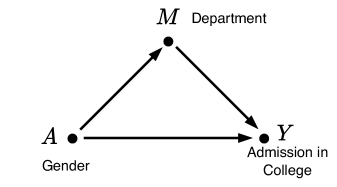
The image depicts a directed acyclic graph illustrating a causal relationship model. It shows three variables: Gender, Department, and Admission in College, and their interrelationships. The diagram uses circles to represent variables and arrows to represent causal influences.
### Components/Axes
The diagram consists of three nodes labeled as follows:
* **A:** Gender
* **M:** Department
* **Y:** Admission in College
Arrows indicate the direction of influence between these variables. There are no axes or scales present.
### Detailed Analysis or Content Details
The diagram shows the following relationships:
1. Gender (A) influences Admission in College (Y). An arrow points from A to Y.
2. Department (M) influences Admission in College (Y). An arrow points from M to Y.
3. Gender (A) influences Department (M). An arrow points from A to M.
There are no numerical values or quantitative data presented in the diagram. It is a purely qualitative representation of hypothesized relationships.
### Key Observations
The diagram suggests a model where both gender and department influence admission to college, and gender also influences the choice of department. The model does not indicate any feedback loops or reciprocal causation.
### Interpretation
This diagram represents a simplified causal model, likely used in statistical modeling or research design. It posits that gender is a factor influencing both the department a student chooses and their chances of admission to college. The department chosen also influences admission. This type of diagram is often used to visualize assumptions about causal relationships before conducting statistical analysis, such as path analysis or structural equation modeling. The absence of numerical data suggests this is a conceptual model rather than a presentation of empirical findings. The model implies that understanding gender and department is crucial for understanding admission outcomes. It does not, however, suggest the *strength* of these relationships, only their direction.