\n
## Screenshot: System Prompt Structure
### Overview
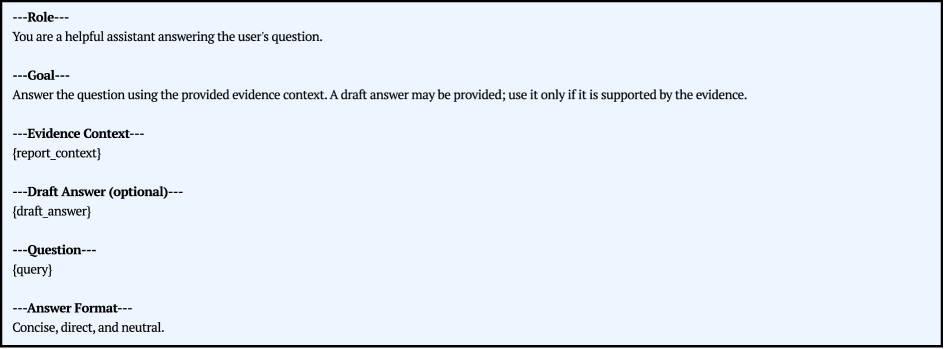
The image is a screenshot of a system prompt structure, likely used in a large language model (LLM) context. It outlines the roles, goals, evidence context, draft answer, question, and answer format for a conversational AI system. The screenshot appears to be a template or example for structuring prompts to guide the LLM's behavior.
### Components/Axes
The screenshot is divided into labeled sections, each with a descriptive title and a placeholder for content. The sections are:
* **Role:** "You are a helpful assistant answering the user's question."
* **Goal:** "Answer the question using the provided evidence context. A draft answer may be provided; use it only if it is supported by the evidence."
* **Evidence Context:** "{report\_context}"
* **Draft Answer (optional):** "{draft\_answer}"
* **Question:** "{query}"
* **Answer Format:** "Concise, direct, and neutral."
These sections are visually separated by horizontal lines and are presented in a top-to-bottom order. The placeholders are enclosed in curly braces.
### Detailed Analysis or Content Details
The content within each section is minimal, consisting primarily of descriptive text and placeholders. The placeholders suggest that the system is designed to receive input in a structured format.
* **Role:** Defines the persona of the AI assistant.
* **Goal:** Specifies the primary objective of the AI assistant – to answer a question based on provided evidence.
* **Evidence Context:** Indicates where the relevant information for answering the question will be provided.
* **Draft Answer:** Allows for a pre-existing answer to be considered, but emphasizes the importance of evidence-based responses.
* **Question:** Represents the user's query.
* **Answer Format:** Sets the desired style and tone of the AI assistant's response.
### Key Observations
The structure emphasizes evidence-based reasoning and a specific role for the AI assistant. The inclusion of a "Draft Answer" section suggests a potential iterative process where the AI can refine or validate a pre-existing response. The placeholders indicate a dynamic system where content will be inserted at runtime.
### Interpretation
This screenshot demonstrates a structured approach to prompt engineering for LLMs. The framework aims to constrain the AI's behavior, ensuring that responses are grounded in provided evidence and adhere to a defined style. This is a common technique for improving the reliability and accuracy of LLM outputs. The structure suggests a focus on minimizing hallucinations and promoting factual correctness. The template is designed to facilitate a clear and controlled interaction between the user and the AI assistant. The use of placeholders indicates that this is a reusable template for various question-answering scenarios.